


A poker pro once said to me the easiest money at the table comes from the player who's won five hands in a row.
This is the same logic you get when you see a roulette spin long enough that you convince yourself you've cracked it. You notice black has hit eight times and red is "due." So, you win and you keep on winning long enough that you start believing you cannot lose. That is until you do.
Merchants have an eerily similar thought the first time they see a warranty provider's numbers. They notice the number of claims filed, calculate the revenue shared, and then conclude they can pull it off too. And I just don't make these claims up in thin air. I've come across my fair share of retailers and sellers who think they can build a warranty program from scratch be the next Best Buy or AppleCare+.
But the truth is, it’s easier said than done. Warranties don't work that way.

A healthy warranty program usually pays out majority of the sum it collects over time.
The house does not win because it gets lucky but because it has enough cash in the vault to cover the nights it doesn't, and because a regulator checked that the cash was really there before handing over a license.
So we put this guide together: what genuinely gives you for selling protection plans, what it cannot give you at any price, and what you are actually signing up for the moment you become the one on the hook.
To be fair, the idea is tempting because the temptation is legitimate.
Putting a protection plan in front of a customer has never been simpler. You can add a plan as a product SKU in an afternoon. You can drop a toggle on the product page, add an offer at checkout, tier the price by cart value, fire a confirmation email automatically, and store the coverage details against the order. Any competent developer can wire that together, and most platforms will get you most of the way there before a developer touches it.
So yes, you can build a protection plan offer that looks and behaves exactly like a professional one.
But see it this way: you can build a beautiful roulette table on a weekend. The vault behind it takes a lot longer. A warranty program works the same way, and if that analogy still feels like a gamble, this table should clear things up:
Nothing in your development budget buys you the right-hand column. Building the offer solves the storefront, and the storefront is maybe a tenth of a warranty program.
Three things majorly, among many others, which are...
Right now, when a customer's treadmill dies in three years, somebody is legally required to fix it according to Magnuson–Moss Warranty Act. That somebody is your provider. They are the obligor, which is the least glamorous and most expensive job in this entire arrangement.
Bring the program in-house and the obligor is you. In most US states, that is a regulated activity with a financial responsibility test attached, and the test generally gives you three doors.
And here's a (not-so) fun thing to note: Registration happens state by state, each with its own filing, its own fee, its own annual renewal, and much other stuff. For instance, Minnesota charges $750 to register. Texas does not even run service contracts through its insurance department, handling them instead through the Department of Licensing and Regulation, so the rules and the agency relationship are different there than almost anywhere else. If you ship to all fifty states, you are managing fifty versions of this.
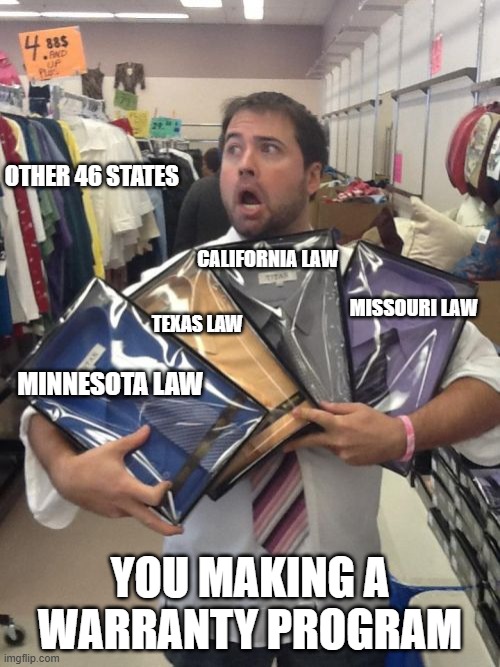
Every DIY warranty plan has a hidden tab. It doesn't appear until a customer files their first claim. And when they do, things usually go south if you are not prepared.
Let's take a piano, for instance. It's hardware might fail and you'll think it would only cost around $300–$800 worth of repair, right?
Wrong!
We are talking about a product that weighs 300 to 1,200 pounds. And a failure could mean shipping it across the country, arranging an in-home repair, or replacing it altogether. Suddenly, that one warranty claim is worth a lot more than the fees it took to sell it.
When you walk into a casino and see chips on the tables, you might think that’s the casino's money. Well, it’s not.
It’s a liability. Somebody can walk up to the cage at any moment and ask for cash, so the chips sit on the balance sheet as an obligation rather than as income. Warranty fees work the same way.
If you sell warranty through someone else's program, life is pretty simple. You earn a commission every time a plan is sold and move on.

Run your own warranty program, and the accounting changes completely. That warranty money isn't really yours yet. It stays on your balance sheet as a promise to pay for claims that could show up months or even years later.
You're committing to five years of risk while looking at maybe six months of sales data.
It doesn't stop there. If you ever raise funding, take on debt, or sell the business, those warranty obligations come under a microscope. Buyers and investors want to know who's paying future claims and whether you've set aside enough money to cover them. If you haven't, the value of the business can take a hit right when you least want it to.
That's why it's worth talking to your accountant before pitching the idea to your board. Building a warranty program is a product decision. Owning one is also a long-term accounting decision.
But now you might ask hasn't Best Buy made 50% of its revenue from protection plans and hasn't AppleCare+ contributed 27.9% (along with other services) to the Apple's Q2 FY2026 revenue?
Fair question, and the answer is that neither of those companies is a player who suddenly got hot. They own the building.
Apple clears the three doors without breaking a sweat, since the net worth test is a rounding error against its balance sheet. Best Buy has Geek Squad, which means it also has technicians on payroll, parts in a distribution network, and roughly a thousand physical locations that double as claims intake counters. Neither of them skipped the vault. They spent decades building it, and the margin you are looking at is the return on that infrastructure rather than a shortcut around it.
So, instead of becoming the warranty provider yourself, ask this from your warranty provider:
Also, while you are asking, verify the things most other merchants tend to assume:
You do not need to buy the casino. You need a better seat and a smaller rake.
You can't choose the cards you're dealt, but you can choose when to fold and when to raise the stakes.
At SureBright we help you keep playing by absorbing all the risk - repair cost, claim management, service network, and all that jazz. But the fun part is, you keep the majority of what your program earns - with rates depending on volume, product mix, and partnership terms. We focus on mutual success and long-term partnerships rather than short-term gains.
So, book a demo today.
.jpg)


M Khizar is a writer enjoys making complicated things feel simple. He writes about warranties, ecommerce, and the small details people usually overlook, until they matter. His work focuses on clarity and helping readers make smarter decisions without overthinking it. Outside of work, he enjoys reading, writing personal blogs, and binge eating with friends.


.jpg)