If you have ever walked into a busy store, seen constant orders, a line of checkout, and employees moving like the place runs on caffeine and panic, you have probably had the same thought as post people do, i.e., ‘this business must be making some serious money’.

And perhaps, they probably do.
We see that assumption everywhere. Even on Shark Tank, founders often talk about how the retail markup is up to 80% on a product - quite exciting on paper, but it is far more layered than that.
As the money from sales goes in every other direction but the merchant’s piggy bank.
A merchant does not get to look at total revenue and call it ‘income’. It’s again more nuanced, more annoying, and a lot less glamourous.
Because the money coming in, is not the money staying in.
Before a merchant dreams of floating in all that cash, the business has already started collecting its share.
So yes, a store can look busy, sound successful, and still leave the owner staring at the numbers like, “Amazing - made so much money, but where is it?”
That gap is what makes this question worth asking - ‘what do merchants really, REALLY make’?
A merchant can sell a lot, look busy, sound successful, and still not be taking home nearly as much as anyone may imagine.
For example, grocery stores - it's not famous for fat leftover profits.
As they often run on extremely thin net margins, around 1.2% on average. (However due to extremely high search volumes, they are often profitable)
What this means is - if a grocery store makes $100 in sales, it may keep only about $1.20 as net profit after expenses.
Yea, you read that right, $1.20 only.
So, when people hear a business did, say, a million dollars in revenue, their brain instantly starts acting like the owner is shopping for a yacht, a vacation home, and a personality change.
Meanwhile, the business owner may be looking at payroll, rent, inventory bills, and card fees thinking, ‘Geez, we barely survived this month’.
Most of the confusion might start here, because these two words get thrown around like they mean the same thing. They do not.
Revenue is the total money a business brings in from sales before expenses are taken out.
Profit is what is left after costs and expenses are removed from that revenue.
In simple terms, if a merchant sells $100 worth of products, that $100 is revenue.
If it costs $60 to buy the products and another $30 went to rent, payroll, payment fees, and other costs, the business is left with $10 - which is the profit.
In 2003, warranties contributed over 50% of Best Buy’s profit even though they accounted for only 3% - 4% of the revenue.
So, if someone tells you their business did a million last month, ask them if its revenue or profit.
As we said earlier, everywhere but to the merchant. So, where exactly is ‘everywhere’?
The first big one is usually cost of goods sold, or COGS. That is what the merchant paid to make, buy, or source the product in the first place. Meaning, if it took $20 to create a product, the retail price must be high enough to have a healthy profit margin.
Then come the operating expenses. These are the day-to-day costs of running the business. Things like;
And these are just the bare minimum expenses which will come with any ordinary business.
Because running a business is generally very expensive, and when those costs are not managed well, they can do a lot more than hurt profits. They can push the business into serious trouble.
One such trouble came in the form of bankruptcy to a multi-location book seller in the U.S.
The company reported that its gross revenue fell from $20.9 million in 2019 to $17.1 million in 2024, while operating costs such as payroll and rent kept rising. Add higher interest costs on debt, and the pressure got too heavy.
Another example can be of a very popular seafood restaurant. It had as many as 706 restaurants in 2012, but by 2024, when it filed for bankruptcy, it had closed about 130 locations.
This multibillion-dollar business, which once did $2.67 billion in annual sales, has lost more than $1 billion and continues to lose money while shutting more restaurants, including one as recently as yesterday. Much of this came down to rising operational costs, high labor expenses, rent, seafood costs, and poorly performing stores.
So after the business takes its share, and assuming the business is still standing, it is easy to think the rest simply goes to the merchant - and yes, technically it does.
But does the merchant get to keep all of it for themselves?
Not always.
A business owner on reddit sharing what he does with the money left after expenses, “300k into savings for business rainy day fund (for example: if a hurricane shuts us down for 5 days unplanned. I’ve promised my employees they won’t get dinged on their pay if it’s not their fault.)”
Now, that kind of answer comes from a merchant who clearly knows that any business is fully capable of humbling you without notice.
Because whatever money is left after expenses is going to the merchant, but it’s not exactly HIS.
In a lot of cases, it becomes a decision.
Some of it may go into the owner’s salary, especially if they need consistent personal income to actually live like a normal human being and not just survive on “future business potential.”
Some of it may stay back as profit inside the business.
And a big part of it often goes straight into reinvestment, not because the bills are unpaid, but because business owners know leftover money today often has a job waiting for tomorrow.
That reinvestment list can be massive;
Which, in business, is usually the only time things break.
Reinvestment is another expense, although it’s not treated as one, but it technically is. And it can be a big one depending upon the operational situation and future goals.
So, adding that to everything we have already covered - the merchant or the business owner is literally left with a fraction of what the business grossed as revenue.
And that’s the real truth happening behind the fancy ‘my biz did $3 mil, last quarter’.
No, of course not.
Two merchants can both look “busy,” both ring up sales all day, and both still take home very different amounts at the end of the month.
One may be running a food business where money disappears into labor, rent, inventory, and spoilage before it ever feels like personal income. Another may run an information or professional-services business where the cost structure is lighter, so a bigger share of revenue actually sticks.
A 2025 payroll-study of mid-small businesses found a typical owner paid themselves about $4,800 a month,
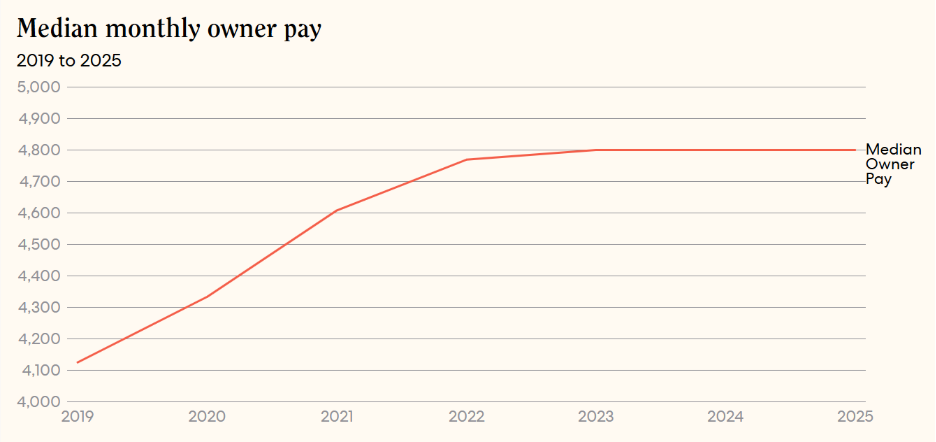
Since 2022, the monthly median earnings of a business owner in the U.S. is $4,800, Source – Gusto Insights
The gap by sector was huge;
The complete table of monthly pay gap between sectors is given below;
So yes, the person selling software and the person selling sandwiches are both “business owners,” but their paychecks are not living in the same neighborhood.
What all of this means if you’re thinking of starting a business or buying one
If you are thinking of starting a business, or buying one from someone else, here is the big lesson ~ do not get hypnotized by revenue.

A business doing strong sales can still leave you underpaid, overworked, and wondering why your bank balance looks so underwhelmed.
Busy does not always mean profitable. And profitable on paper does not always mean cash in your pocket.
So, when you are starting a business, do not begin with the dream version. Instead;
And if you are buying one,
Regardless of whether you’re buying or starting, the real difference often comes down to margins, because weak margins have a way of making even good sales feel underwhelming.
As we get to the end of this article, two things are pretty clear.
First, a merchant is probably not making the kind of absurd money people imagine from the outside. And second, a business can make sales, stay busy, look popular, and still end up financially cornered if too much of that money keeps disappearing before it reaches the owner.
That is exactly why margins matter so much.
Let’s take a multi-billion-dollar American specialty retail chain, for example. It was still doing about $2 billion in net sales in 2024, but that did not save it. The company entered bankruptcy again in January 2025 while carrying $615.7 million in debt, owing more than $133 million to suppliers, and spending about $26 million a month on rent.
A month later, it moved toward closing all 800 stores. Big sales, well-known brand, huge footprint, and still not enough room to breathe.
So, whether you are starting a business, buying one, or just trying to understand what merchants really earn after all expenses - always remember that strong sales help, but protected margins are what make a business feel stable in real life.
That is also why small things that reduce post-sale mess can matter more than they seem.
Even something like offering extended warranty through a platform such as SureBright can help merchants avoid some of the repair, replacement, and support costs that quietly chip away at what is left.
Nothing revolutionary - but just another practical way to help merchants keep more of what they earn.



Abdullah is a marketing professional with five years of experience in content, brand strategy, and audience growth. He has built a strong understanding of warranties, product protection, and the customer trust factors that influence purchase decisions. His work focuses on turning complex topics into clear, engaging, and reader-friendly content. Outside of work, he enjoys football, slow-burn dramas, and stories that take their time to make an impact.




.jpg)