

There is an old saying, “We are what we repeatedly do.”
Will Durant was summarizing Aristotle’s idea about character: do something often enough, and it eventually starts reshaping your identity.
However, online shopping twists that idea very differently.
A customer returns a product. Then visits the same category twice, only to ignore three offers before considering the fourth. But they still don’t make a purchase and abandon the cart with the confidence of a landlord who knows the tenant isn’t running away.
Each action may look small in isolation, but together, they form a trail of gold dust.
Segmentation turns that trail into something merchants can use. It helps businesses spot differences between bargain hunters, loyalists, browsers, impulse buyers, chronic returners, and customers who treat “out for delivery” as an invitation to refresh the tracking page every six minutes.
That was the useful part. Fewer broad assumptions, more relevant decisions.
But customer segments are no longer limited to marketing campaigns. They can also influence fraud checks, return approvals, and refund decisions. The category label like ‘frequent returner’ in your dashboard may look perfectly normal, but its consequences may not be.
But before we dive into those consequences, let’s look at how segmentation has evolved and where its impact is now being felt.
For years, consumers were grouped into segments to tailor strategies and reach customers where they were most likely to convert.
But with time, demographic data gave way to behavioral signals. RFM and customer lifetime value offered new ways to distinguish one customer from another. Merchants kept finding smarter methods, turning marketing from a megaphone aimed at the crowd into a text message meant for one person.
Did it pay dividends? Absolutely.
A Shopify merchant saw the difference after changing their email strategy:
“Email segmentation was flat. B2B buyers were getting the same send timing as B2C consumers. Splitting by behavior and adjusting timing — weekday sends for professional buyers, weekends for consumers — improved open rates to 33–45% and directly attributed revenue doubled.”
But effects of segmentation have now also seeped into post-purchase experience.
Say a customer starts returning things more often. Once that pattern appears, the customer may be flagged as a frequent returner, leading to closer checks or fewer return options.
An Amazon customer described what that can look like:
“Customer service chat had offered a partial refund and to let me keep it ... Amazon CS approved a full refund without requiring a return ... The next day, the refund was reversed, saying it was flagged.”

This Amazon user’s experience shows that segmentation can be helpful for merchants, but it can also become a headache for a loyal customer when used carelessly.
And that raises the bigger question: What can wrong customer labelling cost you?
Not every segmentation decision has the same impact. What matters is where it affects the customer’s journey.
A simple way to look at these decisions is through four areas: message, offer, route, and entitlement. Each can affect a different part of the customer’s journey, from what they see to what they can get after a purchase.
At the message level, a “price-sensitive shopper” tag might decide which email or promotion a customer receives. At the offer level, it could decide which products, prices, or discounts they see. The customer still chooses whether to buy, but what they view changes.
Move up a level, and a “high-risk claim” tag may send a warranty claim for extra checks, adding friction. At the entitlement level, it can affect returns, refunds, replacements, or warranty service. Get it wrong, and you could lose the customer.
And if you think a wrong segmentation rule only creates a business problem, there may be a regulatory one waiting too.
Once personalized pricing practices enter the picture, regulatory scrutiny follows. Regulators are already looking more closely at how pricing systems use customer data, including the mechanisms behind pricing on major platforms such as Amazon.
When that happens, a merchant must explain what information led to the decision and what the customer was told. If they cannot explain why one customer paid more than another, the cost could be much higher than the lost margin.

The FTC is increasing its focus on personalized pricing. In August 2026, it proposed an enforcement policy and opened it for public comment. If adopted, it could treat unexplained price differences as potentially deceptive under Section 5 of the FTC Act.
New York has moved from discussion to disclosure. Its Algorithmic Pricing Disclosure Act, passed in May 2025, requires businesses using personal data to set prices to tell consumers. Connecticut’s 2026 law generally bars retailers and third-party delivery services from using surveillance pricing, effective July 1, 2027. Other businesses using personal data to raise online prices may face disclosure requirements.
Breaking these rules is only one way a segmentation decision can come back to haunt you. Another is when the customers most likely to buy protection are also the ones most likely to claim it.
Imagine your sales team identifies a segment most likely to buy extended protection. The dashboard looks healthy: the attach rate rises, and so does protection revenue. But the same segment may also be making more claims. That can raise claim costs and change your margin.
Insurance has a name for this pattern: adverse selection. Customers more likely to buy protection may also be more likely to use it. They may have broken something before, live in a riskier setup, or expect the plan to be needed. Which is absolutely fine, if there’s no wilful fraud happening behind the scenes.
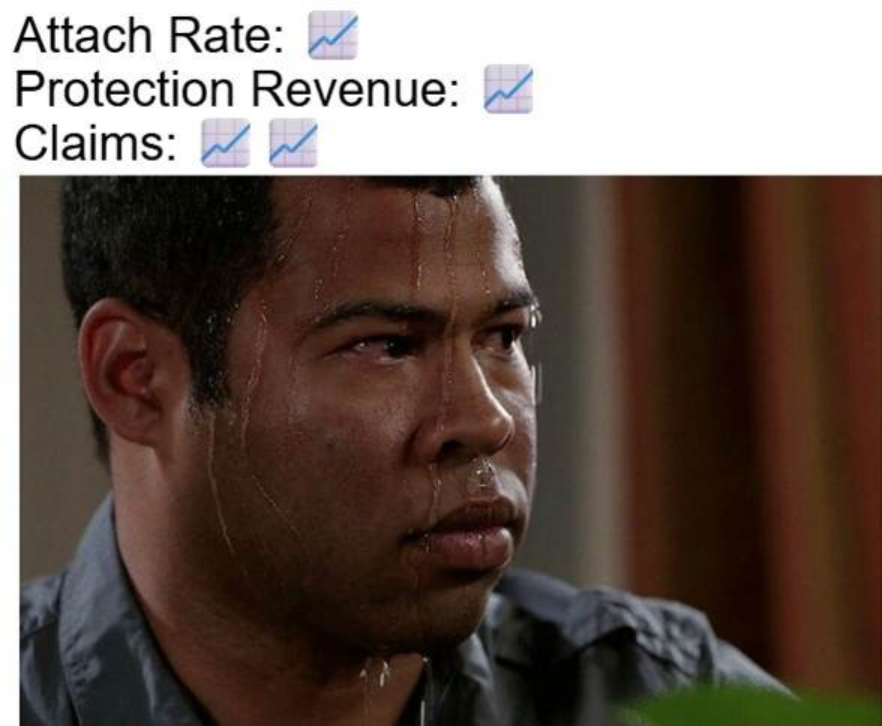
Your marketing dashboard sees purchase intent, while the claims team may see claim propensity. Neither view is wrong; they measure different sides of the pattern.
Both measures affect the program’s economics. A healthy protection plan targets a 45–60% loss ratio. A segment can look valuable from sales while claims change the economics.
Put attach rate and 36-month claim frequency against the same segment cut. When both rise together, you may have found a group with strong demand for protection and a likelihood of using it. The opportunity is to understand that relationship before judging the segment by its attach rate.
Which brings us to the question: How do you know what each segment is doing?

By now, you may have many segments across the business. Some were created for specific campaigns, while others have existed long enough that their current use is unclear. So, for each segment, run these four checks.
If the answer stops at “which email they get and when,” you’re in message territory. When a segment alters price, discounts, returns, or verification, it enters entitlement territory, increasing the cost of error.
Name the signals placing a customer in this group: return frequency, claim history, cart value, device, location, or payment method. If you cannot trace the data lineage, you cannot justify the outcome when challenged- hopefully not in court.
Identify who has the authority to pause or change the segment when it gets something wrong. A segment with no named owner is a decision with no accountability. And yes, that can be extremely painful for your business.
Picture a customer asking, “Why was I shown a higher price?” or “Why was my claim treated differently?” If the answer is simply “the algorithm decided,” the segment is influencing a decision the merchant cannot clearly explain or justify to the customer.
Segments that change only messaging need no further scrutiny. Segments that change price, eligibility, or service access need documented logic, a named owner, and a route for a customer to contest the outcome.
Segmentation becomes more useful when you treat it as a responsibility, not a destination.
The moment a customer label begins shaping what happens next, someone has to own the consequences. For merchants, that means building systems that learn from behavior without letting a useful signal become an expensive habit.
This is where SureBright can take warranty complexity off your plate.
Its protection plans can be embedded across sales channels, while SureBright handles policy administration, claims, customer support, compliance, and financial risk. Merchants keep their revenue share without taking on claim costs or running a separate warranty operation. The portal provides visibility into warranty sales, attachment rates, profits, and SKU performance, keeping the program transparent.
So make protection part of your growth strategy without making warranty operations a responsibility. Book a demo with SureBright.


Pushpender enjoys exploring the stories behind everyday decisions. He writes about warranties, ecommerce, and the psychology of buying. He draws on internet research, lively conversations, and a curiosity for the details most people overlook. With a background in English Literature, he believes good writing isn't measured by how complex it sounds, but by how effortlessly it helps someone understand a complex idea. Outside of work, you'll usually find him reading fiction and history, striking up conversations with people from different walks of life, or jotting down ideas inspired by both.



.jpg)