

Have you ever thought of lighting money on fire?
Yes?
Now imagine tracking it in a spreadsheet, generating a shipping label for it, restocking it incorrectly, refunding it twice, and calling the whole thing ‘returns management’.
That's what most merchants are actually doing. Not on purpose, of course. But when retail returns hit $890 billion in 2024 and your process for handling them is held together by email threads and good intentions, the fire metaphor isn't far off.

At the center of all of this sits a three-letter acronym that most merchants have heard of but few have truly squeezed value from: the RMA, or Return Merchandise Authorization. In practice, it’s the one process flow... the decision tree where you decide whether a return becomes a loss… or turns into recovered revenue.
And right now, most stores are letting that checkpoint run on autopilot while 9% of all returns walk out the door as fraud and nearly two-thirds of shoppers openly admit to pulling stunts like wardrobing, bracketing, or shipping back empty boxes.
So, this article won't bore you with a glossary definition and a five-step flowchart you've already seen twelve times. Instead, we'll walk through how the RMA process actually works in practice, what happens after the returned box lands at your dock, and how the sharpest merchants are turning their returns flow into a profit machine.
But before that let’s brush over...
RMA or Return Merchandise Authorization is the formal, agreed-upon process a business uses to handle product returns, repairs, or replacements under warranty.
Strip away the jargon and an RMA is really just a five-step conversation between you and your customer.
Simple enough on paper. Unfortunately, ecommerce does not happen on paper. It happens in warehouses at 4:47 PM on a Wednesday.
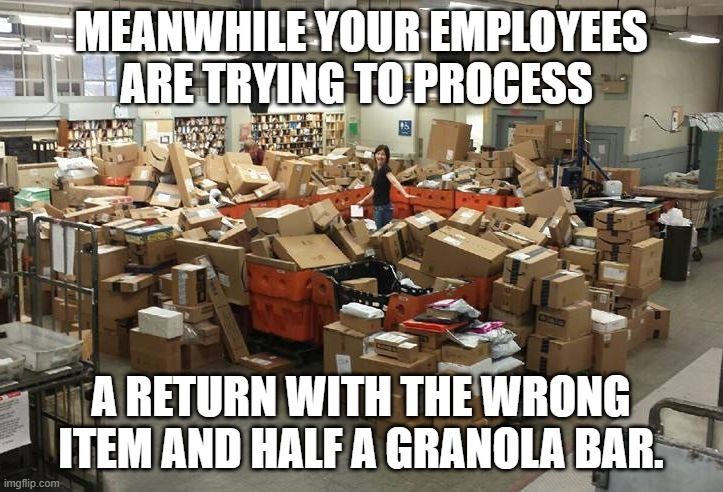
Now, this is the black hole in ecommerce.
Warehouses use a disposition grading system. If you don't have a grading system, every return gets treated the same which means Grade A items sit in limbo next to items that should've been scrapped on arrival. That delay alone costs you money in warehousing, labor, and missed resale windows.
Every returned item gets sorted into one of four buckets:
If you think RMA is a cost center, think again. It's a conversion funnel, just running in reverse.
Not every customer should get the same returns experience.
A first-time buyer returning a $20 item is a standard process. It is a standard window and standard shipping rules should apply.
But a loyalty member with $5,000 in lifetime spend returning that same item? They should get a longer return window, free return shipping, instant refunds before you even receive the product back, and priority processing.
Sounds unfair? Well, it is genius. Your best customers are the least likely to abuse your return policy and the most valuable to retain. Treating them like everyone else is a missed opportunity to deepen loyalty at the exact moment they might be frustrated. Best Buy is the cleanest example of this in action.
My Best Buy Plus ($49.99/year) and My Best Buy Total ($180/year) members get an extended 60-day return window. That's four times longer than the standard 15 days. On top of that, Total members get up to 24 months of product protection on most purchases, free 24/7 tech support, dedicated VIP support lines, and 20% off Geek Squad repairs.
You can't fix what you don't measure. Here are the six numbers every merchant should be tracking:
Note: If you're only tracking return rate, you're flying blind. The refund-to-exchange ratio alone will tell you whether your RMA is leaking revenue or capturing it.
RMA is one of those operational processes that sits in the background, until you realize it's touching your margins, your inventory accuracy, your fraud exposure, and your customer relationships all at once.
The merchants who treat it like paperwork will keep lighting money on fire. But if you treat it like a system with grading frameworks, exchange-first flows, tiered policies, and real KPIs, you will pull revenue out of a process everyone else writes off as a loss.
$890 billion moved backward through retail last year. The only question worth asking is how much of it are you catching on the way back?
Not exactly. The return is the act of sending a product back. The RMA is the approval process that happens before the return.
Even five returns a month without a system means five chances to restock incorrectly, refund the wrong amount, or miss a fraud red flag.
Start with your reason codes. If everyone's saying "too small," fix your size chart. If they're saying "not as described," fix your product photos. Your returns data is literally telling you what to fix.
Depends on your margins and your audience. Free returns drive conversions, but they also attract serial returners. A middle ground: offer free returns for exchanges and store credit, charge a flat fee for refunds.
Watch for repeat returners with high return rates, require photo uploads during the RMA process, verify package weight at receiving, and match serial numbers on electronics. If someone's returning 40% of everything they buy, that's a pattern worth investigating.
.jpg)


M Khizar is a writer enjoys making complicated things feel simple. He writes about warranties, ecommerce, and the small details people usually overlook, until they matter. His work focuses on clarity and helping readers make smarter decisions without overthinking it. Outside of work, he enjoys reading, writing personal blogs, and binge eating with friends.


.jpg)