

A customer once wrote to Chewy after her dog passed away. She had an unopened $70 bag of specialty kibble sitting at home and wanted to know how to send it back.
Instead of running the usual parade of return logistics - generating a shipping label, paying freight, and hiring a warehouse worker to inspect an item that might never be resold - Chewy refunded the $70 on the spot. They asked her to donate the food to a local shelter and even sent a handwritten condolence card with flowers.

It was, first and foremost, an act of genuine human empathy. But in a very unromantic, operational way, it was also a remarkably smart business decision.
Chewy spared itself roughly $20 in freight and handling fees. The customer got an unexpectedly kind gesture during a heartbreaking moment. And the story spread online, sparking a viral wave of organic word-of-mouth marketing that no amount of polished PR could have gotten them.
The lesson hiding inside this story is simple - a refund is not always money set on fire. A 2025 study found that 62% of consumers say they’ll buy more from a merchant after a positive returns experience, while customers who received instant refunds had a 23% higher repurchase rate.
And no, we aren’t suggesting you go full Oprah at every open ticket in your support inbox.
But knowing when a refund is your best move is the exact edge that protects your bottom line and strengthens your brand perception. Consider this blog your guide to knowing the difference.
Ask a room full of merchants how to handle a fifty-dollar return, and you will never get a peaceful consensus. A recent Reddit thread caught this battle in real time. One store owner stood firm on cutting losses early:
“I almost always refund without demanding the item back. After calculating time, return freight, and extra support labor, bringing it home becomes an absolute waste of money.”
Well, who wouldn’t want to be at the receiving end of that neat bargain?
But on that same thread, one clothing seller went berserk hearing that response:
“Margins on my products exceed 60%. I refund serious cash on a return. Why absorb the remaining 40% inventory cost on top?”
Oh, I can assure you a lot of people brought out their popcorn reading that debate, primarily because both merchants are completely right.
For the first seller, forcing a physical return turns a fifty-dollar order into a tiny administrative hostage situation. For the second merchant, bringing the item home is pure common sense. That fifty-dollar shirt still has a glorious second life ahead of it. Retrieve it, hang it up, sell it again tomorrow, and keep your margin intact.
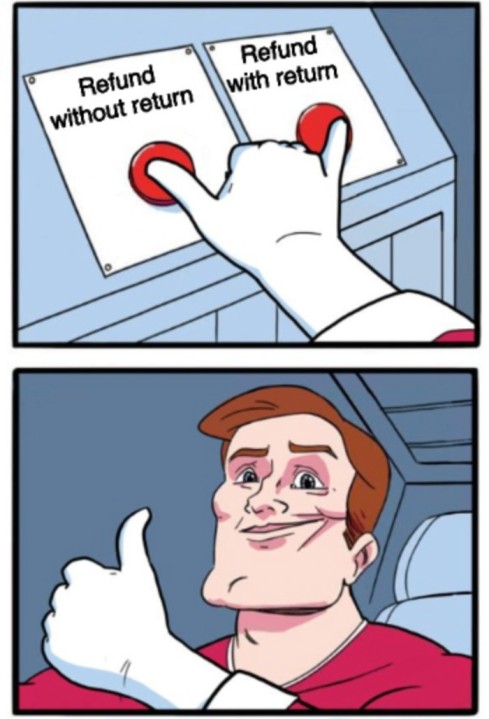
The whole fight boils down to a single question - what is the item actually worth after it finishes its trip back to you?
McKinsey estimates US retailers spend roughly 200 billion dollars a year attempting to claw back value from returned goods. After enduring that entire operational circus, businesses recover barely half of an item’s original retail price.
Statistics like that often appear far from your store until the open box lands on your receiving table.
The point here is, retail pricing is dangerously deceptive. A buyer paid fifty dollars. Your accounting software insists the item retains twenty dollars in value because that was your original manufacturing cost. Yet the second that package hits your loading dock, its true recovery value could be twenty dollars, ten dollars, zero dollars, or a negative number.
One fitness-apparel founder highlighted this absurdity, admitting that depending on the cost of the item, their balance sheet would fare better when a burglar breaks into their warehouse and steals a product off the rack than when a customer buys and returns it.
That “cost of the item” tells you which orders earn a shipping label, and which ones deserve an instant refund paired with a unsaid but implied “keep it.”
Hint: choose an instant refund when the product is worth recovering, and the customer has earned enough trust to be paid before you inspect it. Choose a keep-it refund when recovering the product would cost more than it is worth, or when the item can never realistically go back into sellable inventory.
Remember the $70 Chewy refund?
The money still left Chewy’s account. The payoff came from everything that happened around it.
Start with the payoff that we have been hyper-focused on so far - avoiding a return that costs more than the item is worth.
Some merchants have built their entire refund logic around that. One Shopify seller explained their approach:
“if the item costs less than the shipping fees, we will usually just ask them to recycle it.”
Now that is rather sustainable.
Amazon has baked the same logic into its seller tools. Its Returnless Resolutions program lets US sellers set a maximum item price between $1 and $75, allowing eligible customers to keep the product while the seller avoids return processing, storage, and removal costs. Amazon also excludes categories such as heavy and bulky goods and screens customers for signs of return abuse.
Walmart has built the same idea into Keep It Rules. Sellers can decide which products qualify and configure the conditions in advance, while Walmart also supports Partial Keep It and Replacement Rules.
But this logic is not reserved for cheap or light goods. One shopper ordered two $450 ottomans from All Modern, a Wayfair brand, found the metal feet chipped, and got a full $450 refund within 8 hours with a note to donate or give the pieces away. Shipping two bulky, already-damaged stools across the country was never going to be worth it.
This way you take the loss you were already going to take and avoid adding a return bill on top.
A return request usually arrives after something has already gone wrong, which makes the refund now part of the customer's verdict on your brand.
Nordstrom has taken an unusually relaxed approach to that verdict. Its current returns policy says returns are handled case by case, with the ultimate goal of making customers happy, and says the company believes that when it treats customers fairly, customers will be fair in return.
That philosophy does something very useful - it leaves room for judgment.
A merchant who spends ten minutes arguing over a $2 restocking fee may technically win the transaction and lose the customer. Another merchant can swallow the $2 and move on. And that single-handedly decides whether the customer decides to come back again.
The cleverest refund policy may be the one that earns its keep before anyone asks for their money back.
Think about buying from a brand you have never tried - you like the product, you find the price fair. Then the tiny voice appears: but what happens if I hate it later?
Warby Parker spent years answering that question before the customer ever reached the checkout page. Its Home Try-On program let shoppers try five frames at home before buying. The company later sunset the original program as its store network and virtual try-on tools expanded, calling Home Try-On foundational to building the brand.
The genius was the risk transfer.

The customer got to see the glasses as if they had already been bought. The brand absorbed the uncertainty as acquisition cost.
That same psychology sits underneath a generous refund policy. You are asking the shopper to make a decision today while promising that a bad decision will be relatively painless to undo.
The refund policy is already doing some of your sales team’s work.
With some refunds the product economics are only half the story.
Tubby Todd, a children’s personal care brand, tells customers to give unwanted products to another family in need rather than ship them back. Its co-founder described the thinking behind this frankly, “What are we going to do with an open lotion?”
Surrendering low-value inventory gives you total control over the story the customer tells later. A processed refund can leave behind an unsellable item on a rack, or it can create a loyal buyer who remembers how gracefully you handled the resolution.
Every payoff so far assumed the customer asking is honest. Most are. But a keep-it or instant refund policy with no fences is a neon sign reading “free stuff, no questions asked,” and the wrong people read and share that sign most carefully.
The fix is four simple checks and yes all of them are important.
Price comes first, but never alone. Set a ceiling for keep-it refunds, because a determined abuser will happily cycle cheap orders all day. Go too far the other way, though, and you could turn a legitimate $20 claim into a chargeback, a support headache, or a one-star review.
Then ask what the item is. Opened cosmetics or supplements cannot be resold anyway, so they are keep-it naturals or non-refundable entirely.
Then figure out who exactly is asking for the refund. A loyal customer with one complaint is not the same as a two-week-old account on its third damage claim. One Shopify merchant spotted a customer claiming the same product was faulty twice under different email addresses:
“She didn’t take a replacement just wants a refund. Now 3 months down she used a new email and is ordering the same product. I don’t trust her.”
Start new accounts tight and loosen as they earn trust.
And finally ask why it is coming back. “Arrived damaged” is an easy yes. A vague “changed my mind” on a resaleable product might not be.
And the smartest move of all is shrinking how many refunds reach you in the first place with proper post-purchase flows. Sennheiser saw their returns decline by 26% over the past year. Protection that extends beyond the checkout, like shipping protection and extended warranties, creates added confidence and reduces the likelihood of a damaged parcel or a six-week product failure ever turning into a refund request.
Get the fences right and those safety nets in place, and a refund stops being a gamble. It becomes a decision you already know the answer to.
.jpg)


.jpg)
.jpg)

.png)
