.jpg)


Every merchant loves to say they have a generous return policy.
And for the most part, it might work as intended - handling the occasional wrong size or the “didn’t quite love it” return.
But in retail, even generosity gets tested at the extremes.
Sometimes… decades later. Here’s what a Redditor shared:
“I had a customer come up to a coworker to return some shirt she bought. Nbd, but coworker looks at the receipt and it’s from 20 years ago! Customer says she had it in her closet and just forgot about it! The store I work at is big on letting people return just about anything, no matter how long ago”
At this point, generosity has paved way for something truly absurd and capable of eating your margins at scale - which is why 72% of US retailers now charge for at least some returns.
Because the return problem isn’t one problem. It’s a sizing miss, a product defect, a shipping mishap, and an intentional bracket order.
If you’re applying the same “good return policy” fix to all - this blog is for you. We’ll break down what’s driving your returns, what are the fixes merchants are trying beyond just a robust return policy, and a concrete checklist to act on starting now.
Pull up your dashboard right now.
What you’ll probably see is a return rate.
And the reasons sound almost templatized: A customer who ordered two sizes of the same jacket and sent one back. A blender that gave up within a week. A package that was roughed up pretty hard during transit. You’re familiar with the gist.
But these are three completely different problems with three different root causes and different costs to your business.
And some returns are totally preventable.
“I wish for consistent sizing from store to store so that you’d never be puzzled as to why you were a 4 in one store, a 6 in another, and a 2 in the next”
-A woman frustrated with inconsistent sizing
But some returns are baked into the nature of selling online.
Here’s what someone on Reddit shared:
“My wife has a habit of purchasing 2-3 different sizes of every clothing item she wants to purchase, trying them on and then returning the ones that don’t fit.”

Grab that champagne, this month’s runway is here.
Reasons like changed my mind, ordered multiple to compare, found it cheaper elsewhere are things you didn’t cause. Amazon, Zappos, and a decade of “free returns, no questions asked” probably did.
If a specific jacket gets returned 35% of the time for “too small,” that’s basically a fit note missing from your PDP. But as a merchant, you also know that size charts are casually ignored like a push sign on a pull door.
As a fix, this is what a merchant on Reddit tried out:
“The way I try to combat this is to have a size chart as an image in the thumb gallery, in the description, and as a “Size Guide” link above the description”
Others implement a returns processing fee (we’ll get into whether it actually solves anything later.)
And this is a problem across categories.
Electronics merchants deal with compatibility bracketing - customers ordering three phone cases because the listing didn’t clarify which iPhone generation it fits. Furniture sellers lose margins to dimension uncertainty.
The fix for preventable returns starts at the product page. SKU-level return reason data, fed back into your product pages. Customer-reported fit feedback surfaced where it matters - not buried in reviews, but right next to the “Add to Cart” button. Things like compatibility checkers or dimension calculators. Everything you have access to.
You’re not going to stop a customer from ordering two sizes.
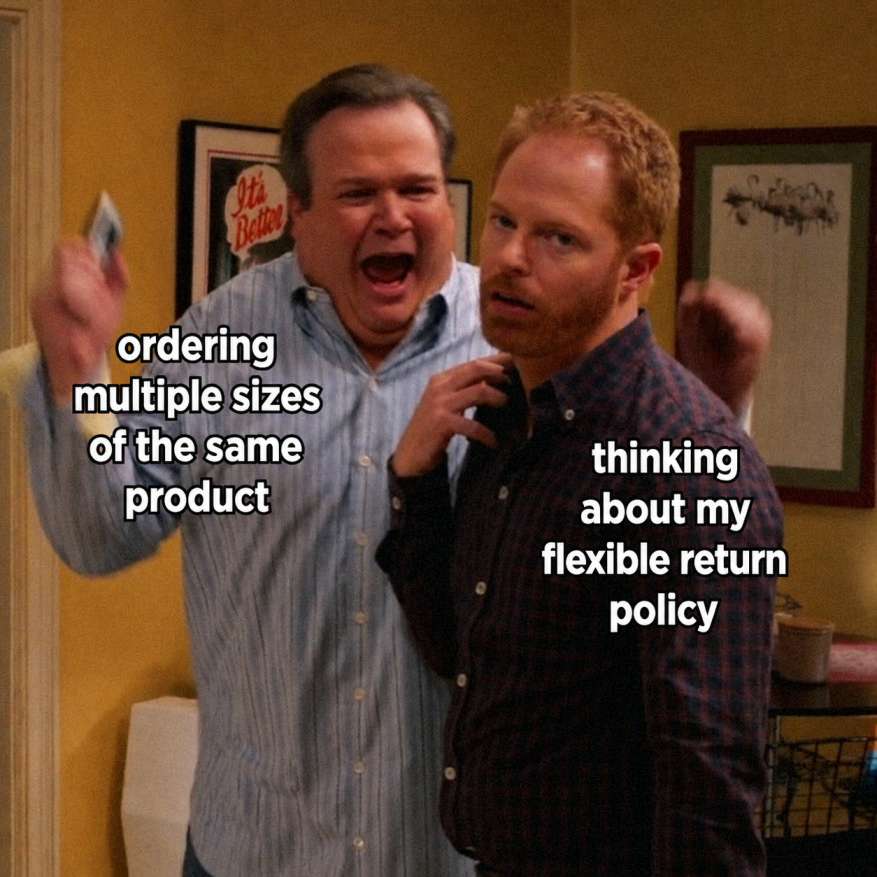
So the question becomes: how cheaply can you process that inevitable return - and can you keep the money in your ecosystem when you do?
And here’s something Alexa Allamano, owner of Foamy Wader shared that adds some useful two cents to that line of thought:
‘Exchanges and size adjustments are always allowed, but due to the handmade nature of our business, cash refunds may incur a 25% restocking fee. That restocking fee often converts return requests into exchanges.”
Most dashboards show a return rate, but not all of them clearly separate why items came back.
Which brings us to the obvious question.
When your margins are thinning, accepting every “didn't love the color” kind of return becomes charity.
This is what a merchant dealing with a picky customer shared:
“This is obviously costing a lot of unnecessary time and rework for the business. We need to receive it back and re-check all the parts and write up a report to show that we found nothing wrong. And it just keeps going back-and-forth like this for weeks”
Add to this the fact that processing a single return costs anywhere from $10 to $65 depending on category.
Meanwhile, on the other side of the counter sit 71% of shoppers who say a single bad return experience is enough to stop them from buying from a brand again.

Is charging for returns wrong? Absolutely not.
But applying a blanket $9 fee to every customer - regardless of their history - is using a sledgehammer where a scalpel would do.
“I run an e-commerce store for men's shoes and really do not know what to do. If you give free returns people abuse it, if you don't then some people won't buy”
But consumers in the same thread weren’t budging either.
“I won't shop online if there is a return fee”
So what does a scalpel look like? Here’s what a merchant explained:
“When I ran my online store I always did free returns. People would abuse it, but only a small amount. My biggest customer was also my biggest returner, but they spent so much money that even with all of their returns they were still my biggest customer by a large margin.”
He ended up banning just 11 addresses total.
And this is what YOU can do starting now:
About half of merchants now let customers redirect their return into a new purchase on the spot - and over half of those add an average $11.28 bonus credit to make that option more attractive.
That incentive costs you a fraction of what you’d lose on the full refund-and-reacquisition cycle.
How many days does it take for you to go from “return received” to “money back in the customer’s account”?
If the answer is more than five days, you have a problem. Most would agree with this buyer’s angst:
“Supposed to get refund by today (14 days) and now they are saying 2/24. Seriously? I spend thousands upon thousands at that company and they wanna play this game? This is maddening.”
68% of shoppers won’t come back to a retailer after a refund takes more than five days. So, refund speed becomes a loyalty and lifetime value lever.
But there’s a trickier bind you’re actually in.
Empty-box scams are up 65% among retailers who track them. So you slowed refunds down, gated them behind warehouse inspections, added 10-14 day processing windows.
Understandable. Nobody wants to instant-refund a box of rocks.

But that 10-day window is also punishing the customers who returned in good faith. And some of them aren’t waiting quietly.
A frustrated customer who doesn't hear back about their refund for a week has a very fast alternative.
One merchant shared:
“Customer said the product didn't fit, sent photos that matched the website exactly, then went straight to a chargeback. The bank sided with him, and I lost the product and paid a fee on top of it.”
Social media has officially turned return hacking into the internet’s favorite competitive sport. It’s no longer just about sending back a sweater that didn't fit; it’s about the thrill of the “glitch” and the dopamine hit of a successful loophole.
These tutorials have spread across TikTok and Facebook.
Slow, adversarial refund processes don’t deter these people. A customer waiting 12 days for a $40 refund sees a TikTok about filing a chargeback and feel like they’re solving a problem you created.
Now, layer on agentic returns. In 2026, AI bots are filing claims at scale across multiple accounts faster than any support team can review them. The slow refund model of fraud prevention is officially dead - it only stops your legitimate customers while the automated fraudsters move on to the next target.
Meeting the high refund and exchange expectation means segmenting strategically:
A customer’s blender dies at day 25. An e-bike motor fails in the second month. A pair of boots arrives looking nothing like the listing.
But are they even the same problem as “ordered the wrong size” or “it looked different on my screen?”
Product failures can be warranty claims.
Shipping damage - a shipping protection claim.
Defects within the manufacturer window are the manufacturer’s cost.
Each one has a resolution path that costs the merchant less - often nothing - and doesn’t touch the return rate metric.
One shopper said:
“They wanted me to pay for international shipping and a very high restocking fee. It was better to just absorb the loss. Never again.”
That customer is gone forever. But if that merchant had shipping protection in place, the claim gets covered, the customer gets a resolution, and the merchant keeps both the revenue and the relationship.
Misrouted returns can inflate your return rate, which triggers more aggressive fraud monitoring, which adds friction for your legitimate customers.

Moreover, there’s an upstream benefit. Warranty and protection data feeds directly back into product and fulfillment decisions.
And merchants with healthy attach rates are recovering margin on individual claims and building a buffer that absorbs the return costs.
Bottomline is returns will keep happening.
What changes is whether you’re running every return through the same pipeline or whether you’re routing each to the resolution that makes financial sense.
.jpg)


.jpg)