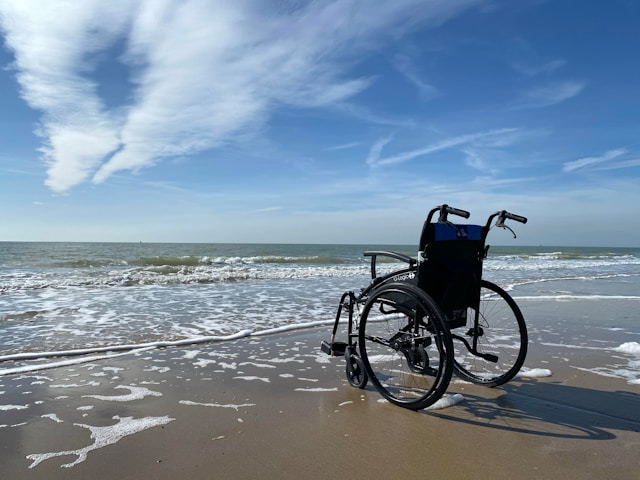


You have an important appointment scheduled for the day. Halfway there, your wheelchair starts acting up.
You call the manufacturer for help, but they tell you the earliest repair is in three weeks. Now that appointment is gone and so is everything else you had planned for the week.
For a lot of people using mobility aids, this is not an isolated incident. Here is what a person on Reddit shared:
“This morning, my chair keeps coming to an abrupt stop and dies everytime I hit a bump. I tried looking to see if anything is unplugged or loose and couldn't find anything.”
For something that’s literally a lifeline, you shouldn’t be left stranded - seeking help on a community forum - or googling local repair techs.

Is there a solution? Yes. But before that - it’s worth knowing what’s covered under your manufacturer warranty.
This blog breaks down how mobility equipment warranties really work - the split coverage timelines you didn’t check, the repair crisis that can leave you housebound for weeks, and the rights and workarounds that keep you covered.
What most people don’t realize - “a warranty” on a power wheelchair or scooter is actually three separate coverages - one for the frame, another one for the motors and electronics, and a 3rd separate one for batteries and consumables.
And each expires on its own schedule.
WHILL covers the frame for 5 years. Golden Technologies and Pride Mobility offer a lifetime warranty.
But frame warranty means the structural welds and metal skeleton. Not the motors bolted to it or the controller or the cushion.

And even a generous frame coverage has conditions most people forget to check.
For instance, Karman Healthcare voids a coverage if the serial number tag is removed, if you can’t produce the original receipt, or if you bought it second-hand.
Here’s what a buyer of a second-hand custom chair found out:
“if it's illegal to remove, i don't understand how it was so easy to get off. there's barely any sticker residue. it's also completely not visible from anywhere anyone would see the chair....i don't know the original owner who did it so i can't even ask why”
But finding the owner doesn’t matter anyway because most mobility equipment warranties are non-transferable.
So, yeah your coverage could’ve been void before you ever sat in it.
The components that make a power wheelchair powered carry far shorter warranties.
WHILL gives electronics coverage for upto 1 year. Golden Technologies offers 2. Pride Mobility ranges from 2 years on scooter electronics to up to 7 years on select lift chair motors.
But expiration is just the tip of the iceberg. Even within the warranty period, manufacturers decide why something failed - and whether it counts for coverage. And sometimes, that process can be frustrating when your daily life depends on the equipment.
"I purchased a Pride Lift Chair (with Lifetime Warranty) in 2022. In 2025 the chair developed significant operational issues... Pride responded stating that the frame and motors were not covered under warranty due to user error. How does error occur when all the user does is sit down and activate the control switches?"
The lifetime warranty is technically true, but it covers the frame welds. The wear and tear are either excluded or covered under an extended warranty.
For instance, Medicare classifies mobility equipment as Durable Medical Equipment and expects it to last a minimum of 5 years before you're eligible for a replacement. During those 5 years, Medicare covers repairs only if the cost is less than replacement. And normal wear is explicitly excluded. So, what may seem ‘lifetime’, may not really be that way in practice.
Batteries degrade with every charge cycle. They’re the component most likely to fail on any powered mobility device.
And unfortunately, they also carry the shortest warranty across every brand.
This is what one scooter owner revealed:
“Battery dies all the time. I am lucky to get 2 hours out of it. I refuse to pay for the upgraded one. It's almost the cost of a new scooter..”
Apart from batteries, tires, armrest pads, joystick covers - all classified as consumables - are excluded from virtually every manufacturer warranty.
Which means even when your coverage looks comprehensive, there are still plenty of ways for it to fall apart.
You’d think warranty coverage is binary. Either something’s covered or it’s not.
But with mobility equipment built for the not so simple routine life, there’s a surprisingly long list of things that can disqualify your claim.
One MobilityWorks customer learned this after their scooter started stalling every few feet:
“MobilityWorks initially denied the issue, then blamed the batteries and even a keychain. After months of poor communication and multiple repair attempts, the issue persisted. Much of this time, I was left without even a loaner scooter.”
And when warranty doesn’t come through, the costs can pile up fast. Most certified technicians charge $250 just to show up - before parts, before labor, before anything. Total bills routinely hit $500-$700. For some scooters, that's close to the price of a new one.
So here are some mistakes you should avoid:
What qualifies as “Unauthorized” can be news to you. And it is the quickest way to watch your coverage walk out the door.
One power wheelchair owner spent $26,000 on a Redman chair. When they filed a warranty claim, the manufacturer voided it - because a company employee who’d since been fired had done work on it. (Apparently, you bought a wheelchair and signed up for their HR drama)
“They are now claiming he was doing these options 'on the side' and 'without company authorization' so my warranty is void.”

Broda, Karman, WHILL - all require prior manufacturer authorization before any repair work. Miss that and you risk voiding your coverage.
Water and mobility equipment don’t gel well - and manufacturers are quite specific about it.
Pride Mobility warns that “direct or prolonged exposure to water or dampness could cause your product to malfunction” and that your chair “should be examined periodically for signs of corrosion caused by water exposure, bodily fluid exposure, or incontinence.”
That last part is worth reading twice.
Incontinence - something many mobility equipment users deal with daily - can void your warranty if it causes corrosion.
La-Z-Boy voids lift chair coverage for “excessive soiling.”
Mobility Scooters Direct states that taking your scooter to the beach can void even your service contract - “if you try to bring your scooter to a local beach and it gets both saltwater and sand in it, that could void the service contract.”
So now they’re prohibiting you from a pleasant time at the beach.

Can a person at least try to live to the fullest?
Manufacturers recommend maintenance (And build warranty exclusions around it.)
Fold & Go is the most explicit. If you don’t tighten every bolt on your chair monthly and check them after every flight, that's “negligence” and it’s not covered. TravelScoot requires you to charge the battery at least every 3-4 months during storage.
Let it fully discharge - and that’s grounds for denial.
Warranty registeration windows are usually time sensitive.
Zip'r Mobility gives you 30 days from purchase to register. Miss it and your warranty is void. CLASP has the same 30-day window.
If registering your warranty wasn’t on your mind the week your equipment arrived, you may have already lost coverage without knowing.
This is the one that hits you like a rock.
You fold your scooter for a flight and this happens:
“United Airlines violated federal law by refusing to have priority cabin space for a wheelchair (mine cost $15,000 and took me a year to get), damaging it in the process.”
Companies like Fold & Go excludes airline damage, transport damage, and - in perhaps the most honest warranty document ever written - “stunt or rally driving your wheelchair down a flight of stairs, riding on a moving escalator, trying to pop a wheelie, drifting, figure skating, and/or bobsledding (unless you are on the United States Paralympic Team).”

Points for honesty.
But the serious exclusions around travel damage are a problem for anyone who bought a mobility aid specifically to travel with it.
That’s the exact gap covered by accidental damage protection.
So, the manufacturer holds all the cards. Now what?
You don’t have to be a victim of the fine print. Protecting your mobility - and your wallet - requires a mix of legal knowledge and better coverage.
Not the most fun thing to do, but changes how your next consumer forum story ends.
If you live in New York or Pennsylvania, you have more power than most. These states have specific warranty acts that require manufacturers to provide a loaner or a refund if the device is out of service for more than 30 days or requires multiple failed repair attempts.
If a manufacturer denies your claim because you used a third-party repair, ask them to show where they provided those parts or services for free - because under Magnuson-Moss, that’s the only way they can enforce that restriction.
None of the coverage we have talked about so far covers things like a drop during transport, a joystick that wears out, an armrest that cracks on a trip.
That’s the gap accidental damage and extended protection were designed for.
Plans like SureBright's cover real-world scenarios during the manufacturer warranty period - and just after it expires. Accidental damage, power surges, and everyday wear are covered from day one. You don’t have to wait for the manufacturer clock to run out.

Some retailers have already figured this out. Healthcare Solutions, a Canadian medical equipment retailer selling rollators, walkers, and mobility aids, offers SureBright protection at checkout - giving customers the option to close the warranty gap at the point of purchase rather than discovering it after something breaks.
That’s the kind of setup where the retailer has your back beyond just the sale.
And if you already own the equipment, SureBright Anywhere lets you add coverage to devices you’ve already purchased that are under manufacturer warranty. No original registration window. No dealer requirement.
Your mobility equipment is your independence. And real life doesn’t happen under controlled conditions. It happens on airplanes, in the rain, and on the way to appointments you can't miss.
Now you know where the gaps are. And more importantly - what actually fills them.
.jpg)


.jpg)