“As someone who has had to warranty products before and someone that works in retail, REGISTER YOUR PRODUCTS. There is nothing more annoying than a customer demanding warranty service when they haven't followed the instructions.”
Okay, this Redditor answered it all.
Whew! That’s a job well saved. Thanks for reading and see you next time... but hold on...
“Read the fine print. You don't have to register when you buy it. They want you to so they can market to you.”
Another Redditor is saying something entirely different... So, what’s going on?
Welcome to the great warranty registration debate!
Here a retail worker and a savvy shopper can both be right, both be wrong, and both be talking past each other at the same time.
And you know it well that that little card sitting at the bottom of your printer box, the pop-up on your TV's first boot screen, the sticker on your blender that says "Register within 30 days to activate your warranty"... they've been making people anxious for decades. And here’s the secret- companies know all about it.

According to the FTC, the vast majority of consumer products are sold with a limited warranty, the kind where registration is technically allowed as a condition of coverage, but only if the company tells you that clearly and upfront.
Most companies don't. Instead, they bury the language, imply urgency, and watch consumers hand over their income bracket, shopping habits, and lifestyle preferences in exchange for protection they already had the moment they walked out of the store.
That being said: who's right? The retail worker or the Reddit skeptic?
Let’s find out.
It’s the reddit skeptic.
That means no, you don’t have to necessarily register a warranty unless told specifically so by the company.
Most warranties begin from the date of purchase, not registration. So, all you need legally is a receipt as proof. Even federal laws (discussed below) exist to specify that warranties cannot be contingent on filling out registration cards. The protection you paid for is already yours.
So, the demographic questions on those registration forms: your household income, how many kids you have, what you do on weekends... they have nothing to do with your product coverage. They exist for one reason, and we'll get to that shortly.
But before that, let’s get into the rights you have.
In 1975, the US Congress passed the Magnuson-Moss Warranty Act, a federal law designed specifically because manufacturers were using warranty language to mislead and intimidate consumers.
Before this law existed, companies could write almost anything into their warranty terms and get away with it.
An infamous example being one which Senator Magnuson used himself while introducing the bill:
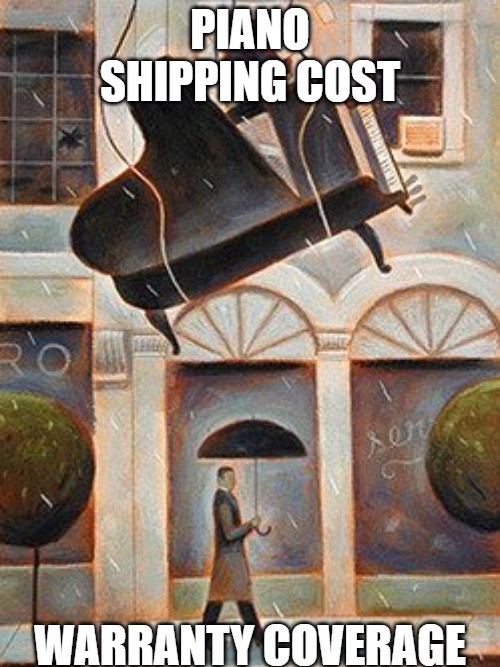
"... purchasers of consumer products discover that their warranty may cover a 25-cent part but not the $100 labor charge, or that there is full coverage on a piano so long as it is shipped at the purchaser's expense to the factory."
Yeah, full coverage on a piano as long as you ship it to the factory at your own expense.
A piano, which weighs, on average, 300 to 500 pounds. The coverage was technically "full." And the company knew with complete confidence that virtually no consumer would ever follow through, because shipping a piano across the country costs more than most repairs ever would. It was a warranty designed to be never used.
The Act prevented companies from doing such shenanigans by requiring warranties to be written in clear, understandable language, and by setting hard rules around what companies can and cannot demand from you.
However, there’s one catch.
Did you know that almost everything you buy, your printer, your fridge, your headphones - all comes with a limited warranty?
That means registration can technically be required, but the FTC's Code of Federal Regulations is clear that the company must disclose this upfront and explicitly. If a warranty doesn't say plainly that registration is required to receive coverage, it isn't.
Beyond Magnuson-Moss, several states have added their own layers of consumer protection. California's consumer protection laws, for example, are among the strongest in the country and explicitly protect residents from deceptive warranty practices.
Because what they're collecting is worth a lot more than you think.
When you fill out a warranty registration form, especially the parts asking about your income range, family size, occupation, or buying habits, you are giving away information that company can use or sell.
Yep, it seems harmless, but companies make money from that data. It gets sold to advertisers and used to build marketing profiles. Think of it like the physical version of internet cookies used to show you ads everywhere you look.
According to reports, your age, gender, and location are worth around $0.0005. The fact that you're shopping for a car bumps that number up to a whole $0.0021. And if you're pregnant? That information is worth $0.11 per person to a data broker, roughly 220 times more than knowing your zip code.

However, there's also a subtler business reason. Industry research shows that customers who register a product are more likely to purchase upsells, accessories, and complementary products.
None of this makes these companies villains. But does it mean you should walk into registration with eyes open?
There are a few situations where registering a product is genuinely worth doing, as it can actually help protect your purchase.
If your appliance isn't registered, many manufacturers can default to the original ship date, not your purchase date, as the start of your warranty. Products can sit in a warehouse or on a showroom floor for weeks or months before you buy them. So, it is better to tie your warranty to your actual purchase date by registering.
This is the most important reason to register anything. If a manufacturer discovers a defect, a fire risk, a contamination issue, a structural failure, the only way they can contact you directly is if they have your information. For instance, children's products like cribs, strollers, and car seats, registration cards have been mandatory since 2010 precisely for this reason. For baby gear especially, register immediately and provide accurate contact details.
Some manufacturers use registration as an incentive rather than a requirement. Goodman, for instance, offers standard warranty coverage to all customers but extends additional coverage, covering more components, for longer, to customers who register their HVAC systems within 60 days of installation.
Beyond the basics, there are other situations that actually cause headaches and tend to be messier. Let’s talk about what to do in those scenarios:
This confuses people because the receipt has someone else's name on it. For most brands, this isn't a problem. The proof of purchase just needs to show a purchase date, regardless of whose name is on it.
This depends entirely on whether the warranty is transferable, and most Limited Warranties aren't, at least not automatically. Most brands restrict coverage to the original purchaser only. Very few, like Apple, honor the warranty regardless of ownership changes as long as the coverage window is still open.
Five years from now, when your washing machine starts making a noise it shouldn't, you will not want to be digging through a junk drawer hoping last Tuesday's grocery receipt didn't cover up the appliance receipt from 2020. Registered products mean your purchase date and product details are already on file. It also helps track when warranties are expiring much easier, so you can explore extended coverage options before you're suddenly unprotected.
If you've decided it's worth doing, here's all it takes, under five minutes, start to finish.
That's it. And if a registration form won't let you submit without your household income or shopping habits, remember, you're filling out a marketing survey dressed up as a warranty registration form.
Now, most manufacturer warranties cover defects in materials and workmanship things that went wrong in the factory. They do not cover the moment your kid drops the laptop, the accidental coffee spill, the cracked screen, or the slow deterioration that comes with everyday use. That's the gap that catches people off-guard no matter if they registered diligently, filed every card, or kept every receipt.
That's where a good accidental warranty actually earns its keep. Not as a replacement for knowing your manufacturer warranty rights, but as the layer underneath that covers what the manufacturer won't.
So yes: understand your rights, register the products that matter, give away only the personal information you have to, and keep your receipts or confirmation emails somewhere findable. But also know what your coverage actually covers.
.jpg)


M Khizar is a writer enjoys making complicated things feel simple. He writes about warranties, ecommerce, and the small details people usually overlook, until they matter. His work focuses on clarity and helping readers make smarter decisions without overthinking it. Outside of work, he enjoys reading, writing personal blogs, and binge eating with friends.


.jpg)
.jpg)