


Knock knock?
No need to ask ‘who’s there’ because your security camera can see who’s at the other end, your smart lock can open itself, and your sensors can track if someone’s trying to play ‘Home Alone’ with you.
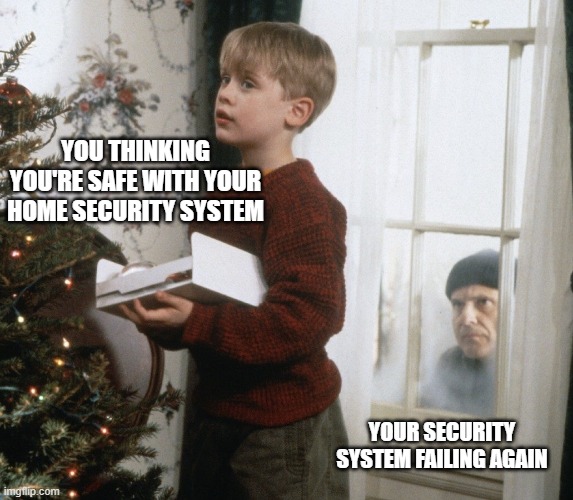
But for how long?
The average smart home security system has more than 25 connected devices, each could be from a different brand, each with a different coverage term, each with a different customer service process, and each perfectly capable of failing on its own schedule. That is a lot of moving parts held together by the assumption that someone, somewhere, has it all covered.
Well, the problem is - it ain’t so.
So, here’s what actually happens when something breaks: you dig out all your warranty documents, you try figuring who to contact, you start calling them one by one in the hope they wouldn’t pass the buck to someone else, you figure their claim process and pray that it’s approved. Frustrated you might even decide to get it repaired on your own cost... but by the time you do so, you realize that another device has gone dark. And so, you end up repeating the process until you retire, or your devices do.
Sure, your smart home security needs maintenance, but wouldn't life be easier if you could just reach out once, file one claim, and have the whole system back up before you go to sleep?
Well, there’s one trick that does exactly that.
Let's play a game.
Welcome to "What's broken in my smart home?"
Today's contestant is a frustrated homeowner who just discovered that the security panel controlling part of their system has stopped working:
Disclaimer: These are accounts from real people and not a figment of writer’s imagination.
“The house has a security panel but I think its broken [...] I dont know if its hardwired, im guessing it is. there is a screen panel, and a keypad, are they the same system? the screen panel doesnt work, but i think the keypad one does? there are no instructions anywhere. If the screen panel is broken, do i need to just buy a whole new system?”
Now, your challenge is to figure out what to do next.
In choice #1, you have: Replace the entire security setup.
Here, you’ll get a brand-new collection of cameras, sensors, locks, alarms, hubs, and the whole shebang. The only catch is it'll cost you anywhere from $180 to $3000+, before installation fees, cloud subscriptions, and all the other (not-so) fun surprises show up.
But wait, there's more!
With choice #2, you have: The warranty treasure hunt.
You get to dig through drawers looking for receipts, figure out which manufacturer made which device, call multiple support lines. explain your setup to five different customer service agents, and repeat until either the issue is resolved or your sanity leaves the building.
So...What’s your choice?
Take your time.

Well, I know both are terrible options: One drains your wallet and the other drains your will to live.
You see, standard warranties were never built for this moment.
They were built for the moment before it, when every device was brand new, sitting in its own box, with a warranty card and receipt neatly attached.
Smart home security doesn't work like that anymore. Your screen panel is connected to your keypad. Your keypad tells your hub what to do. Your hub controls your cameras, smart locks, video doorbell, and fire alarms. Pull one thread and suddenly you're trying to untangle the whole security sock.
When traditional warranties were created, a "security system" usually meant one panel from one manufacturer installed by one company.
Today, it means a dozen connected devices from a dozen different brands, all expected to work together as a single system.
Which means when something breaks, as our contestant just discovered, you've stumbled into the smart home security warranty gap that was there all along.
Well then, does that mean buying a new security system is a better option?
Not really, there’s another option... somewhere in between, but a lot better:
This is where everything changes.
Instead of chasing four manufacturers with four claim processes, a Whole System Warranty puts the entire installation under one plan. Yeah, I could have told you about that solution earlier. But where's the fun in doing that?
Basically, you get:
And of course, it is more feasible than investing in a new smart home security.
But the practical difference is not just financial; it is the experience of making a claim.
All you need to do is make a call. You do not need to know which brand failed or why. You do not need to diagnose the system yourself or argue about whether the failure was hardware or installation. You file the claim, it gets approved, a repair visit gets scheduled, and your system comes back online.
That is it. That is the whole process.
And in case you need to understand it a little better, here’s a pretty little table-
“I have 5 [camera] in my house under this plan and a few of them kept dying. Their warranty keeps saying they don't have the older ones in stock anymore so cannot give me a replacement.”
What this houseowner has been served on a silver platter is called a “compatibility trap”.
And to tell you the truth, it’s not just a one-off complaint. It is a pattern, and it is becoming more common as smart home brands silently discontinue older hardware, push firmware updates that brick legacy devices, or simply shut down the cloud infrastructure an entire product line depended on.
The device just... stops being supported. But what about your standard warranty, does it cover this? Unfortunately not, it was written for manufacturing defects, not abandonment.
Even Google did it with Nest Secure alarm system in 2020. Insteon, one of the most widely installed smart home platforms, shut down its servers overnight in 2022, with zero warning, leaving thousands of homes with fully installed, completely useless hardware. Even Amazon ended support for Kindle e-readers released in 2012 or earlier.
It gets worse for integrated systems. One orphaned device in a chain of twelve can destabilize the devices around it. A discontinued smart hub can take your locks, cameras, and sensors down with it when support ends.

The fix: A Whole System Warranty does not just cover what breaks. It covers what needs replacing or reimbursement when repair is not longer on the table. If a component can no longer be repaired or sourced, replacement is the outcome. That is the only real answer to a compatibility trap: a warranty that does not care why something stopped working, only that it did.
Home security systems have come a long way. The coverage protecting it has not, at least not until now.
You spent real money building a system that works as one. The warranty should work the same way. You should get one plan, one claim with no gaps, no finger-pointing, no bill you did not see coming.
SureBright's Whole System Warranty was built specifically for custom-integrated systems, everything covered, nothing left behind, with a claims process that actually resolves in 24-48 hours.
Want to see how it works and get your system covered? Contact us to get started.
.jpg)


M Khizar is a writer enjoys making complicated things feel simple. He writes about warranties, ecommerce, and the small details people usually overlook, until they matter. His work focuses on clarity and helping readers make smarter decisions without overthinking it. Outside of work, he enjoys reading, writing personal blogs, and binge eating with friends.


.jpg)


.png)
