

Right alongside AI, social payments are currently being hyped as e-commerce’s next holy grail. Even the pitch sounds magical: a customer is doomscrolling TikTok, spots a cozy weighted blanket, taps "Buy Now" right inside the feed, and lets Apple Pay handle the rest with a double-click.
No wonder people on the internet are calling this the inevitable future:
"We're already seeing it happen. Tiktok shop. Instagram shopping. Youtube links. Influencers pushing products directly in the feed. In 5 years I think the distinction between "social media" and "shopping" will be gone completely.”
And the setup looks convincing on paper too. Your audience spend over 2 hours a day scrolling social feeds and about 48% of these users say they have made an impulse purchase of a product they saw on social media. So it makes sense to place the checkout moment right at the point of discovery.
But the reality is way too far from this.
A recent survey found that 62% of people say social platforms influence what they buy, while only 6% actually want to buy there. The vast majority simply don't trust social apps with their payment details - yet.

So, let’s pull back the curtain on the real potential of social media payments, who is actually benefiting from the transaction, who loses and what happens to your add-on revenue if or when you surrender your register to an algorithm.
If in-app checkout were the guaranteed future, Meta would be the last company on earth to walk away from it. It walked away anyway.
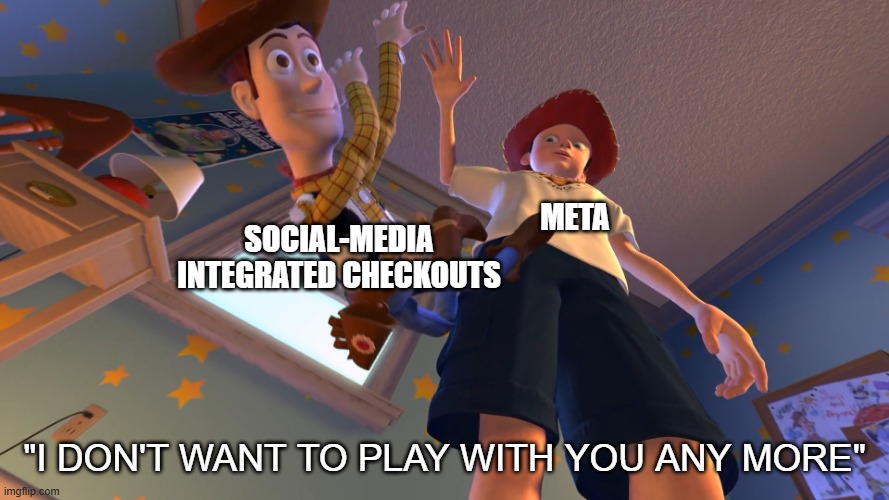
In 2025, Meta pulled checkout out of Facebook and Instagram Shops in the US and pointed shoppers back to merchant websites. On its way out, Meta also stopped handling order management, returns and dispute resolution for those orders, which is a polite way of saying "your customer, your problem now."
Interestingly, this pattern has been quite familiar. So, if you dig into the history of social payments what you'll find is a crowded graveyard.
But as you noticed in the above timeline, TikTok did the exact opposite of Meta and doubled down on keeping shoppers indoors.
So the two biggest players in social commerce looked at the same opportunity and reached opposite conclusions. And if you are not able to guess already, that means one thing for you: if your entire payment strategy or customer base is inside one app, you are betting on one company's roadmap, and it can change anytime. That’s not leveraging, that’s gambling with extra steps.
Yes and no, and that is not a dodge. It depends entirely on what you sell.
The money says the channel is real. Social commerce is expected to pass $100 billion in 2026, and TikTok Shop more than doubled its US sales in 2025. Meanwhile roughly half of all shoppers now find new products on social, and among Gen Z that rises to about three quarters. None of that is going backwards.
What hasn’t happened is the takeover everyone predicted. In-app checkout adoption remains stubbornly stuck in the low double digits, while the roughly 6% of shoppers who actively prefer buying inside an app has barely moved, even as discovery keeps climbing. The platforms keep building the checkout counter. Shoppers keep browsing past it like they forgot their wallets.
The honest read is that in-app checkout settles in as a channel rather than a replacement. It works well where the purchase is cheap, quick and creator-led, like impulse beauty, novelty, snacks, collectibles and anything sold in a live auction. But it struggles where the purchase needs comparing, configuring, financing or protecting, which describes most of what experienced merchants actually sell.
So build for both, and stop waiting for one to kill the other.
Most merchants get this wrong by treating in-app checkout like a switch: sync the whole catalogue, turn it on everywhere, and hope the algorithmic gods are feeling generous. That's what leads to returns and reconciliation.
So, it is better to start from an awkward truth: an in-app checkout is not yours to optimize. You did not build it and you cannot change it. Integrating it well is about sequencing, and about the handful of levers the platform does leave you.
Here is the order that works.
1. Fix your own checkout first: It is the cheapest win available. You see, wallets do most of the heavy lifting, because typing a card number on a phone is where these orders fade away. That also means optimizing your add-ons – about which we’ll talk more in the next section.
2. Send social traffic to the product, never the homepage: Deep link every creator collaboration, story link and bio link straight to the item being talked about. This single change usually moves conversion more than any payment feature will.
3. Test in-app checkout with a handful of SKUs, rather than your catalogue: Pick items that are cheap, need no configuring, rarely come back, and do not depend on an add-on for their margin. Keep those listings simple too, because every extra size and color option is another tap between the scroll and the sale. Everything else stays on your site.
4. Build the boring plumbing before the volume arrives: Keep inventory synced, because an impulse shopper who hits “out of stock” rarely circles back. Send orders into your normal system. Reconcile settlements regularly. Route returns to a real person, with support coverage built around the platform’s response deadlines, not your office hours. None of this is glamorous. And that’s exactly why it needs to work before the orders start piling up.
Now, let's talk about -
Now if you've had social payments working for a long time, you must have noticed how these apps pull a dirty trick: with their right hand, they show your audience a shiny, high converting "Buy Now" button. With their left hand, they throw away your high-margin add-ons, silently snatch your attach rate, and then trade the loyalty of your customers with endorphin points. It is sleight-of-hand trick that keeps your add-on revenue at bay.
In-app checkouts are built to do one thing quickly, which is sell one item. But your margin per order does not necessarily have to decrease.
There are three places where you can still capture that add-on revenue:
Some platforms limit what you can do with buyer information and restrict contacting that customer off-platform, so your follow-up options are narrower than they would be for a website order. Check what your platform's seller terms allow before you build a flow that depends on emailing that buyer, because finding out afterwards is expensive.
Yours, mostly, and much more than the hype suggests.
The feed is a phenomenal salesperson. It gets attention you could never buy, from people who were not shopping for anything, and it hands them to you warm. What it has not managed to do is convince people to trust it with their card details that's why the largest platform of them all handed the register back.
So treat social as the best top-of-funnel machine ever built and treat your own checkout as the place the business actually happens. Make that page fast, familiar and honest about costs. Then decide deliberately where your add-on revenue goes, rather than discovering later that it went missing.
1. Can you still check out inside Instagram?
Not natively in the US. Meta removed native checkout from Facebook and Instagram Shops in 2025, so those purchases now finish on your website.
2. Is it safe to accept payment through social apps?
Through a proper platform checkout, yes, with the trade-off being fees and limited access to customer data. Through person-to-person transfers in a chat, no, because neither side gets meaningful buyer or seller protection.
3. Which payment methods convert best on mobile?
Digital wallets, because they remove typing entirely. Cards remain necessary as a fallback, and pay-over-time options help most on higher-priced items.
4. Can you sell an extended warranty on TikTok Shop?
Not inside the platform checkout. Protection plans on social orders have to be offered after the sale, through your confirmation flow, your packaging or your follow-up, within whatever the platform's seller terms permit.
.jpg)


M Khizar is a writer enjoys making complicated things feel simple. He writes about warranties, ecommerce, and the small details people usually overlook, until they matter. His work focuses on clarity and helping readers make smarter decisions without overthinking it. Outside of work, he enjoys reading, writing personal blogs, and binge eating with friends.