

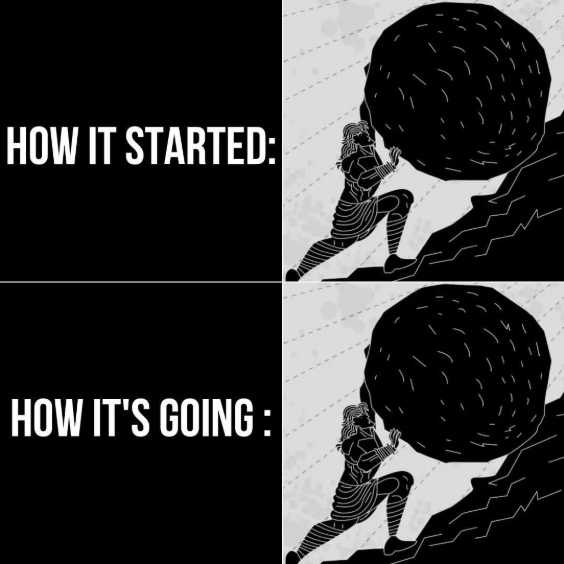
In Greek mythology, King Sisyphus was cursed by the gods to push a boulder up a hill for eternity, only to watch it roll back to the bottom every time he neared the top. Run a loyalty program for a few years, and you would have plenty in common with him.
At first, it all looks promising. You saw Sephora’s Beauty Insider program crossing 46 million members, driving around 80% of the company's transactions. Every case study on earth was calling loyalty points the engine behind it. So you too built your own program. You wired up the tiers and dropped a refer-a-friend button on the site, then sat back to wait for the repeat purchases to come flooding in. What flooded in was a slow, faintly embarrassing silence.
As one merchant described their version of that silence:
“Set up a points program 4 months ago. Most people don't notice it exists, and the ones who do accumulate points but never redeem them. Meanwhile, I’m paying for the app every month with nothing to show for it.”
That ghost-town effect is the real loyalty story of 2026, and it is far sneakier than most merchants realize. As one study found - around 56% of ecommerce loyalty members are inactive, and roughly 74% mentally check out within their first two months without ever clicking unsubscribe.
Nobody storms off in a huff. They just drift, while your program keeps gamely emailing people who stopped reading it back in the spring.
So before you write off your Q4 loyalty budget, it’s worth asking why the rewards boulder keeps rolling back. This piece looks at what e-commerce loyalty really looks like in 2026 and what a program has to do to actually stay put near the top.
Take some comfort in knowing you are in crowded company. Around 93% of consumers now belong to at least one loyalty program, and plenty of them are juggling five, ten, or sometimes fifteen at a time.
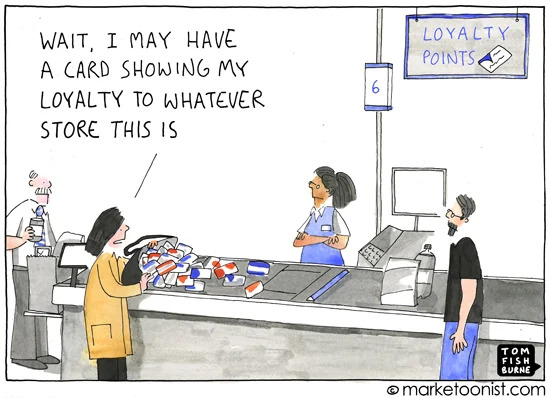
But on consumer forums, you can practically hear the fatigue setting in. One shopper described meeting a woman with an app for every store she walked into, a marketing department’s fever dream:
“If I’m going to buy I might as well get rewards.”
That sums up the engine behind the entire industry. But no buyer wakes up wanting a thirteenth rewards account. People collect them like you collect browser tabs you keep meaning to close.
Their goodwill curdles the moment the fine print shows up:
“I wish the rewards programs were that easy and simple today😅 before it was 10 ice cream purchases = 1 free ice cream. Now, it’s complicated bullshit like points earned only on Friday purchases between 12pm-1pm”
When a customer describes your program as a chore, the loyalty you were counting on starts to fade.
Add to that the complexity of redemption, which creates operational drag on your side too, piling up support tickets, rule explanations, and integration quirks until what was supposed to be a “set-and-forget” program turns into a recurring tax on your team. And there is more to why it gets grim for the person running one.
Most Shopify stores reach for the same short shelf of apps, which means the “custom” program you agonized over behaves exactly like your competitor’s. It looks identical too, right down to the cheerful popup announcing 200 points the shopper will forget by checkout.
That is what the industry gently calls a sea of sameness, and a good program stopped being an advantage a while ago. At most, it is the retail equivalent of free wifi, noticed only when it goes missing.
And sameness breeds indifference. which brings us to our problem today.
Loyalty fatigue is one name for several different behavioral patterns. The trouble with these patterns is that customers rarely reject your programs outright. The fatigue sets in ways that might not even show up on your dashboard.
For starters, a points balance in itself gives a customer nothing to feel, so once the novelty fades, there is no reason to think about the brand between orders. For you, the damage shows up in the churn, when consumers feel disinterested:
“The more interesting experiments I’ve seen recently are less about “earn and redeem” and more about moments that just feel… unexpected. Earn and redeem makes sense for like fast food places, but I've seen better customer experiences when the rewards are random.”
- A buyer’s honest take on loyalty fatigue
And even when the reward itself is appealing, customers can lose interest if getting there feels like work. Building suspense is not always the best strategy. Often, it leads to frustrated buyers who tried to play along and gave up.
For instance, departmental store Dillard’s reportedly required $750 in spending to earn a $10 certificate. The reward was there, but it was so far away that customers had to keep doing the math to convince themselves it was worth pursuing.
When the payoff feels too far away, there is less reason to keep engaging with the program. And once engagement starts slipping, merchants have an obvious lever to pull - communication.
But if you treat your loyalty programs as a license to spam, even the customers who liked your store get worn down by the sheer volume of contact. According to some studies, 70% percent of shoppers unsubscribed from at least three brands in a single three-month stretch because the messages kept piling up, and plenty switched to a competitor on the way out.
On a rather alarming front, though, is an unhinged version of this statistic:
“My new Black Friday tradition: I unsubscribe from every single brand that emails me today.”
After enough programs compete for their attention, customers start meeting the next one with less patience and more resistance.
To a growing number of shoppers, a rewards program increasingly looks like data harvesting. That suspicion sharpens when someone exposes or mishandles their data.
In July 2026, a proposed class action against Chick-fil-A alleged that a breach of its Chick-fil-A One rewards program exposed members’ personal, account, and payment-related information. The case has not established liability, but it highlights a concern customers increasingly have with loyalty programs: they hand over personal data in exchange for points and personalized offers, yet bear the risk when that data is compromised.
At the end of the day, your customers want to feel known by your brand without feeling watched by it.
And even when they stay, a poorly executed program undermines the very thing it was built to create. When you pile your loyalty onto discounts, you attract people whose loyalty is solely to the discount itself. A study found that reward-driven strategies can make customers less loyal, not more, by nudging them to keep chasing the best available offers.
Once you notice customers drifting, the reflex is to fix the program. And how do you do it? Simple - richer points, a shinier tier, and one more targeted email in the sequence. But that is a fresh coat of paint on the same old design.
What you need to do as fatigue hits is stop trying to win on points and start competing on how the whole thing feels to the end customer.
Looking back at Sephora, the real edge was never a fatter points table either. Its Beauty Insider Challenges got 30% of members to actively opt into the gamified Challenges instead of passively letting points accrue. The point isn’t that gamification automatically creates loyalty. It's that Sephora gives customers a reason to engage with the program as a community beyond accumulating points.
Stop eroding the trust you already have. Points that expire in silence or tiers that reset, and thresholds that creep upward the moment members reach them. These are the very moves that lead people to quit. For instance, when Starbucks reshuffled members into new Green, Gold, and Reserve tiers, regular customers revolted over status they had already earned. McDonald's got the same treatment after raising the point cost of long-standing rewards, a move members saw as plain inflation on their rewards.
So, the first thing to do is to stop moving the goalposts on customers who already earned their spot.
Make the climb feel worth the effort. Shorten the wait to that first real reward, since plenty of members give up before they ever earn anything. Hand out points for the things that signal belonging rather than spending, like reviews, referrals, and showing up to a members-only drop. Trade the generic coupon for something a competitor cannot copy in an afternoon - early access or a VIP moment.
The programs people actually rave about are built exactly this way, with Nike Member Days, Rapha's cycling community, and Sephora's Beauty Insider circle all selling you into something worth belonging to.
Message fatigue is its own slow exit, since shoppers walk away from brands that over-send, and it is repetition that finally tips them into unsubscribing.
Ulta Beauty runs its Ultamate Rewards program on that principle - loyalty communications are driven in a way where emails and app alerts feel personal and timely, not generic. The payoff is significant, with members now drive roughly 95% of Ulta’s sales, a sign that relevance, not volume or discounts for that matter, is doing the heavy lifting.
Charging for membership sounds like the opposite of curing fatigue, and yet it can deepen loyalty. Paid-program members are 60% more likely to spend more after joining, because people who pay to get in tend to want their money’s worth. The move is to keep a free base tier and make the paid upgrade optional, so you strengthen your best relationships without slamming the door on the bargain hunters.
Securing customer loyalty doesn’t always mean giving customers another loyalty point. Sometimes, it means giving them more reasons to trust that your brand will stand by them after the purchase when something goes wrong. Product protection is one way to offer that peace of mind, extending the relationship beyond checkout while giving merchants an opportunity to earn incremental margin and continue delivering value long after the sale.
Because lasting loyalty isn’t built by giving customers more reasons to earn points, it’s built by giving them more reasons to stay.
.jpg)




.jpg)