


Congratulations! Your store is now fully AI-commerce compliant!!
Your products can now be discovered by AI agents and compared with your competitors, giving you another shot at reaching customers who might never visit your website.
Sounds wonderful, right?
So, are you ready to give retail bots the keys to your store?
Not so fast. Before you start welcoming every AI agent through the door, you should first see whether AI commerce is actually helping the brands that have already embraced it.
In a recent rankings, Nixon, Online Labels and Everlane, were among the brands ranked highest for AI commerce readiness yet they sat at No. 722, No. 814 and No. 264, respectively, by e-commerce sales.
Now the question arises: Who were performing well in overall sales?
Well, it was Amazon and Walmart. But even there, AI commerce tells a different story. Walmart sits at No. 37 while Amazon trails at No. 158, leaving a gap of 121 places between two retailers that dominate conventional e-commerce.
Now, as a merchant, you see the path diverging into two, with neither seeming like the road less taken.
One route is obvious: open your product data to third-party AI agents and let them bring your store into conversations happening somewhere else. The other is equally tempting: keep those doors tighter, especially when you cannot control what an agent does with the information it finds.
So, which road should you take? Let’s see where each one leads before you hand AI the keys.
The promise of AI commerce is easy to sell; figuring out what you are actually giving up for it is harder.
For some merchants, that means betting on algorithmic distribution through AI; for others, it means keeping control through direct ownership, making their products legible to machines while keeping the commercial relationship on their own property.
The first bet is trickier than it sounds. Wharton researchers ran roughly 26,000 tests and found that AI recommendations changed when the surrounding context changed, including information about reviews and competing products. An LLM-readable catalog, therefore, does not guarantee a machine-selected product.
It also raises a concern merchants are already voicing. One e-commerce seller on Reddit asked
“What happens when we lose control of the shopper's shopping experience because it's all on the AI platform?”
That brings us to the second bet, but it has a cost too. An agent cannot recommend what it cannot access well enough to understand. Close the door too tightly and you protect the customer journey while disappearing from part of the discovery process.
So a middle ground is the only safe option pursue, right? Because even the platforms allow you to stay on this path. Google’s UCP, for example, lets businesses choose which commerce capabilities they support rather than treating access as all or nothing. OpenAI can send shoppers to a merchant’s own checkout while also supporting deeper experiences such as Walmart’s in ChatGPT environment.
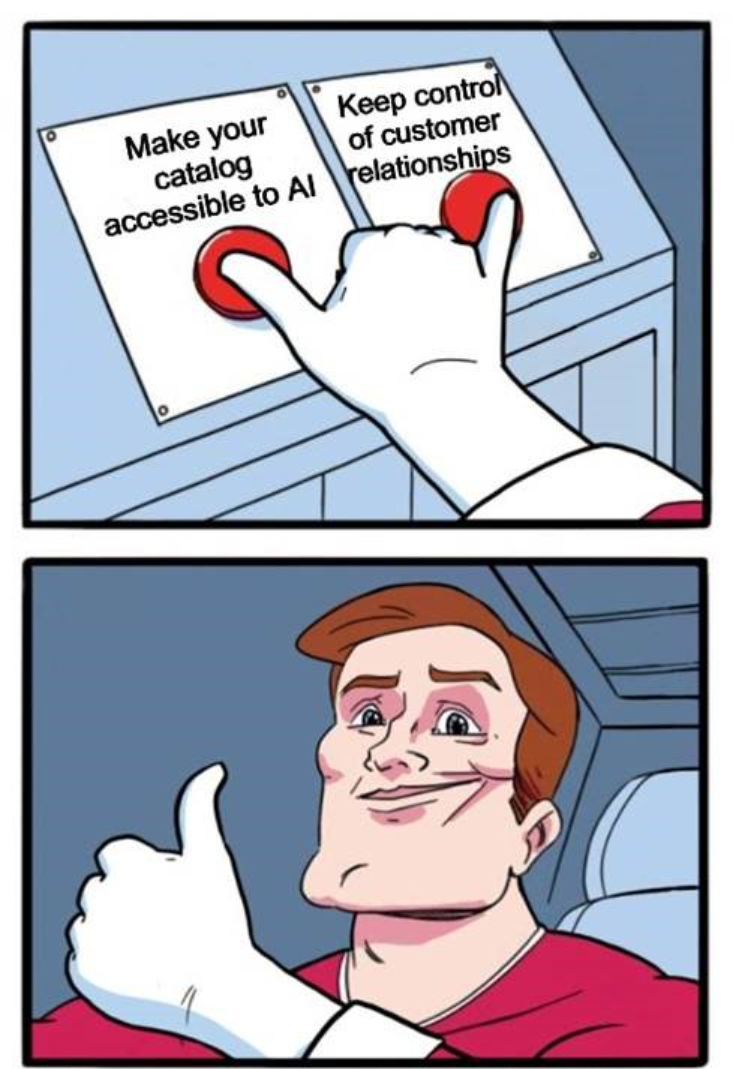
For now, the smarter bet may be to see who is actually benefiting from the shift.
AI commerce is giving a niche retailer a chance to compete on relevance rather than reach.

Traditional search has spent years rewarding retailers that can accumulate visibility. Backlinks, domain authority, advertising spend, and sheer traffic all help a store get in front of the shopper.
AI shopping can flip that sequence. Instead of asking, “Which retailers are already the most visible?”, an agent starts with “Which product best fits what this shopper query?” A niche retailer does not have to win the entire search landscape to have a shot at that answer. It only has to be the better match when the request gets specific.
Shopify says this is already happening across its merchant base. The company found that AI search has disproportionately benefited smaller brands, particularly those selling niche products. But getting recommended a few times by AI does not mean it will recommend you again.
A traditional search ranking, once earned, tends to stay put the next time someone runs the same search. An AI recommendation provides no such assurance, and a Recomaze study shows just how shaky that makes things for merchants. The study ran six purchase-intent queries against each of 9,720 stores on Google Gemini, 58,320 tests in all, and a store was named just 14% of the time. The rest of the time, the shopper was pointed to a competitor or told nothing at all.
So if being a niche brand doesn't guarantee success in AI commerce, the question becomes what the agent is actually weighing each time it decides.
A shopper sees a product. An agent sees a schema.
That schema can contain the product title, variant, price, availability, category, images and identifiers. UCP’s catalog specification goes further, allowing agents to retrieve a particular variant, compare prices and filter products against a query. Shopify’s catalog infrastructure similarly maps merchant catalogs into structured fields that agents can parse.
The interesting part is what happens when a shopper’s request gets precise.
“Find me running shoes” leaves plenty of room for interpretation. “Find me women’s trail shoes, size 8, under $150” gives the agent a set of conditions to resolve. If size exists only as a variant buried behind a product page, or the relevant price and stock status are stale, the agent has less certainty about what it can actually offer.
There is another wrinkle. Two merchants can sell essentially the same product while structuring their catalogs completely differently. Shopify recently described having to reconcile listings where one merchant groups flavors under a single product and another creates a separate listing for each flavor. The customer understands both. A machine has to figure out the relationship.
That means catalog structure is no longer just a back-office concern. It can affect whether an agent recognizes two listings as comparable products, identifies the right variant or retrieves the correct offer.
And if an external system is reconstructing your products from these signals, how much of that reconstruction are you comfortable leaving outside your control?
The strongest argument for keeping AI at arm’s length has little to do with fear of bots. It is about what happens after the recommendation works.
A customer who discovers a product through an AI platform can still leave that platform and buy from the retailer. That distinction has real value. Reuters reported that AI-referred shoppers were generating 41% higher revenue per visit than non-AI traffic in Adobe’s May 2026 data, while retailers such as Walmart, Ulta Beauty and Wayfair were still pushing to keep the final transaction on their own sites.
Why fight for that last click when an agent could simply finish the job?
Because the checkout is also where a retailer learns who bought, what else they considered, what they put in the basket and what brought them back. Move too much of that activity into an intermediary and the transaction may still be yours financially while becoming less useful strategically.
There is another problem. An agent has no particular reason to build your brand preference. Its job is to satisfy the shopper’s request. If another seller offers a better match next time, the same system that introduced your product can introduce somebody else’s.
That makes AI discovery valuable without making AI the owner of the relationship.
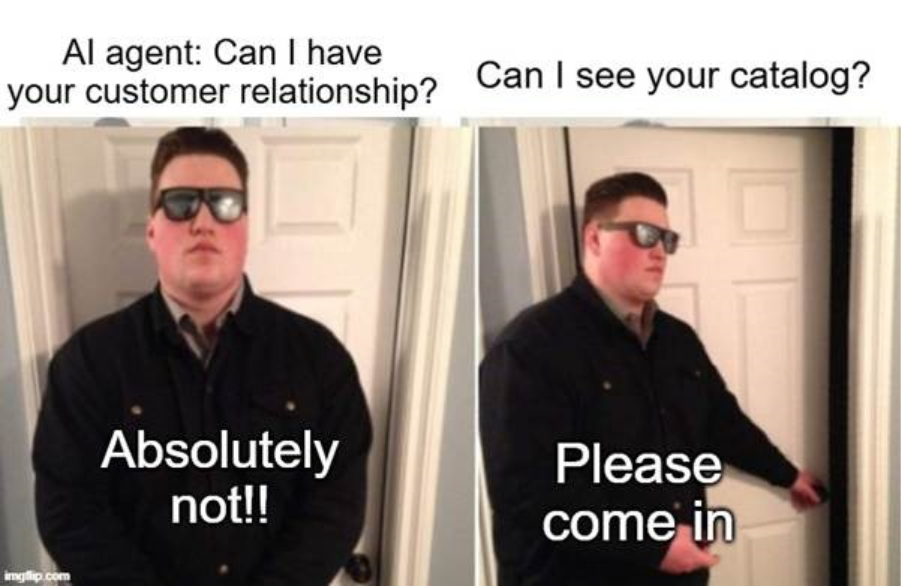
The sensible boundary, then, is to let the intermediary bring the customer to the door, but think twice before handing it the keys.
For some retailers, that boundary will be worth protecting even when a deeper AI integration promises a smoother transaction.
The question was never whether AI gets a seat at the checkout counter. It is already pulling up a chair.
The more useful decision is where you draw the line. Let AI help shoppers find your products and compare their options. But once the customer reaches your store, there are parts of the experience worth keeping in your hands.
Protection is one of them.
An AI agent can recommend a product and help complete a purchase. It cannot make that product less likely to break or answer the customer’s next question when something goes wrong. That responsibility still lands with you.
SureBright helps you handle that part without building a warranty operation from scratch. You can offer protection at checkout while SureBright manages the setup, plan administration and claims process, and you keep a share of the protection revenue.
AI may change how customers find you. Make sure you still have something valuable to offer when they arrive.
With SureBright, you can add protection to your products in minutes and give customers another reason to buy from you, wherever that purchase begins.
See how SureBright can help you protect your sales.


Pushpender enjoys exploring the stories behind everyday decisions. He writes about warranties, ecommerce, and the psychology of buying. He draws on internet research, lively conversations, and a curiosity for the details most people overlook. With a background in English Literature, he believes good writing isn't measured by how complex it sounds, but by how effortlessly it helps someone understand a complex idea. Outside of work, you'll usually find him reading fiction and history, striking up conversations with people from different walks of life, or jotting down ideas inspired by both.


%20(1)%20(1).jpg)

.jpg)