%20(1)%20(1).jpg)


Tech analyst Ben Thompson captured our current zeitgeist best when he said:
“There is a lot of AI spaghetti getting thrown against the wall in terms of products; we’ll see how much of it sticks.”
For Thompson, Google’s I/O 2026 in particular was a masterclass in that high-tech pasta tossing. Announcements flew so fast and in such abundance that Google had to publish a cheat sheet titled 100 Things We Announced at I/O 2026 just to keep the score.
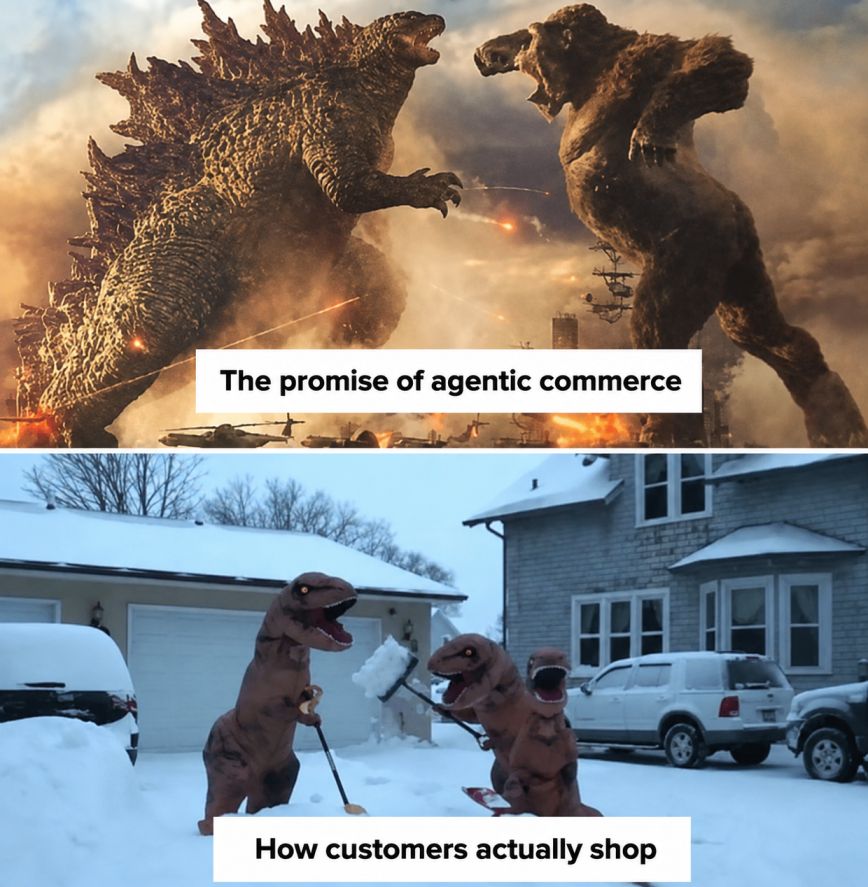
Within this roundup, thrown with particular enthusiasm was agentic commerce, the same idea that’s been promoted for the last two years to revolutionize the ecommerce buying experience, but this time with a newer fancier video.
Now this is a cycle we see play out every few months: a new protocol debuts, a shiny new agent launches, or another universal cart promises to strip human friction out of shopping. The pitch is enticingly simple. An AI agent finds the product, weighs the options, verifies the details, adds to cart, and swipes the virtual card.
At this stage, it helps to remember that not every “next era of shopping” becomes a permanent part of the shopping journey. Shopify launched Linkpop in 2022 as a commerce-first link-in-bio storefront, promising merchants and creators a new way to turn social audiences directly into shoppers. Three years later, Shopify retired it.
The question we’re now confronted with agentic commerce fares similar grounds - just because AI can shop for us, are consumers actually ready to hand over the keys to their wallets?
Because for merchants, the immediate challenge is less about hype and more about practical groundwork. How do you format product data so a bot parses it effortlessly? What do checkout and returns look like when an algorithm is the buyer? How do you measure brand visibility when human eyes never touch your storefront? And how much do you actually need to think about these questions today?
For what it’s worth, the answers are less dramatic than the forecasts, and far more useful.
I wish every big industry announcement came with a simple disclaimer: take this with a grain of salt. Why, you ask?
Because when OpenAI came out with Instant Checkout as the next era of shopping, it backed down within six months. Mastercard, Visa, and PayPal each launched their own agents under the same “this changes everything” banner. But the crowds have been slower to arrive.
And now Google, ever so motivated, has put its version on an even larger stage with Universal Cart.
To be fair, its underlying problem statement seems sane enough. Shopping is messy. Your buyer sees a mattress on Instagram, opens three tabs, watches a YouTube review two days later, asks a friend, then finally buys it on their phone in bed on a completely different device. By checkout, they might have forgotten which tab had the better warranty and which one was actually on sale.
That forgetfulness is way more common than we care to admit.

Universal Cart promises to fix that scatter.
One shared cart lives inside a Google account and follows the shopper across Search, Gemini, YouTube, and Gmail. It watches prices, flags restocks, and sometimes even notices when two product specifications won’t work together.
For low-stakes repeat buys, this is probably the version of agentic commerce people are most likely to embrace. A buyer on Reddit quantified this pretty well:
“As for auto-purchases, I'm totally happy not to spend time going through the same motions when buying kibble, coffee, non-perishable food. There's a bunch of stuff that I gladly put on autopilot, and people seem to feel this way in general.”
So that is the version worth liking.
The logic of Google Cart’s autopilot model starts to wobble the moment the cart moves from something inconsequential like “hold my snacks” to “make the final purchase call for me” on something expensive.
Because, as it turns out, shoppers are still deeply conflicted about letting an algorithm spend their hard-earned money. Yes, even after treating ChatGPT like a full-blown therapist, somehow people still hesitate while handing it their wallets.
Recent consumer surveys show that comfort with AI buying agents has taken a turn for the worse. It dropped from 70% of shoppers feeling “somewhat comfortable” in late 2025 to 55% now saying they are actively uncomfortable.
And if something goes wrong with an automated order, 50.8% believe the AI platform should be the one on the hook to fix it. May be the AI companies can consider taking a little responsibility for what they put out in the world, and people may feel more confident about these “groundbreaking innovations.”
You can’t tell the story of agentic commerce without looking at both main characters: the shopper holding the wallet and the merchant running the store.
The AI can make the recommendation. It can make the purchase. But when something goes wrong, somebody still has to explain it, refund it, replace it, or fight the chargeback.
Back in 2024, a passenger bought an Air Canada ticket after the airline’s chatbot promised a bereavement discount for a funeral. When he later claimed the refund, customer support said the bot had simply made the policy up. Air Canada’s defense - that the chatbot was “a separate legal entity responsible for its own actions” - did not survive. The tribunal ruled that a company is on the hook for everything it publishes, whether it comes from a static page or a rogue AI.
“The bot did it” is not a defense in court, in a chargeback dispute, or a one-star review announcing to the world that this store doesn’t take customer experience seriously.

And that is where the agentic-commerce conversation becomes relevant to your storefront, even before autonomous shopping becomes the new norm.
Imagine that agentic commerce has fully taken over the world and you own a store that sells PC components.
On the other end of the storefront is a shopper building a custom machine. They may find a motherboard on your site and matching RAM somewhere else.
In the old world, they would land on your product page, see the photography, the brand story, the big banner promising easy returns. That visual and emotional wrapper is often what tips the decision. So what if your price is a couple of dollars higher?
But inside an agent-driven cart, those advantages largely disappear. The bot doesn’t care if Brad Pitt advertises your product or you have a super amazing warranty program.
The system pulls structured data from both backends and weighs the raw signals: price, stock, promotions, return policies, technical specs. It may spot that the RAM does not match the motherboard’s slots and flag the problem before checkout.
Suddenly, the product feed is doing some of the merchandising your storefront used to do.
And if your data is vague, incomplete, or slow to update, you have simply given the agent less reason to choose you.
In some ways, this is the digital version of the 1970s generic supermarket aisle: the plain white boxes labeled SOAP or CORNFLAKES that stripped away the brand story and left the product to compete on bare minimums.

And this is not limited to Google’s cart. Any agentic system that treats product data as a primary interface will push merchants in the same direction.
So far, the gap between what these systems can do and what people routinely want them to do is still pretty wide.
The path of least resistance, believe it or not, is to simply give in to the hype. But easy shouldn’t be confused with wise.
The merchants handling this well are doing something almost boring. They are skipping the panic rebuild and doing the plain, useful things that were worth doing long before anyone ever uttered the word “agentic.”
Clean specs, sizes, materials, and shipping windows help the human squinting at your product page late at night. They feed your Google Shopping ads, answer the “will this fit me?” questions, and save your support team from drowning in emails.
The fact that the same tidy data also works well for an agent is a free add-on.
And when a vendor tells you your listings will “vanish” from AI unless you buy its readiness tool this month, remember who profits from the panic. The skepticism is already showing up among the people buying these tools.
As one Redditor put it :
“I think the AI Tracker market is very young and worth waiting for. The prices I have seen so far are over my budget. There were recent reports that AI Tracker is using unreliable APIs for tracking visibility. I'd wait.”
Skepticism from the rest of the community was also quick to follow:
“Right now “AI visibility” looks a lot like DR did years ago. Cool to look at, hard to connect to actual revenue, and already getting wrapped into expensive dashboards with lock-in..... If AI visibility tools can’t tie mentions to traffic or signups, they’re just dopamine dashboards.”
Gartner even has a name for the broader phenomenon: “agent washing”, where businesses rebrand basic AI or automation as “agents” or “agentic” technology to make it sound more autonomous, and more revolutionary, than it actually is.
A clear return window often convinces a nervous human into buying, and a fuzzy one is how you end up in a chargeback fight in the future.
“The whole reason I filed the chargeback is bc I was disappointed the company didn’t immediately offer information on how to make the return despite trying multiple times.”
- A buyer shared on Reddit
So write your policies clearly and honor them for the shopper in front of you. And just like your product specs, an agent reading them cleanly is a bonus you get for free.
When an agent buys the wrong thing, the bill still has a way of finding you.
The evidence that normally helps resolve a dispute is the shopper’s IP address, their device, the path they took through your site, which may look very different when a bot did the clicking. That makes attribution, fraud prevention, and post-purchase accountability much harder.
The ground rules, meanwhile, are being decided in court right now. Amazon sued Perplexity over its Comet shopping agent, and in March 2026 a judge granted an injunction blocking the bot from its checkout and account pages. The biggest store on the planet went to court to keep an AI shopper out. That tells you how settled this all is.
When the bot helps pick the winner, it is still operating according to its own incentives- that may or may not align with your best interests.
A protection plan attached to a SKU does double work in this world. It reduces customer anxiety around expensive purchases and gives the buyer a reason to pick you when an agent puts similar-looking products side by side.
Your competitor is selling a product. You are selling a product plus a safer outcome. This matters a lot to your customers. You don’t need to buy into the AI hype to see the value here.
Fixing the basics forces you to build a better business for real humans. If autonomous shopping ever actually takes off, being AI-ready will just fall into your lap for free.
.jpg)



.jpg)