.jpg)


We called it - not once but twice now.
Back when OpenAI was pitching Instant Checkout as the future of commerce, we told you it wouldn't work. And now, OpenAI has shut down the feature within six months, admitting it "did not offer the level of flexibility that we aspire to provide." Meaning, they created a lot of hype (thanks to consequence-free influencers), but their value proposition was never rooted in real customer behavior.
Walmart after giving it their best found that in-chat purchases converted at one-third the rate of click-out transactions.
Translation? People weren't buying in ChatGPT, no matter how seamless OpenAI claimed it would be.
For you as merchants, the takeaway is ~ your customers don't want to buy inside a chatbot. They want to shop where they feel at home. That's your website, your brand, your carefully curated space. They want to remember where to find that one item they love, or see recommendations based on what they've already bought from you. They want to click "buy now" knowing exactly what to expect because they've done it a hundred times on your site. That's connection. That's control. That's loyalty.
Selling their self-serving agenda of “AI is going to transform how you sell things online”, OpenAI and its hype machinery of social media influencers onboarded many merchants. Namely Etsy (as their first live partner), Walmart, and many Shopify businesses.
But unfortunately, for some of these early adopters, an expensive lesson was on way (3x conversion loss for walmart) realizing that~ chasing AI hype doesn't move units.
Perhaps, Amazon saw it coming- that's why they never implemented a version of Instant Checkout. More importantly, they even blocked several of these AI crawlers. Though yes, they also did build ‘Buy For Me’, which too has received a lot of backlash from merchants.
So, what has OpenAI learned from this gigantic failure.
You guessed it right- nothing - as they're already pushing their next big thing, and we're here to tell you why it'll likely land with the same thud.

Moving past the really bad pun (almost dad joke-ish level), and seeing at least 5 new hype videos on ‘How Instant Checkout was going to change everything’ - cause if that happened, why did OpenAI shut it down?
Simply because it’s costing a lot of money to run it, and after Walmart’s blowback, it’s doubtful that any big-name merchant will even look this way.
Instant checkout had many flaws;
In a nutshell it confused “AI can help me choose” with “I want to buy here,” when those are two very different behaviors.
So, did anyone see this coming? (apart from us of course)
Yes, OpenAI themselves were leaving obvious clues that it was about to happen. Before the announcement of a complete withdrawal of the feature, they had already started rolling it back, as reported earlier this month.
And then they shut down Sora three days ago and their ‘Erotic’ chatbot just yesterday.
It’s almost as if they were prepping up for something, cleaning up failed products which were originally hyped to change the industry and became nothing, but liabilities.
Could this be a pre-IPO cleanup?
We will let you decide.
So, what's OpenAI's grand plan now?
They're calling it Product Discovery, and honestly, it sounds a lot like they took the Instant Checkout disaster, removed its USP (which was in-chat checkout) and are now calling it innovation.

Once again, trying to fix a problem which never needed fixing.
Also, what’s with these names, ‘Instant Checkout’ and ‘Product Discovery’, no wonder there was a job posting of a content strategist sometime back.
For you as merchants, OpenAI is already positioning it as a win.
Their pitch? ‘Send me your product feed so people can forget Google exists as a search engine and we have the monopoly.’
Jokes aside, how does it work?

You enter whatever you want and instead of just giving you text/comparison tables, ChatGPT will send images with a link to the merchant’s website for checkout.
Yep, that’s the big new change coming to ecommerce that will “CHANGE THE INDUSTRY FOREVER”
Once again, OpenAI is making the same mistake.
It’s trying to change how people shop online, eliminating intricacies that makes a shopping experience unique to them, and what makes them loyal.
And, as you may have guessed already.
Because OpenAI is still looking at shopping as a rational behavior, not as a 'ooh, this looks exciting' behavior - how people usually buy.
Product Discovery sounds less aggressive than Instant Checkout, sure.
No forced in-chat payment, no awkward “buy now” moment inside a chatbot. Just prettier product cards, comparisons, images, and a promise that ChatGPT will help people figure out what to buy faster.
OpenAI’s own pitch is basically, fewer tabs, less searching, quicker decisions. Nice line when ‘lining’ up for an IPO.
But, it’s still not how most people shop when real money is about to leave their account.
Because shopping is not just “show me three decent options and I’ll take it from here.”
People want confidence before they click;
After all, if it were that easy- wouldn't the giants- Amazon, Walmart, Shopify have had already cracked it. You do know right, that they have teams of people who obsess over improving customer experience by milliseconds?
Constructor’s 2025 ecommerce study found that reviews are the top trust signal for 67% of shoppers, 84% say reviews influence what they buy, and older shoppers care heavily about clear return policies and secure checkout.
And the bigger problem for OpenAI is discovery itself. Funny how the problem is literally baked into the feature's name. (as if it’s a sign)
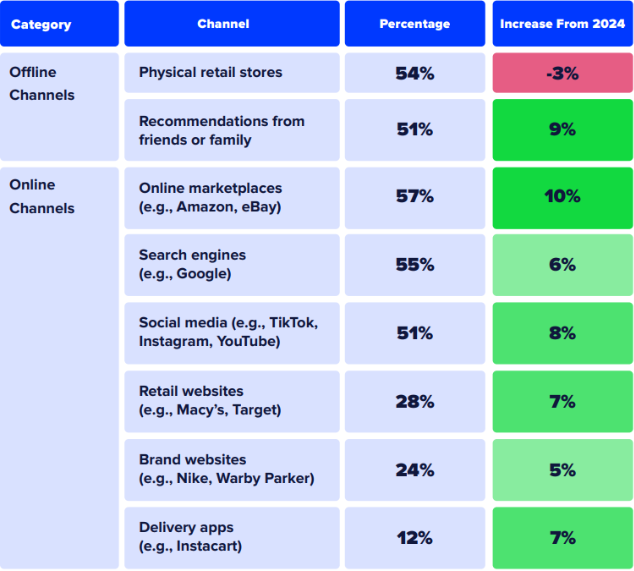
A US based consumer research report found that;-
So, when OpenAI tries to pitch ChatGPT as the new place where product discovery begins, it is not entering an empty room.
It is barging into a place where Amazon, Google, retailer sites, review pages, and social platforms have already trained the customers for years.
Also, let’s be honest, “fewer tabs” is not some grand consumer revolution.
Those tabs exist for a reason - One tab has a better price. Another has faster shipping with reviews from people who sound slightly less fake. And yet another has a return policy buried in tiny text that still matters more than the entire AI summary.
The mess is not accidental. The mess is how people shop when they care.
And for you as merchants, this new setup still comes with the same ugly trade-off.
OpenAI says Product Discovery brings you “higher-intent shoppers” who are closer to a decision.
Maybe. (How they maybe promised ecommerce revolution with instant checkout)
But it also reduces your brand into one card in somebody else’s interface, sitting next to a dozen lookalikes with the same polite little bullet points.
Your store stops feeling like your store and starts feeling like inventory in a very expensive recommendation engine.
So no, we are not buying the sequel either. And perhaps you shouldn’t too.
Here’s the truth AI companies do not like hearing.
Real businesses do not run on demos, launch threads, and LinkedIn poetry. They run on margins, repeat customers, trust, and systems which still work when the hype cycle moves on to its next shiny toy.
Sure, you can get some instant buzz around the market and a dopamine boost, witnessing a hoard of hype merchants on your way, but for how long?
Because if a feature sounds futuristic but asks your customers to behave in a completely unnatural way, you are probably not looking at innovation.
You are looking at an expensive theater.
And for you - the merchant, your job is not to help AI companies justify their valuation.
It is to protect what actually keeps your business healthy. Your customer experience, your profits, and the parts of your business that still make sense in the real world.
At SureBright, we care a lot more about those real merchant interests and their profits (no onboarding cost + revenue sharing on each eligible warranty sold) than whatever “commerce revolution” gets announced this week.
Because when the hype dies, you are still the one left dealing with reality.


Abdullah is a marketing professional with five years of experience in content, brand strategy, and audience growth. He has built a strong understanding of warranties, product protection, and the customer trust factors that influence purchase decisions. His work focuses on turning complex topics into clear, engaging, and reader-friendly content. Outside of work, he enjoys football, slow-burn dramas, and stories that take their time to make an impact.