


Disclaimer- This article contains disturbing scenes of businesses confusing revenue with success. Viewer discretion is advised.
Welcome back.
Today we’ll learn how businesses accidentally spend $100 to sell a $130 hoodie. Repeatedly.
Yes, that might mean your ads are generating sales, but your accountant, however, is still grumpy.
Why?
Because marketers collectively waste 26% of their total budget, despite how smart they dress up or how polished their writing is. And no, this is not yet another plugin for “hey, use this AI and get rid of all your marketing problems”. It is quite the opposite.
Now do the math on your own marketing budget.
Take two merchants, for example, both selling the same $800 grill. Both running Google ads. Both hitting their sales targets. Merchant A is celebrating. But merchant B is celebrating harder. Why? Because the customers their marketing channel keeps bringing back is twice as efficient and powerful as Merchant A.
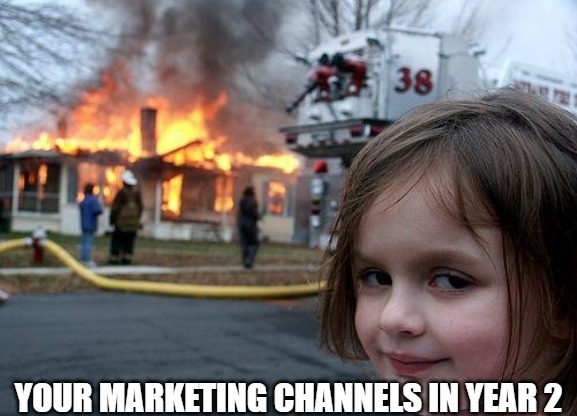
That's the distinction marketers rarely make: the difference between a channel that works and a channel that's actually profitable. They feel identical in month one. But they feel very different in year two.
Here's a Reddit merchant who figured this out the hard way:
"I've tried most of the obvious stuff over the years. Paid ads, cold email, LinkedIn outreach, Product Hunt, SEO blogging. Some of it worked in flashes. None of it compounded the way one thing did."
And what was that one thing?
That's exactly what we're here to help you find out (along with a few others).
Sorry, but please stay tuned. You won’t regret it.
Every merchant has a channel that drives sales.
But driving sales is one thing and having a profitable marketing channel is another.
And most of the time you are doing only driving sales with more ad spend than revenue.
No wonder most merchants watch ROAS (return on ad spend) and CAC (customer acquisition cost) because those numbers are visible, clean, and available the same week you run a campaign. The problem is that a low CAC can still be a terrible result - if the customers that channel attracts buy once and disappear.
The number that actually matters is your CAC:LTV ratio. Customer Lifetime Value against what you spent on acquiring them. The average across ecommerce is 3:1 for every dollar spent acquiring a customer, that customer should return three dollars over their lifetime with you. Anything below that and you are likely losing money once you account for operating costs, returns, and overhead.
Just like those eggs kept on your kitchen counter, marketing channel too, has a shelf life.

Campaigns that remain profitable for years become unprofitable almost overnight. Just take this case, for instance, organic reach on social media has dropped below 5% on most major platforms and continues to fall. Meta advertisers saw CPMs rise by 15–40% in a single month in early 2026.
But why is that?
Well, mainly because of the changes in the industry. SEO is being reshaped by AI-generated answers in search results. The market is becoming more saturated day by day with many new players joining and older ones becoming stronger and taking away your audience. And with platforms becoming more streamlined (again thanks to AI), the marketing channels that built your business three years ago is almost certainly performing differently today.
But that’s no reason to panic. It is only a reason to build one habit:
Four times a year, pull three numbers for every active channel:
The goal of the audit isn’t to panic-delete channels. It’s to spot the slow financial leak before your CFO starts using words like “we need to talk right now.”
Partly. But which part?

Let’s understand it this way: Two merchants are selling the same product on the same Google Shopping ad. One converts at 2.8%. The other converts at 3.6%. They are spending identical amounts on the same channel. One is substantially more profitable because of what the customer sees when they land and what they feel when or after they check out.
And this all happens when your post-purchase game is strong.
Brands that invest in post-purchase experience see 15–25% revenue increases compared to those focused solely on acquisition.
You’ll come across 100s of blogs around cart abandonment emails, gift cards, referral bonuses... but one of the most underutilized yet profitable post-purchase trust signal in retail is product protection.
Did you know that the tech retail giant, Best Buy’s nearly 50% of net profits comes from selling extended warranties?
And that statistic is not just limited to electronics , premium home appliance retailers like Hell's Kitchen, Blackstone Grills, Verdi, SpeedyPress Irons, and many others have also been seeing about 21% higher customer return rates when they integrated SureBright extended warranties into their checkout journey.
But if you are still not convinced, here are alternative post-purchase strategies to swap in:
By now, you should have a clearer picture of which channels can actually making you money and also which ones are quietly draining it.
But sometimes, the biggest gains don’t come from launching another campaign. They come from improving what happens after the click.
That’s where Surebright comes in. We offer a post-purchase experience that integrates within your website smoothly and in minutes. SureBright’s extended warranty program is one of the easiest ways to add a product protection offer at checkout, helping reduce return rates, increase customer confidence, and improve the ROI of the traffic you are already paying for.
So, schedule your demo today with our experts
.jpg)


M Khizar is a writer enjoys making complicated things feel simple. He writes about warranties, ecommerce, and the small details people usually overlook, until they matter. His work focuses on clarity and helping readers make smarter decisions without overthinking it. Outside of work, he enjoys reading, writing personal blogs, and binge eating with friends.