Tring tring!
Who’s this you ask? It is you from the future.
“Hey Mark.
I hate to be the bearer of bad news, but that state-of-the-art new laptop you just unboxed is going to cost you your peace of mind.
This morning you were peeling the fresh plastic off that gorgeous new flagship screen and lining up the keyboard stickers. But let’s jump ahead exactly 14 months.
The honeymoon period is officially over and the magic is gone. The laptop won’t turn on, it won’t charge. That manufacturer warranty you were banking on expired exactly 60 days ago, leaving you holding the bill for a catastrophic hardware failure.”
If you find yourself in Mark’s shoes, it doesn’t matter if your machine features a glowing Apple logo, a sleek Dell XPS badge, or the premium aluminium trim of an HP, Lenovo, or ASUS - the industry baseline is completely identical.
Let’s have a clear look at which laptop brands give you the longest protection out of the box, as well as the subtle, easily missed gaps in that coverage you’ll want to plan for.
Before we jump into the nitty-gritties of coverage across brands, it makes sense to get some fundamentals of laptop warranty coverage clear.
Imagine three different buyers walking out of the same store with the same laptop.
The first one uses it for email, streaming, and the occasional video call. Light workload, wide failure window. A 1-year warranty plus a small sinking fund can carry her through most years without much drama.
The second is a freelance designer who spends nine hours a day inside Adobe Creative Cloud. Her laptop is her livelihood. A failure after the manufacturer warranty has already expired means lost income while she scrambles for a fix. Three years of coverage is the floor she should look for, and that means a paid extension or a third-party plan.
The third is a college student gaming six hours a night on a $2,500 Razer Blade. GPUs under sustained thermal load fail earlier than office machines. Three years is the floor for him too, four or five is safer.
Ideally each should get a different warranty plan, but companies resort to a one size fits all solution. Consequently, they walked into three different risk profiles.
For the designer and the gamer especially, the warranty math diverges further than most buyers realise.
And one last thing before we go further - even the right warranty length fails to save you when the coverage skips over the things most likely to break.
This brings us to the next problem to unpack.
In the warranty industry, the disappearing act has earned a notorious reputation.
.jpg)
Safe to say, it does not spare even a customer like you who has spent hard earned savings on a laptop you had an eye on for months. To see where your money actually goes, we have to look past the shiny aluminum cases and focus on the exact components that break.
Framework stands out as the ultimate outlier in consumer technology.
On a discussion about its warranty coverage on Reddit, this is what a buyer said:
“I'm the type of person who'll pay for the 5 year full warranty including accidental if possible, mainly so I can worry less using it day to day.”
Customers like these are a goldmine for the warranty providers. But the crux of Framework’s warranty biscuit is that its real-world repair friction is practically zero, earning a flawless 10 out of 10 serviceability rating from iFixit.
Instead of gluing the chassis shut, Framework puts a QR code on every modular component and sells replacements directly through an open marketplace. If a charging port wears out or a screen cracks on month thirteen, you do not face a massive corporate repair bill. You simply order the part and swap it out yourself in minutes.
Coverage at a glance: 1 year standard limited warranty, extendable to 3 years through AppleCare+ at $269 to $499 upfront, or indefinitely through AppleCare One at $19.99 a month.
Apple builds spectacular silicon, but when the hardware fails, your investment faces a massive financial wall. One frustrated owner shared this exact nightmare online:
“My Macbook Air M1 (2020) suddenly shutdown with in 2 seconds of log in, unable to power on Again and last 20 months i used moderately only. After analysing apple service centre team said M1 logic board failure and they can't retrieve back data and entire mother board need to be replaced. Mother board replacement cost is half of new Mac book air prize. why is apple not repairing logic board only? even if i replace mother board apple will give 90 days warranty only, if it happens again after 90 days then what is the use of spending 600$.”
And even if you decide to pay that massive $600 invoice, Apple only guarantees the replacement motherboard for a brief 90 days.
And the single largest vulnerability waiting for you is the official Apple Service Policy Guidelines that state that core hardware support begins to vanish between five and seven years after distribution ends. Once that window closes, official Apple service providers are legally permitted to deny your repair entirely.
The Dell XPS series represents absolute luxury, carrying retail prices from $1,800 to $3,500. Buyers assume this financial tier guarantees robust protection. But the truth remains quite a departure.
Dell reserves its three-year premium coverage for corporate Latitude models, while dropping consumer XPS devices down to a standard twelve-month calendar.
And worse yet, the real trap remains hidden inside the power cell.
The Dell Battery Support Terms explain that laptop batteries are categorized strictly as consumable components. Because power cells degrade naturally, their default coverage is capped at a strict one-year limit. Even if you shell out extra money to extend the laptop warranty to year three, a swollen or dead battery remains your sole financial responsibility.
Let’s talk about the mechanical gymnastics required to own a flexible 2-in-1 laptop. Flipping your screen back and forth looks incredibly slick in commercials, but it puts absolute hell on the tiny internal ribbon cables routing through the hinge.
When those cables inevitably give up you run straight into the ultimate corporate shield: the Customer-Induced Damage denial.
Per the official HP Support Guidelines, the depot technician inspecting your machine has immense discretion. If they pull your laptop out of the shipping box and spot a single microscopic casing scratch or a minor aluminum scuff from your backpack, they are fully authorized to claim that an external impact caused the internal wire to snap.
Just like that, a blatant design defect gets pinned on your daily commute, transforming normal wear and tear into an instant, expensive user penalty.
High-end gaming laptops like the Legion 9i scale up to $4,000, yet they inherit the exact same single-year coverage window bundled with a basic $400 student machine. This creates a severe structural gap because premium gaming GPUs run under massive thermal stress. Intense heat naturally degrades internal solder joints over time.
And in worst cases, you might experience what one Redditor did
“Legion on fire, literally”
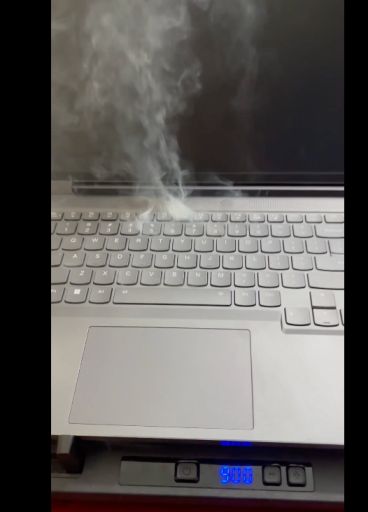
“I took literally every measure possible to ensure longevity but it only lasted 2.5 years. I guess deliberate action is still inferior to God's plan.”
When a $4,000 investment requires actual divine intervention to survive, a basic twelve-month warranty is just a corporate countdown timer.
Razer commands the highest price ceiling in mobile PC gaming, yet their baseline safety net matches the cheapest budget computers.
The real hazard is the sheer velocity of out-of-warranty invoice costs. Because Razer maintains strict proprietary control over spare components, independent shops are starved for parts.
consumers documented out-of-warranty diagnostic bills regularly topping $1,500 for standard motherboard swaps.
“The laptop was bought brand new for $2200, the screen went blank so I send it in for out of warranty repair, and here is my repair bill!!”
.jpg)
This intense post-warranty pricing has caused online gaming communities to actively push prospective buyers toward alternative brands.
So what would future-you tell Mark to do differently?
The first move is simple. Stop treating the warranty length on the spec sheet as the whole answer. Duration matters, but the exclusion list matters more, and the gap between what the manufacturer covers and what your laptop actually faces is where most owners get burned.
The second move closes that gap. A third-party extended plan sits inside that exact territory. Spills, drops, swollen batteries, cracked hinges, even the cosmetic blemishes a technician would otherwise use to deny your claim. All covered. No Customer Induced Damage loop.
And this way Mark’s 14-month nightmare becomes an avoidable story instead of a permanent regret.
.jpg)


.jpg)
.jpg)