


"Culture eats strategy for breakfast" is one of the most common quotes in business circles.
Peter Drucker gets the credit, but it was Mark Fields, who had it taped to his office wall at Ford years before he became the company's CEO. His point was simple: the best strategy in the world dies on the vine if the culture underneath won't carry it.
E-commerce has its own version of that appetite. And if you're running on BigCommerce, it's- “operational challenges eats your marketing strategy for breakfast.
Take the example of a webhook system. Its job is to notify sales channels about changes in the inventory system. But if its success rate dips below 90% in any two-minute stretch, BigCommerce blocks it for three minutes. The platform tries to reconnect 10 times during the next 12 hours, but if the issue persists, whatever that webhook was carrying vanishes into thin air. On a platform where the average order value is $137 that's real money slipping out the back door, with no alarm telling you to go find it.
Then there's the newer Feedonomics Surface integration built by BigCommerce, which automatically pushes your product listings to ad channels. Describing the experience, one merchant wrote:
"We're a higher-tier BigCommerce account... After integrating the new Feedonomics app, it's been one problem after another. Our support ticket has now been open for nearly three weeks with no resolution. Initial issues included product titles being pushed to Meta with variant data, which was manually fixed by support. Then our Meta Commerce Manager isn't recording pixel conversions at all, even though Business Manager is correctly receiving pixel events."
These are just a couple of issues that can quickly turn into bad dreams.
There are many more that can play the spoilsport. However, with small fixes, you can keep them from ever getting there.
Read the message a bewildered buyer got from his retailer when he completed a purchase:
“The screen has been double sold, and been shipped out already I don’t know how that happened. Must’ve been some kind of glitch in the system of eBay. Can you please request for cancellation of this transaction? Sorry for the inconvenience.”

Don't jump to conclusions, though. The retailer's dashboard didn't hallucinate another screen the way an AI chatbot invents facts when it cannot find the answer.
Fetching all the details of a 5,000-item catalog takes a hundred trips to the BigCommerce database, because it can only return 50 items at a time by default. Run an inventory app and an ad feed down that same road at once, and their combined traffic crowds the shared hourly ceiling of 20,000 to 60,000 requests.
So the stock count wasn't wrong; it was just late to update. And you can't afford to ignore that lateness. Every such incident can cost you somewhere between $114 and $380 once you count the refund and the reputational damage from the review that usually follows.
You'll be surprised to know you don't need to upgrade your plan to fix that. BigCommerce allows you to increase the list request to up to 250 items. Once you've done that, the same catalog needs only 20 trips. Another thing you can do is stop letting each app guess the inventory stock at its own convenience. Let BigCommerce tell them instead: a webhook fires the instant a sale happens, so every app moves off the same signal at once, instead of three clocks slowly drifting apart.
A late inventory count, at least, leaves a shelf you can go to recount. A chargeback leaves nothing to recount at all, only a fight you've already lost before you knew it started.
Ask a merchant what a chargeback actually costs, and they will probably name the fee first. But there are more consequences than just that.
As you must be aware, BigCommerce only provides the platform to sell the products, and for them, the transaction ends there. Every post-purchase dispute happens entirely inside your own payment gateway. BigCommerce even admits that if you win a dispute, you don't get the chargeback fee back. Stripe walks away with its $15, and PayPal keeps its $20. Once you add in the lost goods and the hours spent proving your case, Mastercard puts the real, all-in cost of a single chargeback near $110. But the fee is not the end.

As one merchant revealed what it costs beyond money:
“A month later, I still got hit with a chargeback for “unauthorized transaction.” The funds were frozen and I spent days piecing together evidence stressing over this whole ordeal, plus submitting the whole evidence and waiting days for an answer.”
This is hardly the first time merchants have run into this problem. Some have become so familiar with it that they have built entire operating procedures around it, a trend we explored in The Chargeback Wars.
And, like them, you could avoid it too. All you have to do is export your Stripe and PayPal dispute data every week, or have your developer wire Stripe's dispute webhook, so an order gets tagged as disputed the moment a case opens. Why?
Because Stripe only gives you 7 to 21 days to respond before the case closes in the cardholder's favor, catching it early is what actually gives you a chance to contest it, before you lose access to your own funds.
Beyond the Stripe calendar, the email hurdle awaits you. And it prevents you from reminding your customer about their incomplete order.
You might be having a hard time believing an email could ever be the thing capping your growth. But undelivered emails really can.
An email is one of the easiest methods to remind a customer to complete a purchase they've abandoned mid-cart. It costs almost nothing to send, and ‘if’ it does its job, it can bring back $10.34 in revenue on average. Make the send AI-optimized, and that figure rises to $18.90 per email.
That “if” is where the money starts slipping away. One business owner saw it happening firsthand:
“Since I’ve made the automation live, I know for a fact that I’ve had customers who are subscribed to email marketing come to my site, add things to their cart, and then leave the site without making it to checkout. For some reason no emails have triggered at all.”
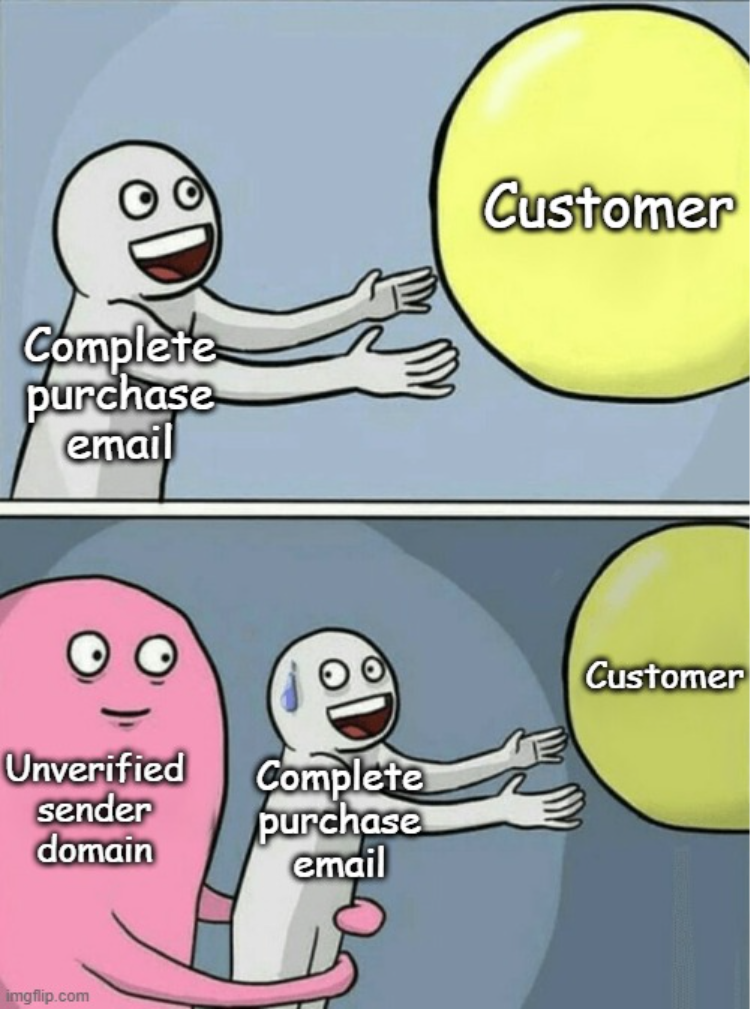
So, what exactly is stopping those emails from reaching the customers?
Email authentication has been a part of the deliverability game for years, but the rules around it have become increasingly strict. In 2024, Google and Yahoo began enforcing stricter requirements for senders including domain authentication. Microsoft followed 16 months later, enforcing from May 2025. Instead of routing non-compliant messages to spam, where a customer might still stumble on your email reminder, they could be blocked from arriving at all.
None of this calls for a redesign. It calls for proving to email providers who's actually sending your mail, the same way a passport proves who's standing at a border before they're allowed through. Have whoever manages your store's email confirm that proof is in place across every sender touching your domain, order confirmations included.
Get that right once, and the reminder BigCommerce already sends finally gets to do the one job it was built for.
Email authentication is about proving who sent a message. Your order systems have a different identity problem: remembering what happened after a customer placed it.
Check your feature list, and BigCommerce says it does quotes but only on the B2B version. That means a buyer can also ask for a custom price and even negotiate it before placing an order. But that negotiation only became properly flexible in 2025, when the platform introduced its Configure Price Quote system, giving sales teams a faster way to build and adjust those quotes.
So even with a quoting tool in place, a lot of the surrounding work still happens manually. McKinsey found that non-selling activities consume close to two-thirds of the average sales team's time.
Returns have identical blind spots, under a different name. BigCommerce seemed to notice this back in 2020, it brought in Happy Returns specifically because its own tool couldn't manage a return start to finish. A simple refund still closes itself in minutes; there is nothing to remember. But add a warranty check or a supplier sign-off, and the return needs to remember which step already happened and who approved it, which is exactly the kind of memory BigCommerce doesn't keep. So, somebody has to reconstruct the story by hand instead.
This does not show at fifty orders a month. At five thousand, the cracks become impossible to miss: each tool is holding its own fragment of the same customer's history, and none of them are comparing notes.
Solving it starts with prioritizing, not rebuilding. Connect the tool costing you the most, usually the return tool, to an app that writes its status back into the BigCommerce order itself. That way the history lives on the order instead of being scattered across an inbox and a spreadsheet. Start with returns, since it's the one place a customer notices the missing memory in real time, mid-complaint, rather than somewhere quietly buried in the back office.
None of these issues make BigCommerce a bad platform. They make it a real one, and real platforms run on upkeep, not perfection. The same way a car doesn't need a new engine every time the dashboard lights up. Sometimes it just needs the oil changed.
The merchants who stay ahead of this aren't necessarily spending more or hiring better developers. They have something much less exciting: a calendar reminder.
Once a month, give someone half an hour to ask what changed. Did an app get added? Or did a workflow change?
That's not glamorous work, but neither is checking the oil. What matters is doing it before something breaks. The same thinking applies after the sale, where SureBright helps merchants add protection without creating another system to babysit.
See how SureBright can help you turn post-sale protection into another layer of value for your customers.


Pushpender enjoys exploring the stories behind everyday decisions. He writes about warranties, ecommerce, and the psychology of buying. He draws on internet research, lively conversations, and a curiosity for the details most people overlook. With a background in English Literature, he believes good writing isn't measured by how complex it sounds, but by how effortlessly it helps someone understand a complex idea. Outside of work, you'll usually find him reading fiction and history, striking up conversations with people from different walks of life, or jotting down ideas inspired by both.