.jpg)


You knew better.
You did the research. Watched the YouTube reviews. Read the Reddit threads. Compared bodies, lenses, and dynamic range charts like it was your job.
But then you also told yourself, ‘I’m careful. I don’t need a warranty. I won’t be that person.’

One day you’re on a trip. You’re lining up the perfect shot, feeling like you’re about to submit something to National Geographic. You shift your weight, and then gravity humbles you.
Your camera hits the ground, and your screen is shattered. You know that the manufacturer’s warranty won’t cover this.
If you had opted for a camera warranty earlier, would you have avoided the panic?
Let’s find out.
Modern cameras are not tanks. They are precision electronics packed into compact bodies, paired with lenses that cost a lot of money. You know this, of course- you paid for it.
And statistically, this is not bad luck.
40% of camera failures are due to accidents. These could be from dramatic falls or just regular drops, spills, and everyday mishaps. And this stat means that accidental damage is not rare. It is part of normal ownership, especially if you travel, shoot outdoors, or use your camera often.
Most of the time, accidents aren’t because of reckless behavior. Most people don’t wake up and go skydiving with their unsecured DSLRs.
Most accidents actually happen because of:
These mishaps can happen anytime and anywhere. And yes, to anyone.
You can’t frame your camera on the wall. They’re meant to be taken around with you and used. And the problem isn’t only that accidents happen; it’s that manufacturer warranties for cameras don’t do much.
Most camera manufacturers like Sony and Fujifilm include a 1-year limited warranty. It sounds reassuring, until you actually need it.
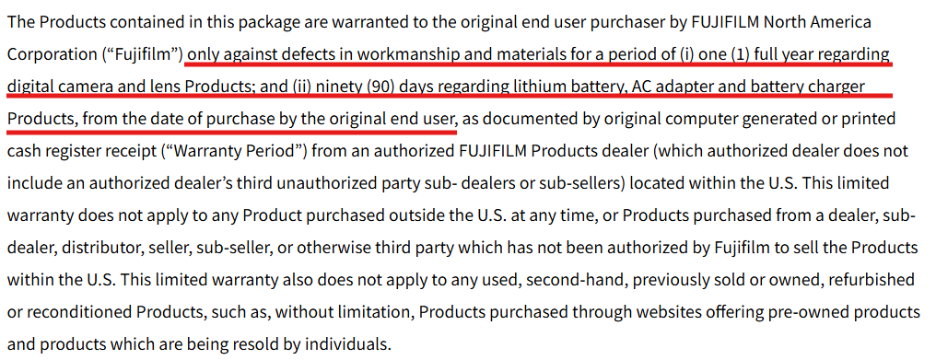
Caption: The actual terms of Fujifilm’s manufacturer warranty
So if your camera survives the factory but not your backpack, the standard warranty politely steps aside and leaves you to deal with the aftermath.
This is when many people realize that a manufacturer's warranty is designed to protect the brand from direct liabilities, not protect you from real world use.
Third party camera warranties fill the gap that manufacturer warranties create by giving you more coverage for a longer duration.
Providers for these usually have two main plans: extended warranties and accidental damage warranties.
The extended plans give you more coverage than manufacturer warranties and even covers wear and tear. Accidental warranty plans cover all this and also damages like:
In addition to the extra coverage, providers like SureBright manage the claims process end-to-end, so you don’t have to be as involved. Their goal is simple: to reduce stress for you after something goes wrong.
Insurance usually covers a very specific set of conditions and failures, even if they say they cover theft and accidental damage.
“I have about $15k worth of camera gear. My USAA policy covers theft, damage, or ‘lost’ worldwide, but mechanical failures aren’t covered.” - A frustrated photographer on Reddit.
A lot of the claims processes for insurance aren’t that great either. An exasperated user on Reddit learnt this the hard way:
“What is the point of insurance when I can’t use it? Company denied insurance for filing a claim. My insurer just denied renewal after a claim.”
These are not rare edge cases. These are professionals who assumed insurance would be there, only to find out too late that it was not.
Good camera warranties, on the other hand, cover everything, from the cost of components to labor and shipping costs.
The difference between each type of protection becomes clearer when you compare the coverage they provide.
Your camera is not a museum piece. It is meant to travel, create, explore, and occasionally survive mistakes.
Manufacturer warranties do not account for real life. Insurance is not designed for everyday accidents. And assuming nothing will go wrong is optimistic at best. And from what we know, hope is not a strategy.
Protection plans exist to support you when life happens, gravity wins, and you want to focus on your next shot instead of your bank account.
The best warranty providers understand that the memories you make are priceless, and they help you by protecting the gear that helps you capture those moments.



.jpg)

.jpg)