

Tl;dr - In October 2025, Spotify opened its full ad inventory to Amazon DSP and Yahoo DSP buyers for the first time, giving ecommerce sellers programmatic access to 700M+ listeners powered by Amazon's shopping data. The headlines made it sound like a plug-and-play goldmine. The reality is more complicated. Amazon's managed-service DSP requires a minimum spend of $50,000. Even self-service through an agency typically starts at $10,000–$35,000/month, a wall most sellers never get past. The channel genuinely works. But not for everyone, not right away, and not without knowing what you're walking into.
It is October 2025. Spotify drops an announcement. Marketing Twitter lights up. Ad tech newsletters go wild. The headline is almost too good: Amazon and Yahoo DSP buyers can now access Spotify's entire ad inventory: audio, video, display - all from their existing dashboards. Powered by Amazon's first-party shopping data. Targeting 700 million monthly listeners!
For ecommerce sellers, it read like a gift.
The promise was simple: the same data that makes your Amazon campaigns work (the purchase history, the browsing behavior, the abandoned carts) could now follow your customer into their morning run playlist.
Everyone shared it. A few people bookmarked it. And then... most sellers went back to tweaking their PPC bids.
Well, that's what happens when a genuinely exciting channel meets the reality of what it actually takes to use it.
So, this isn't the announcement article. Those were written in October. This is the follow-up nobody published: what the deal actually meant, why most merchants still aren't using it, and whether you should do it or not.
Before 2025, getting your brand onto Spotify required going through Spotify's own self-serve tool (Spotify Ads Manager) or working directly with their team.
That worked fine for some. But for ecommerce sellers already running sophisticated campaigns through Amazon DSP or Yahoo DSP, it meant managing separate platforms and data streams with separate reporting.
The efficiency just wasn't there.
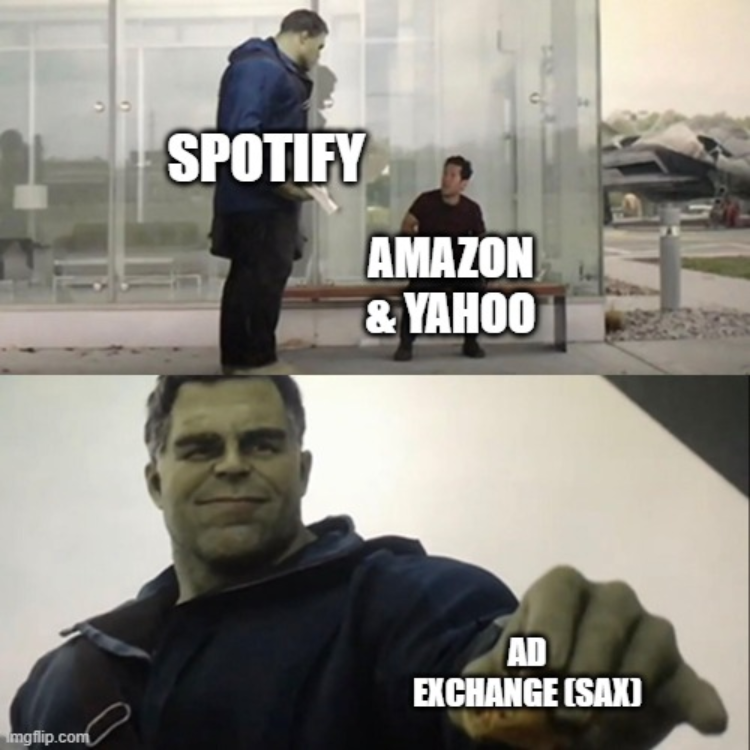
So Spotify launched its Ad Exchange (SAX) in April 2025, initially with The Trade Desk and Google's DV360. Amazon and Yahoo integrations expand that marketplace further, giving even more advertisers programmatic access to Spotify's inventory.
To understand why this became such a big deal, let's quickly explain what a DSP actually is because this term is going to get thrown around a lot.
DSP = Demand-Side Platform. Think of it as a single "buying desk" where advertisers can purchase ad space across dozens of websites, apps, and platforms automatically, in real time, at scale. Instead of going to each platform one by one, a DSP handles it all from one dashboard. Amazon DSP and Yahoo DSP are two of the most powerful ones in the market.
So when Amazon DSP connected to Spotify's inventory, what you actually started getting is the ability to reach Spotify listeners using Amazon's data to target them all without ever leaving your Amazon Ads interface.
This integration is already live across nine major markets: the U.S., U.K., Canada, Germany, France, Italy, Spain, Brazil, and Mexico - with more countries being added in 2026.
On paper, the timing was perfect. Since Spotify's Ad Exchange launched in April 2025, the number of advertisers using it surged by 142%. Yahoo DSP beta testers reported numbers that made performance marketers raise an eyebrow: conversion rates improving by nearly 70% and cost per action dropping by almost 90%.
That’s one question no one has asked since the update. But we are asking it. So, here's what the press releases didn't mention.
The entire appeal of this deal: Amazon's first-party shopping data powering Spotify targeting, lives inside Amazon DSP. And Amazon DSP has a price of entry that most sellers never see coming.
Amazon's managed-service option typically requires a minimum spend of $10,000. Even the self-service route, accessed through an approved agency partner, requires a significant financial commitment, with most agencies recommending at least $10,000–$35,000 per month to run campaigns that actually generate meaningful data.
For many small and mid-sized businesses, this spend threshold makes Amazon DSP completely inaccessible.
Some agency partners have lowered that floor, a few offer DSP access starting around $5,000/month, but that still puts this firmly out of reach for the average Shopify or early-stage Amazon seller who's spending a few hundred dollars a month on Sponsored Products and calling it a day.

Even if you clear the budget hurdle, there's a creative problem waiting on the other side.
Ecommerce sellers are built for visuals like product photos, comparison carousels, and lifestyle images. You resize assets for different placements, tweak copy, and swap headlines. The workflow will be familiar.
Audio is a completely different muscle. A Spotify ad is a 15–30 second script. Spoken. By a human voice. With a hook, a product mention, a CTA, and a tone that fits the listening moment, all without a single pixel to lean on.
And let’s talk about a few numbers to better understand this.
Human voices outperform AI voices by 34% in trust perception, and ads under 20 seconds have the best completion rates. That means the bar for quality is real. A flat, corporate-sounding script read over generic background music will not only underperform, but it can actively damage brand perception in a high-attention environment where the listener is just focused on hearing.
This one is the sneakiest barrier of all, and it affects even the sellers who manage to get campaigns live.
Ecommerce advertising has trained merchants to expect a tight feedback loop. You spend on Amazon PPC, you see clicks, you see orders, you calculate ACoS. The cause-and-effect is almost immediate.
A November 2025 survey found that 55% of advertisers say measuring ROI is their single biggest barrier to investing more in audio advertising. So, it is not cost, not creative, not technical complexity but measurement.
Sure, it is not hard to find measurable results, but other platforms do it better.
There's a broader issue underneath all of these practical barriers: most ecommerce sellers have been trained to think transactionally.
Amazon PPC is keyword intent. Someone types what they want, you show up, they buy. It's direct and gives fast-feedback. Spotify is the opposite. It's emotional, contextual, and slow-burn. Your ad plays while someone is feeling good. They're not in shopping mode. You're not capturing demand. You're building it.
For many categories, it's actually the stronger long-term play. But it requires a completely different campaign philosophy, and most sellers don't have anyone in their corner who's built that kind of thinking into their ad stack.
The people winning with this channel right now tend to share a few things in common. They're not all big brands. But they're not first-time advertisers either.
There's something Spotify keeps saying in its advertiser materials that's easy to dismiss as marketing spin but is actually backed up by research: the attention quality on this platform is genuinely different.
65% of Spotify users say time spent on the platform feels more positive than time spent on social media. Users stream an average of 2.5 hours per day, and 51% of free-tier users say they pay more attention to Spotify ads because they feel more relevant and tailored.
Think about what that means for your ad. It's not competing with 47 other posts in a doomscroll. It's not a pre-roll someone is counting the seconds on. It's playing while someone is in a good mood, doing something they chose to do, with their phone in their hand and nowhere else to be.
But here's the other side of that coin: the same intimacy that makes the ad experience better also raises the stakes for bad creative. A lazy audio ad in a high-attention environment can actively annoy. And because there's no visual to anchor it, everything rides on the words, the voice, and the 30 seconds you get. There's no room to hide behind a good product photo. And if you do it really badly, your leads can react like this Redditor:
“Currently listening to the show on Spotify and I hate how Geek and Sundry uses ads. I already pay for premium not to deal with them and now I am stuck with those freaking ads anyway. I hate how they can put the show on halt and break the flow, but I especially hate the tone of some of them.”
When audio and video ads are combined in a Spotify campaign, third-party research shows a 7% lift in brand awareness and a 27% lift in purchase intent compared to audio alone. So the format ceiling is high. But getting there requires creative investment most sellers aren't used to making.
The thing about channels is that they are hard to access: the difficulty is what keeps them underpriced.
Right now, the Spotify auction via Amazon DSP is relatively uncrowded. Most sellers are still debating whether to try it. The Spotify Ad Exchange has grown 142% in advertiser adoption since April 2025 - that sounds like a lot until you remember how small the base was at launch. There is still meaningful first-mover advantage available in most product categories.
That window doesn't stay open forever. The same thing happened with Amazon PPC in 2018, with Facebook ads in 2015, with Google Shopping in 2012. Every channel has a golden period when reach is high, competition is low, and early movers build brand recognition that compounds for years. Spotify via DSP is in that window right now.
Beyond timing, there are structural reasons this channel is going to matter more, not less:
Starting in 2026, Megaphone-hosted podcast publishers will be able to book private marketplace deals through the Spotify Ad Exchange - opening a completely new tier of inventory that combines Spotify's audience targeting with the trust and engagement of podcast advertising. That's a significant expansion of what this channel can do.
Third-party cookie deprecation is also making first-party data partnerships like this rarer and more valuable. Amazon's shopping signals are among the richest behavioral datasets in commerce. The ability to reach people on Spotify using that data is not something you can replicate on most other audio platforms.
We know, not every seller needs to jump into Spotify ads, and that’s a good thing. This channel works best when it’s used with the right intent, not just because it’s new or trending.
Spotify removed a layer of friction that kept a lot of ecommerce sellers out of premium audio and video advertising.
You no longer need to stitch together multiple platforms, guess attribution, or treat streaming ads like a branding-only play. With Spotify inventory now sitting inside Amazon and Yahoo DSPs, this becomes something performance-driven, measurable, and most importantly, actionable.
If you’re already investing in acquiring customers through channels like Spotify, the next step is increasing the value of every single conversion.
SureBright helps you do just that.
Instead of letting that hard-earned sale end at checkout, we give you the opportunity to turn it into a higher-value transaction by offering extended warranties and protection plans directly within your purchase flow. It’s a simple way to boost revenue per order, improve customer confidence, and create a better post-purchase experience, without adding operational complexity.
Q: Do I need a huge budget to advertise on Spotify via Amazon DSP?
A. Amazon DSP typically requires a minimum spend (often $10,000+/month for self-service). However, Spotify Ads Manager offers a more accessible self-serve option with lower entry budgets, starting around $250.
Q: What's the difference between Spotify Ads Manager and Amazon DSP buying Spotify inventory?
A. Spotify Ads Manager is Spotify's own self-serve platform. It is good for smaller budgets and direct control. Amazon DSP buying Spotify inventory is a programmatic layer that uses Amazon's data signals for more precise targeting, suited for larger, data-driven campaigns.
Q: Are Spotify ads effective for ecommerce?
A. Early data is promising. Beta testers of the Yahoo DSP integration saw conversion rates improve by about 70% and cost per action drop by about 90%. Web Traffic campaigns on Spotify Ads Manager show 103% higher page view rates vs. standard brand awareness campaigns.
Q: Will Spotify ads appear on the free tier only?
A. Primarily yes. Spotify Free users see/hear ads. Spotify Premium subscribers have an ad-free experience. However, sponsored sessions and certain video placements can appear even within free-tier engagement windows.
Q: What kind of creative do I need for Spotify audio ads?
A. A 15–30 second audio script with a clear CTA, read by a voice artist or generated with Spotify's creative tools. Spotify's Ad Studio can help create audio ads even if you have no existing assets.
.jpg)


M Khizar is a writer enjoys making complicated things feel simple. He writes about warranties, ecommerce, and the small details people usually overlook, until they matter. His work focuses on clarity and helping readers make smarter decisions without overthinking it. Outside of work, he enjoys reading, writing personal blogs, and binge eating with friends.


.jpg)