You know that feeling right after buying an appliance, when you are already a little drained by the amount you just spent?
That is usually the exact moment the warranty shows up.
And most people react to it the same way. Not with excitement. More with a quiet, slightly irritated- “Please, not one more thing.”
You tell yourself the appliance is new. It should last. You are careful with your stuff. And anyway, if nothing is wrong right now, why pay extra?
That logic definitely feels reasonable in the moment. Honestly, it is the kind of logic most of us use when we are tired, done spending, and just want to get on with our lives and enjoy the excitement of the new appliance in peace for five minutes.
And thus, this totally fair chain of thought makes it much easier to brush aside the warranty part.
The gap shows up later, when “I probably do not need this” runs into how much appliance trouble actually costs. (Hint- most people spend up to $3,500 for a single time repair or replacement).
It usually shows up as a repair bill, a full replacement, or accidental damage, and it always arrives when you’d have wished to avoid it.
And for this exact reason, options like an extended warranty show up at checkout in the first place, to give that wish a better plan than just hoping for the best.
So, let’s unpack why warranty feels so non-essential at first, even when that feeling does not age very well. And, how cost-effective it can be compared to other options.

Yep, once the full amount shows up, it can very quickly push past your budget and start poking its nose into the money you had set aside for emergencies or a vacation.
Because replacing an appliance is rarely just about paying for another machine. You may also be paying for:
And whatever small unpleasant surprise bill shows up once the old unit comes out and the new one goes in.
Speaking about additional delivery costs - Best Buy for example, lists appliance delivery starting around $39.99, with some refrigerator setups going much higher when installation or a new waterline is involved, and notes that final cart prices may still include additional required parts.

So, by now you know that the number you first see is often just the tipping point, as what comes next is often more taxing.
And that is the “getting your life back to normal” cost.
Because depending on what breaks, the mess is never just financial.
A fridge problem can mean spoiled food. A washer issue can turn into laundry piling up like it has a personal grudge against you. And a broken oven during the holidays...geez!

That is basically how one appliance turns the whole family into a complaint committee, because appliances have a weird talent for failing at the worst possible time.
So, when people say, “I’ll just deal with it later,” what they usually imagine is one neat future expense. What they often get instead is a stack of smaller, uglier costs that show up all at once.
And that’s why replacement cost almost always feels bigger in real life than it did in your imagination. Not because you are bad at math, but because you are usually only counting the appliance cost, not everything that comes attached to the problem.
So, when is the right time to be cautious and act?
Right before something breaks!

If you are regretting not choosing a warranty plan, do not panic. You may already have some coverage through the manufacturer, and you may still have time to add protection beyond that.
There are three types of appliance warranty;
Manufacturer warranty, or the one that comes with the appliance and quietly presents itself as “free,” which sounds generous until you realize the coverage is often limited, time-bound, and full of terms you probably did not read because you were busy buying a refrigerator, not preparing for a law suit.
An extended third party-warranty, which you usually choose separately, keeps the protection going after the manufacturer warranty taps out. Depending on the plan, it can also help with later breakdowns , which is where “free coverage” often gets a little shy.
And then there is accidental warranty, which covers the kind of damage people actually worry about once the appliance is inside a real home and not sitting safely in a showroom. This usually includes, but is not limited to-
Here’s a brief faceoff between the three in the comparison table given below. So that you have more clarity.
It is true that household appliances checkouts are already expensive, and if that is your reason for skipping warranty earlier, Surebright gives you a little breathing room.
As the platform offers extended warranty up to 30 days post purchase.
So, as mentioned earlier - do not fret already as you still may have time to extend protection beyond manufacturer warranty.
And once you do get it, you’ll see how - warranty saves you stress, surprise costs, repair bills, replacement pressure, and in many cases, far more money than it seemed to cost at checkout.
Think of it like choosing LED bulbs over the cheaper ones. At checkout, the better option can feel like an unnecessary extra. Later, when the cheaper one fails sooner and you are paying again, that upfront cost makes a lot more sense.
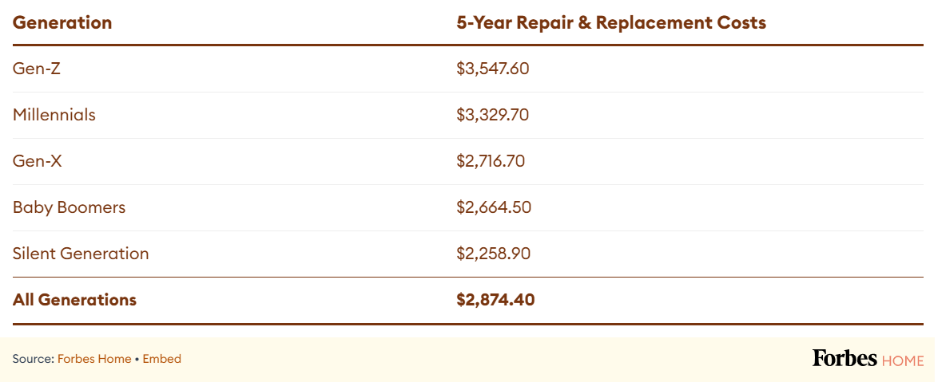
As 94% of homeowners had to repair or replace a major appliance in five years in the U.S., and that cost them anywhere from $2,258 to $3,547, according to a Forbes survey.
So, if you are still wondering whether a third-party appliance warranty actually saves money, the numbers are not exactly subtle.
The plans currently show pricing from about $19 to $449, depending on the product and coverage tier. Put that next to the $2,258 to $3,547, and the gap gets very real, very fast.
In percentage terms, that means a covered issue could leave you avoiding roughly 80% to 99% of that expense. Even a $159 of any extended warranty plan would still work out to about 93% to 96% less than taking that full hit yourself.
And honestly, that is the kind of math that feels a lot more convincing when it is your fridge, your washer, or your oven acting up.

Paying a smaller, planned amount now is annoying, sure. Paying thousands later, unexpectedly, is the kind of annoying that sticks with you.
So no, this is not really about being overly cautious. It is about looking at a possible four-figure problem and realizing you may be able to cut most of that cost, sometimes by more than 90%, with a warranty that costs a fraction of the repair or replacement bill.
And once you see it that way, an extended appliance warranty stops looking like an add-on and starts looking like one of those decisions your future self will be very relieved you made.