TL;DR: How do you build a new product without jeopardizing your existing business? This blog breaks down how to take calculated risks without overwhelming your most limited resources: your time, your team, and your best-performing products. Afterall, the goal is growth without undoing what you’ve already built. So, before you test another landing page or run another survey, ask a harder question: does this product deserve a place next to what’s already proven? Because most failed products silently drain your time, focus, and capital. So test small, test within validated channels, and stop following playbooks as if you’re starting from zero.
What if you replaced a product people had loved for 99 years with something new because a competitor’s product was performing better?
Sounds risky, right?
But that’s exactly what Coca‑Cola did in 1985. Pepsi was winning taste tests for a sweeter Soda and gaining market share. So, Coca‑Cola too developed a sweeter formula, tested it on 200,000 consumers, and replaced the original Coke entirely.

Billboards proclaimed: “The Best Just Got Better!” The company spent $4 million on the launch. Initial sales looked promising. Blind taste tests showed 61% preferred the new formula.
But soon, angry phone calls flooded headquarters. Customers hoarded cases of original Coke. News crews filmed protests outside bottling plants.
Within 79 days, Coca‑Cola brought back the original formula as “Coca‑Cola Classic.” The reversal cost $34 million in development and unsold inventory.
So, what went wrong? Didn’t they have the world’s best resources and sales instinct that could have never gotten to make that big a disaster.
Coca‑Cola focused on taste metrics while ignoring how their product had become part of customers’ daily rituals.
Everyone is susceptible to the pull of shiny new products. But if you already have a successful venture, the risk isn’t limited to launching something that fails. It’s equally launching something that works just enough to distract you from what's already working.
Most merchants with a few years of experience behind them have absorbed enough precarity to recover money. Maybe even a bad inventory call, a failed ad test, or even a supplier that doesn’t work out.
While these are painful setbacks, they're fixable and for experienced business-owners even somewhat predictable.
But the other side to this is when a new product sells just okay, but still eats up your cash flow on a slow burn mode, cannibalizes some of your existing ROI, either drowns you in returns and a team that is now or splits your team across more problems than what they can handle.
When you’re already running a profitable business, your attention is the scarcest resource. Every minute you spend sourcing samples, briefing designers and teams, or testing a new product page is an hour not spent on away from theyour customers, margins, and channels that are already providing returns.
To put things into perspective….
Puzzle Ready was a single-product ecommerce business that sold jigsaw puzzle boards built by Neil Jervis. By 2021, it was doing $3 million in annual revenue. They made 99% percent of sales through Amazon FBA.
However, Jervis recounts not sleeping well.
On the back of his mind were anxieties regarding massive inventory orders months before the holiday season and the projections were scary. When sales boomed during COVID, rather than feeling relieved, he worried about what would happen when lockdowns ended.
To top it all, he went through the familiar what ifs facing every founder: the shipping costs, factory delays, Amazon algorithm changes, and competitors.
So even though his business was thriving, the mental load was exhausting him. Eventually, Jervis sold Puzzle Ready to eBrands. The acquisition closed in December 2021. Puzzle Ready sold for a seven‑figure sum, with a multiple of 6x profit, 3.5x paid upfront, and the remaining 2.5x tied to performance over the next year.
Jervis’s experience is a proof that time and effort are the most important resources for merchants – sometimes even more than the product. So, the first step to testing a product isn’t thinking whether it is good. Or whether there’s demand. It is defining your future success metrics and setting a limit to your investment in terms of time, money as well as bandwidth.
And most advice on product validation before launch can be grouped into the following clusters:
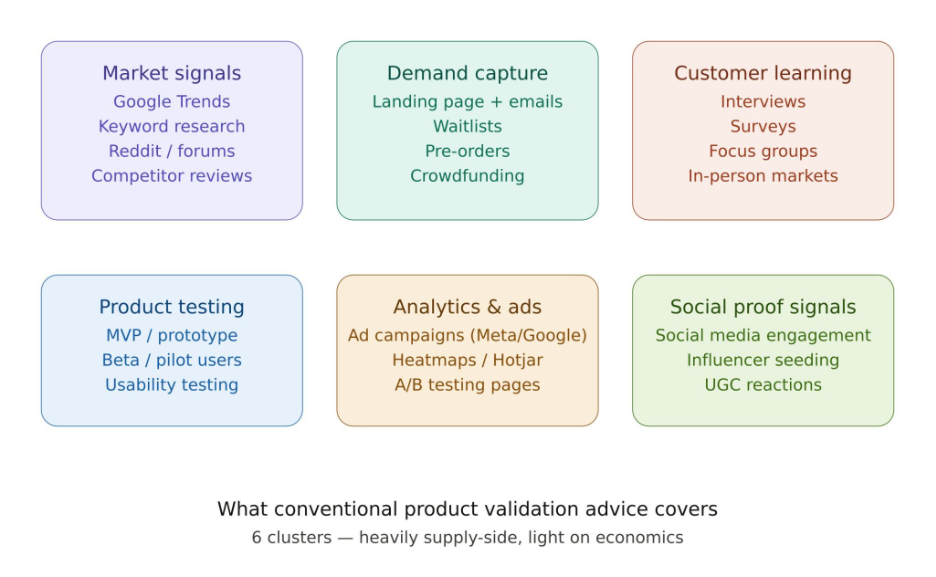
However, the biggest blind spot in virtually all this product validation advice is that it treats “people want this” as equivalent to “this is a viable business.”
Confusing consumer appetite with commercial viability is precisely how Coca-Cola watched $34 million in development and dead inventory vanish into the void in just 79 days.

When you look past the surface-level hype, the cold fundamentals of business begin to reassert themselves and expose crucial gaps:
The first gap: The Mirage of the Willingness to Pay
You have a product idea that people say they want, and your survey data or waitlist numbers look electric. But there is a massive chasm between a spoken desire and the psychological friction of an actual transaction. A landing page test with a “Coming Soon” email capture might show a 20% interest rate, but that will never tell you how many of those people will balk when faced with a $79 price tag and a shipping fee.
The second gap: Channel Intelligence
To validate your data, it is important to select the right channel because a channel that has worked for your existing products might not work for your new one. Smart merchants avoid this noise by using the Bullseye Framework - a disciplined system that filters dozens of potential marketing channels into the 1-2 that drive real growth. It moves your strategy from hopeful guessing to systematic selection, ensuring you only scale the channels that your unit economics can actually support.
The third gap: The Retention Dilemma
Repeat purchase. A one‑time purchase product with high acquisition costs is a completely different business than a consumable with strong repurchase rates. That distinction must be tested before you ever order inventory, because if your CAC is higher than your profit on the first sale, you aren't building a business, you’re subsidizing your customers' lifestyles. Ideally, your data should show early signs of LTV (Lifetime Value) expansion during testing.
The fourth gap: Price Point Delusion
There is a psychological canyon between a “yes” in a survey and the friction of a real checkout. Survey data is often a collection of aspirational lies; people like to imagine themselves as customers right up until they have to part with their money. In 2026, with inflation-weary consumers and instant price-comparison tools, willingness to pay remains a theory until the first payment clears. If your survey suggested $45 but your abandonment rate is 85%, you aren't looking at a technical glitch, you’re looking at the gap between a polite opinion and a financial sacrifice.
The fifth gap: The Logistics Conundrum
Supply chain and minimum order quantities can become a roadblock. Product validation is not a simple yes or no question about demand. And if you already have a successful business, the question is bigger: does this product fit into the business you’ve already built, or does it demand a whole new set of economics, channels, and operational complexity?
At this point you already know the standard metrics for a profitable business-
So when you’re thinking about a new product, ask yourself, where does it fit into that picture?
If you currently convert at 3.5% and your new product’s test page is struggling at 1%, it might be more than a traffic problem.
Like a user on Reddit shared
“It totally depends on your vertical and market but globally, a 3% CR is common.
Performance marketing is HARD to make work now, CAC is sky high and climbing.
You simply cannot rely on it for the bulk of your traffic as its unsustainable, especially if you have poor unit economics otherwise. It's like marriages, most end in divorce.”
Once you’ve cleared the internal audit, you move to the live test, a real-world peek at how people behave when they are asked to sacrifice time or money for your offer. For a new launch or a new business, you aren't just looking for “clicks”; you are looking for Product-Market Resonance.
Following are some diagnostics for your live-market test:
1. The Jobs To Be Done (JTBD) Filter
Before obsessing over your click-through rate, ask: What “job” is the customer hiring this product to do? If your Click Through Rate (CTR) is lower than your usual campaigns, it’s rarely a creative problem, it’s a misalignment of the job. You might be pitching a nice to have when the market is looking for a must have.
2. Net Promoter Score (NPS) as a Growth Engine
In the early days, “intent to refer” is a vanity metric. You need to measure actual advocacy. High NPS among your first 50 customers is the only reliable predictor of whether you can eventually lower your Customer Acquisition Cost (CAC). If early adopters aren’t actively recommending the product, your marketing will always be an uphill battle where you buy every single sale.
3. The Unit Economic Ceiling
A small ad test can be useful to calculate actual CAC. For instance, if your product yields $30 in profit but costs $45 to acquire a customer, the business model is broken at the root. While you can survive a loss-leader strategy on an established hero SKU, a new product without a Break-Even path just becomes a high-priced hobby.
4. Lifetime Value (LTV) Signals
Did any test buyers come back? Did they ask about subscriptions or refills? A product that only sells once requires a massive margin to survive. A product capable of repeat revenue, however, creates a compounding effect that can eventually offset even the highest initial acquisition costs.
By measuring the abovementioned metrics, you are basically assessing consumers in real time instead of asking them what they think they’d do.
After you’ve gotten your fundamentals in place and run all the tests, you can still end up with a product that flops. The Multi‑Glider case study is a perfect example.
Multi-Glider was a 2‑in‑1 razor and nose hair trimmer. The creators tested different landing pages, refined the message, and were assured by positive numbers. They actually focussed on a real painpoint, which was the pain of plucking nose hair. When they highlighted missed spots while shaving, they hit the best positioning.
But underneath the encouraging signs, lay a weaker reality.
The cost per lead was $5.59. That was higher than benchmarks for similar products in the same price range. The email engagement was low and people subscribed but didn’t open the messages. Only 0.05% of visitors actually placed a reservation.
However, the creators moved forward believing their product was the exception.
The Kickstarter launch raised $3,081 and 46 people backed out. Naturally, the product never took off.
This tells you that benchmarks exist for a reason even if nothing is guaranteed. Experienced merchants already have them. If your new product’s signals are consistently below your own averages or below what’s normal for similar products, you must pay attention.
There is no magic formula, but when these three thresholds align, the risk shifts from gambling to investing.
1. The Unit Economic Floor: Margin Resilience
It isn’t enough for the margin to hold up on a spreadsheet; it must survive the messy reality of when you want to scale.
The Shopify Reality: Experienced merchants on Shopify forums often cite the 3:1 Rule. This means your gross margin should be at least 3x your projected CAC. This buffer is what allows you to survive the inevitable return rate, the payment processing tax, and the rising costs of shipping.
If your margin is razor-thin at the test stage, it will vanish entirely once you account for the overhead of customer support and damaged inventory.
2. The Behavioral Proof: Robust Repeat Intent
What you’re looking for in the final validation stage is dependency.
Look for early signals of LTV (Lifetime Value) expansion. Did 5% of your test group ask for a subscription? Did they ask about complementary products? If the product is a “one-and-done" with a high CAC, the business model is a treadmill. If it’s a consumable or a ritual product, it’s an asset.
3. The Scalability Ceiling: Channel Economics
You must prove that you can buy customers at a price that leaves you with a profit.
As the Bullseye Framework suggests, you are looking for Channel-Product Fit. Your Go signal is finding at least one channel where the CAC is stable even as you increase the spend.
If your test CAC was $10 because you targeted a hyper-specific audience, but scaling to a broader audience jumps that CAC to $40, your business is not a scalable venture. You commit only when the math remains solvent at 10x the volume.
All in all, to move from a gamble to a calculated investment, your “Go” signal is the alignment of resilient margins, proven repeat intent, and scalable channel economics
At the end of the day, you can run every audit, track every metric, and hit every threshold, and the product can still fail.
A Euromonitor research showed that 25% of new product launches in key consumer goods categories disappear within two years. In some categories, the failure rate hits 50%.
And these are products that got distribution, had investment, and still vanished. So, validation doesn’t eliminate risk. It just makes sure you’re building on something that actually has a chance.
PS. If you’re going to spend your time and mental bandwidth on the right new products, it helps to have a few parts of your business that run themselves.
Extended warranties and shipping protection fit solve that need perfectly. Merchants using SureBright see attach rates around 20%, a lift in conversion, and a bump in average order value, all without adding any new tasks to your to-do list.
Several of our merchant partners are open to share how they are using the extra bandwidth and income to launch new experiments and products without fearing failure, it’s a simple way to reclaim a bit of headspace.
.jpg)


.jpg)