Let the court session begin.
Our prime accused today is the Deluxe Double-High Air Mattress with built-in internal pump.
The charges? First-degree aggravated hip bruising, overnight abandonment of holiday guests, and malicious psychological gaslighting.
Every year, thousands of consumers bring this seemingly innocent piece of vinyl into their homes, thinking they’ve bought a convenient hospitality solution. But by 3:00 AM, the crime is committed. You wake up shivering, your lower back firmly pressed against the cold hardwood floor, trapped inside a plastic taco of your own making.
You know you pumped it to maximum capacity before bed. You know nobody brought a sharp object near it. Yet, when you pull up the warranty booklet to demand justice, the manufacturer makes a plea of absolute innocence.
“The mattress isn’t leaking, your honor. It’s just stretching.”

Welcome to the world of air mattress warranties, where the fine print can sometimes make you doubt your own senses. And what you’re reading above is only a scratch on the surface of all that could go wrong.
In this blog, we’re demystifying the obstacle courses built into standard manufacturer coverage. And we’ll show you exactly what is needed to close these consumer gaps, protecting your wallet and sleep.
The first rule of warranty disputes on air mattresses is simple: if the problem can be explained away, it doesn’t have to be fixed.
This defense opens with a science lecture.
Vinyl naturally expands the first few nights under your body weight, they explain, and when the bedroom cools overnight, the air inside contracts and the bed sags without a single molecule actually escaping. Both of those things happen to be true, and both make a very convenient alibi.
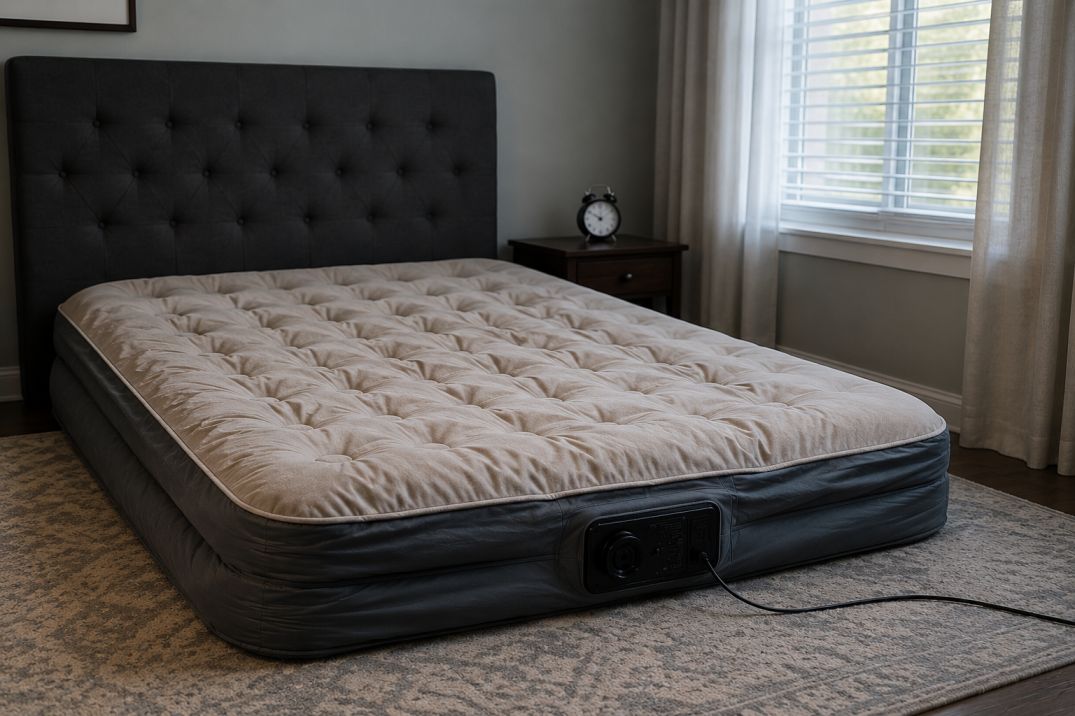
Troubleshooting research points out, a real temperature drop lowers the pressure inside and shrinks the chambers, so your early softening gets filed under “normal relaxation” and the claim is dismissed before it ever gets heard.
So how do you cross-examine a defense built on actual physics?
Well, it’s easy to prove or disprove. you just watch the pattern over a week. Stretching calms down after two or three nights, and temperature sag reverses the moment the room warms back up. A genuine factory defect ignores all of that. If the bed keeps flattening night after night in a climate-controlled room, the brand is liable.
The most common failure on these beds hides in an awkward spot, the seal around the built-in pump housing, which is the one rigid section your patch kit cannot do anything for.
One owner summed up this whole genre of complaint:
“My air mattress is leaking air, but I can't find a hole anywhere! I think it may be the built-in pump. I can hear a hard piece sliding around inside my air bed, and thinking maybe the pump broke off inside? My mattress will fill up and hold air, but it leaks rapidly. I have to add air every hour to keep from sinking to the floor by morning.”

Say you push through and demand the manufacturer to treat it as a real defect.
Repair guides lay out the drill: inflate the bed, rub a sudsy sponge over it and watch for bubbles, then sand the flocking down to bare vinyl with 150 to 200 grit sandpaper before a patch will stick.
A weekend of unpaid detective work over an invisible crime, and plenty of owners just quit. And to you, that surrender looks like the whole point.
A process tedious enough to outlast your patience is the cheapest claims filter a company will ever run.
You give up on the manufacturer and decide to simply return the thing.
The return counter says no
Target, for one, considers an opened airbed used and no longer eligible for a refund in most cases, offering an exchange at best.
Most stores will tell you it comes down to hygiene. What actually drives it is the occasional “free weekend rental” problem, where shoppers buy a bed for a holiday or a camping trip, use it once, and bring it back on Monday. To shut that down, retailers got strict with everyone. Strict, and occasionally inventive.
“I have been trying to make Walmart take back an air mattress for two months now, and they refuse.” The store manager at the Walmart on South Duff Avenue in Ames, Iowa (shout out to Leslie Hall!) has started making up new rules on when an air mattress can be returned—including that the federal government limits returns to 15 days “because of the bed bugs, you know.”
No, we didn’t know that, Walmart manager.
So you circle back to the brand’s warranty process, and the bill leaves you wondering if this is ever going to get better. This is how a customer summed up the experience:
“They only offer replacement and you have to pay $85 for shipping. ** company and customer service.”
We can only assume what fills the blanks.

Some plans make you ship the product back prepaid, use a return authorization number good for only 30 days, and pay a restocking fee. For a deflated queen, the freight alone can cost more than the bed. Most owners run that math and just give up.
As one frustrated buyer concluded after weighing the shipping, he might as well keep it.
“BY THE TIME I PAY FOR RETURN SHIPPING AND COVER THEIR SHIPPING , I MIGHT AS WELL KEEP IT FOR EMERGENCY USE. I TRULY HAD HOPED THIS WORKED OUT BECAUSE I HAD INTENTIONS OF USING IT FOR GUESTS !”
Mind you this is not a formatting error; the review was actually in all caps.
And when a claim does go through, the replacement can take close to a month to land, which helps nobody who bought the bed for one specific weekend.
The moment your air mattress meets the messy reality of everyday life such as punctures, pet claws, or a gritty garage floor, your protection disappears.
There are a lot of YouTube tutorials that help you DIY your way to mattress repairs at home.
However, taking their advice can be a financial trap.
Many major brands insert legal clauses stating that coverage is entirely voided the moment any unauthorized alterations or repair attempts are made on the vinyl.
For beds featuring a built-in electric pump, the legal landmines extend directly to your bedroom wall outlets. Operating manuals frequently contain a strict warning against running the heavy-duty internal motor via a standard extension cord. Because drawing high amperage through a thin extension cord drops the voltage and overheats the motor, a fried circuit board gives the factory the perfect excuse to reject your claim under user negligence.
Buying an inflatable bed marketed for home use and taking it on a weekend camping trip instantly voids your protection.
Basically, spending a night on a tent floor is legally classified as an abnormal environment. If the company determines the PVC was subjected to typical campsite friction or outdoor temperature fluctuations, they will throw out the claim even if the actual failure was a factory seam split.
Ultimately, the most effective barrier to a successful claim is the legal requirement to provide photographic proof of the defect. When the failure is a microscopic hiss hidden deep within the fabric flocking or escaping silently around the internal pump housing, capturing it on a smartphone camera is an impossible task.

By now you have met the whole cast. The manufacturer that blames physics, the retailer that keeps your money. So who is actually on your side?
The Magnuson-Moss Warranty Act says that once a company gives you any written warranty, it cannot take away your basic right to a product that does what it is supposed to do, which for a bed means holding air all night. It also stops a brand from forcing you to use only its own parts, and can make it cover your legal fees if you win. The problem is that such rights are typically accessed for a $40,000 car, not a $40 air bed. No lawyer will take that case, so the right just sits there unused.
This is the part where a third-party extended plan proves its worth. These cover the exact gaps this blog has walked through. The valve, seam, and pump failures, the punctures and tears a manufacturer will never touch, the receipt you misplaced and the registration you never filed, all of it sits inside the plan.
Put the money in context. A built-in pump has no cheap patch, so when it quits you are replacing the whole bed, and we already saw that shipping a dud back can cost more than the bed did.
Even premium beds sold on 25-year warranties start charging you a prorated share after only the first two years. A plan costs a fraction of replacing a bed even once.
And it fits how these beds actually get used. They might come out for guests and camping trips, then sit in a closet for months, so a slow leak often surfaces long after the manufacturer’s window has closed.
An air mattress is sold on a single promise, that it holds air. Your coverage should hold up just as well.
.jpg)




.jpg)