

Come closer and place your hand on the crystal ball.
I see… a shopper. They’re searching for your brand. They know your name and they’re ready to buy.
Wait!
Something’s appearing in the crystal… Oh dear! It’s your competitor. They’re above your website. They’re running an ad and your customer is clicking it.
The crystal ball says you’re about to lose a sale.
What I just showed you now is a classic example of brand bidding or conquest ads. To refresh, it means a rival paying Google to show their ad when shoppers search for your brand. Every search on Google triggers a tiny auction, and your store's name is one of the items up for grabs. The same happens across Amazon, Bing, & several other ad platforms.
Interestingly, the crystal ball can show the past too, and big brands were playing this game long before it reached your search results. For example, Burger King geofenced more than 14,000 US McDonald's locations. Anyone within 600 feet of one could order a Whopper for a penny in the Burger King app and get detoured to the nearest Burger King to pick it up. The promo image even swapped McDonald's famous slogan for "Billions Swerved."
That begs the question: why do rivals bother with this?
Well, without going into the fairness of it, the reason’s quite ordinary: conquest ads are one of the best performing marketing lever. Someone searching your name is the warmest shopper they can ever get. As one performance marketer put it:
"Branded will always convert better because the intent is extremely high: the user knows they want a service and they are looking for your company specifically."
And even the research supports it, with one of the studies claiming that branded search campaigns yield a 1299% Return on Ad Spend (ROAS) compared to just a 68% ROAS for non-branded campaigns.
To counter your competitors stealing your high intent traffic, plenty of merchants are forced to pay to bid on their own brand just to keep the spot- across Google, Amazon and every other ad platform.
That being said, the magic ball also promises a fix for the future.
Google lets competitors bid on your brand name, but there are rules about what they can say in the ad. And sometimes, the competitor showing up above you didn’t even choose your brand name themselves. Google’s system matched their ad to the search automatically.
So, in this guide, we'll go through what can be shut down and how to tell a deliberate attack from an accident. Then we'll also look at why most merchants who bid on someone else's brand end up paying for clicks that don’t result in any conversions on their store.
To keep it short, every search sets off a lightning-fast auction for the ad slots on that page. Advertisers pick the keywords they want to show up for, and nothing technically stops a rival from picking your store's name.
The highest bid doesn't automatically win, though. Google also scores how relevant each ad is to the search, a bit like a talent show where money gets you an audition, but talent still counts.

And that's good news for you, because nobody is more relevant to a search for your name than you.
So why does Google allow brand bidding or conquesting in the first place? Its trademark policy lists using trademarks as keywords among the things it won't restrict. What it does police is the ad text, where a direct competitor can't put your trademark in the headline or description.
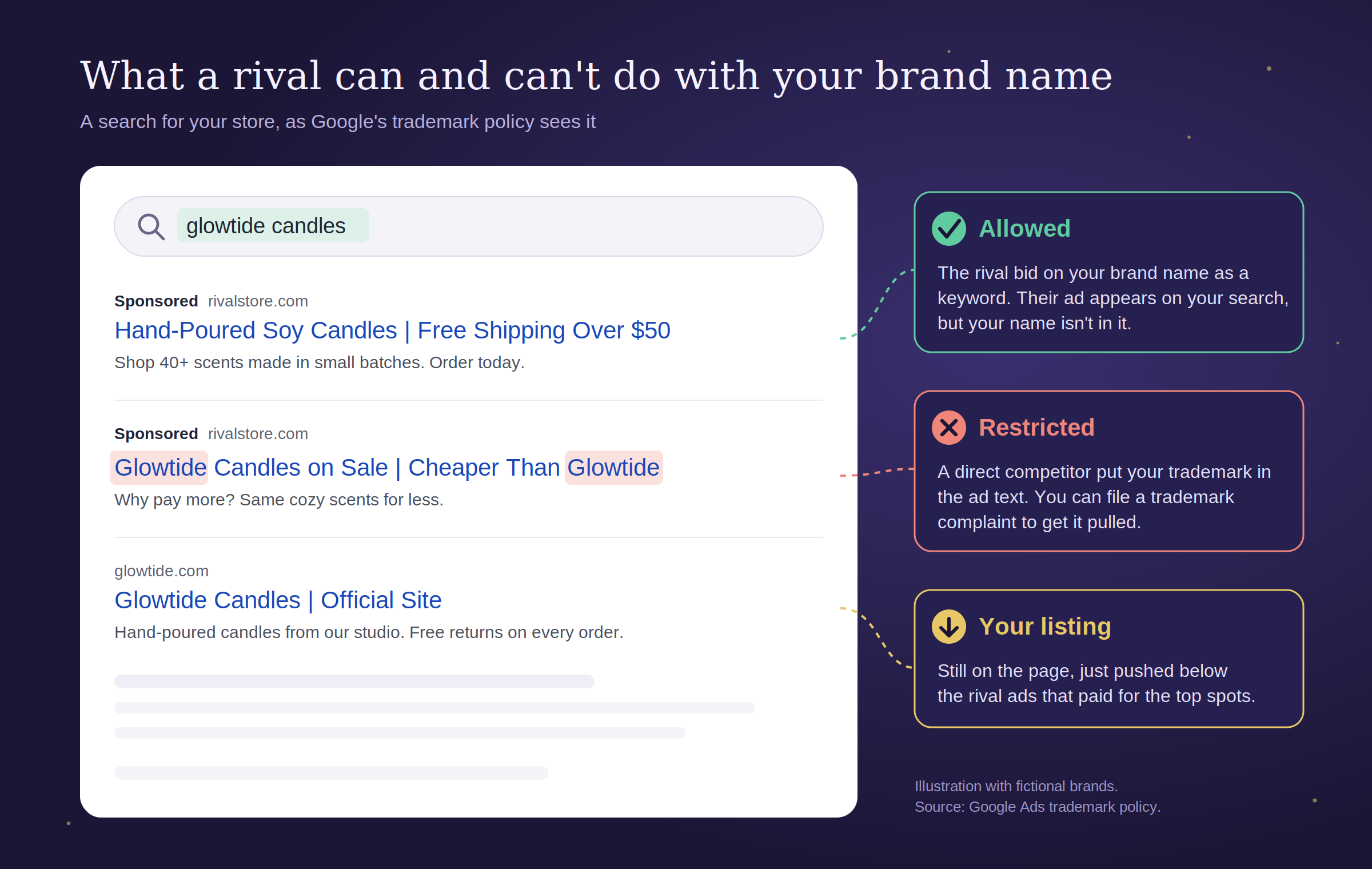
The less polite reason is money. Rivals pay to appear on your name and you pay to bid on brand terms just to stand in front of your own door and Google gets paid either way. You don't need a crystal ball to predict that.
Most guides stop at Google, which is a bit like reading only one palm. Here's how the rules change as you move between platforms.
On Google, AdWords bidding on competitor brand names is fair play, but using a competitor's name in Google AdWords ad copy is where the trouble starts as we’ve discussed before. Even that has exceptions written into the policy. Resellers who genuinely sell your products can use your name, and so can review or information sites. So can anyone using the word in its everyday meaning, which is bad news if your store is called Bloom and a florist is bidding on it.
Microsoft Advertising is stricter in places. In certain markets listed in its intellectual property policy, it will investigate complaints about your trademark being used as a keyword, and not only in the ad text.
Amazon sits at the other end of the table. As one seller explained on Amazon's own forum:
“If your competitor has your brand in their product title that is a different matter, but if they are just bidding on keywords and phrases containing your brand name there is nothing Amazon will do. Amazon actively encourage this because it makes them more money from advertising.”
Meta and TikTok join the party in different ways. Meta's ads target people rather than searches, so there's no brand keyword for a rival to buy. TikTok has sold keyword-based Search Ads in the US since September 2024, so brand bidding has arrived there too.
Here’s how all the platforms compare for brand bidding:
Now let’s talk about what you can actually shut down and what you have to outbid. Your response depends on who's sitting in your spot:
Check whether a robot did it.
Google's broad match, Performance Max and AI Max campaigns stretch a merchant's keywords to cover searches Google thinks are related, and competitor brand names often make the cut. Your rival bid on "wireless earbuds," and Google decided a search for your earbud store was close enough. Merchants on the receiving end of this complain about it too, like on this Google Ads Community:
“... We are spending thousands of dollars a month in clicks that are meant to be for other businesses. We end up spending a significant amount of resources rediverting calls to our business as people think they're calling someone else.”
To see who's actually showing up, open the Auction Insights report on your brand campaign. It lists the advertisers competing in the same auctions as you and how often they appear, which beats googling yourself forty times a day.
If the culprit turns out to be automation, the fix may be one friendly email. Ask the rival to add your brand to their exclusion list. Many will, because showing up on your name usually wastes their money anyway.
The shopper searches your name again, sees the rival's ad, scrolls past it and buys from you.
But what changed this time?
They had a reason to choose you that the competitor couldn't copy.
A rival can rent the spot above your listing, while the promise you make after checkout stays yours alone. When you offer a protection plan on every order, shoppers know that if their purchase breaks down, they'll come back to you, and your brand ad can say so in its headline. That's a reason to click the real you, and it keeps customers returning long after the sale.
SureBright helps merchants add branded product protection to their checkout, so the trust you've built carries through every purchase.
Talk to our team about turning your brand name into the one shoppers keep choosing, with no fortune telling this time.
.jpg)


M Khizar is a writer enjoys making complicated things feel simple. He writes about warranties, ecommerce, and the small details people usually overlook, until they matter. His work focuses on clarity and helping readers make smarter decisions without overthinking it. Outside of work, he enjoys reading, writing personal blogs, and binge eating with friends.


.jpg)