.jpg)


Meteorologists generally warn people about the calmest part of a hurricane, called the Eye.
When the hurricane's eye passes overhead, the wind drops, the rain stops, and occasionally even the sun breaks through. People step outside to take stock, mistaking the lull for the end of the storm. Then the storm arrives as fiercely blowing from the opposite direction.
For e-commerce merchants, September is the eye - a brief stretch of calm between the year’s biggest shopping storms, i.e., the holiday season.
Prime Day’s four-day squall blew through in June this year. Black Friday is already visible on the horizon, and Amazon's Prime Big Deal Days will send the first gusts on October 6. For now, with September nearing its end, the skies are quiet enough to ask the question one new seller posted on Amazon's seller forums after Prime Day:
“My sales basically fell off a cliff right after Prime Day. That part I expected — everyone front-loads their buying for the deals. But here's what caught me off guard: sales also dropped in the 3 days before Prime Day.”
A veteran seller didn’t bother softening the blow, “You REALLY need to spend more time on the Forum. If you had looked for Prime Days stories you would already know that it collapses orders BEFORE and it destroys them AFTER.”
The June data shows shoppers weren’t skipping the sale so much as finishing it early. They researched and filled their carts before the banners went up, which means they had already made most of their decisions before Day 1.
And June punched well above its weight. Shoppers spent $26.4 billion during Prime Day 2026, about $2.3 billion more than the previous year, making it one of the biggest shopping events of the year.
That same shopper is walking into your store this holiday season. So, in this blog, we’ll explore what Prime Day trends reveal about the coming holiday season and what you can expect about your customers’ behavioral patterns this Black Friday and Cyber Monday.
Amazon built Prime Day in 2015 to wake up a sleepy July. Eleven summers later, the whole industry sets its watch by it. Walmart and Target ran overlapping sales this June, while Adobe's $26.4 billion tally captured online spending across U.S. retailers, not just Amazon. BofA estimates that Amazon itself accounted for about $21.6 billion of that through its marketplace, leaving the rest to other retailers.
So Amazon threw the party, and $26.4 billion got spent all over the neighborhood.
Picture a shopper in late June with four tabs open. Amazon in the first, Walmart in the second, and Target in the third. Your product page sits in the fourth, wedged between a lightning deal and a countdown timer.
That shopper is hardly an exception. This year, more than half of Prime Day buyers compared prices across retailers, and nearly half also shopped Walmart’s rival sale.
Some merchants have found new ways to increase the odds of getting their websites into that fourth tab.
During last October’s Prime sale, for instance, bedding brand Brooklinen offered 15% off sitewide. Bagging on those sales, it also ran the same discount on its Amazon storefront, plus up to 30% off on bedding and bath bundles.
Some, on the other hand, proposed eccentric means of riding the hype train to increase traffic to owned stores:
“You can jump on it on email marketing - just call it prime day sale and use a discount code on your store 'PRIMEDAY' and it gives a relevant offer. People do not give af - and ride the wave of 'it's a time to buy stuff' energy people have dude. You got this!”
Solid energy, questionable legal advice. Amazon trademarked “Prime Day” way back in 2016.
.jpg)
On the other hand, some merchants treat June as a rehearsal for November. Liquid I.V., whose hydration packets sat near the top of this year’s Prime Day bestseller list, leaned into build-your-own bundles and “buy three, get one free” offers on its own site to lift order values. The team carries those learnings straight into the stretch around Black Friday and Cyber Monday.
You see each business reads the same shopper a little differently.
This year’s most typical Prime Day haul looked a lot like a grocery run. Protein shakes, hydration packets, and a bag of cat treats. Numerator put the average order at $47.66, down from $53.34 last year.
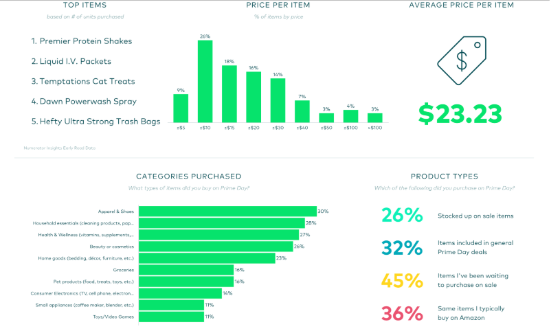
The studies’ results also revealed that two-thirds of participating households placed two or more separate orders across the four days. Even so, the average household spent around $143.45 by the end of it, down from $156.37 last year.
On several brands’ own sites, items per basket fell 22%, while the value of each item slipped only 6%. And that is when the individual product price tags barely moved, despite the tariff uncertainty or hike in fuel prices.
The thrift was organized, too. On a consumer forum, one user greeted Prime Day with a mantra:
“Prime Day is here, repeat after me, you are only getting a bargain if you already know the price from before.”
Looks like plenty of shoppers took the advice. Their carts got lighter, while the research phase got longer as they kept an eye out for pre-sale and post-sale prices.
The same shopper filling a cart with $20 essentials happily traded up when the right item hit the right price. Adobe found the share of the most expensive electronics sold jumped 51%.
The catch is what counts as “right.” because in June, more than 70% of shoppers said a deal needed at least 30% off to feel worthwhile, though the average discount on Amazon slid to 20.9%.
One shopper summed up the mood:
“I got some good deals, but I passed up many that weren't. I also passed on some of the items that were decent prices but were significantly cheaper in the spring sale or at Cyber Monday last year.”
This is what economist Richard Thaler calls transaction utility - shoppers want the product, and they also want to feel like they won.
This is why merchants now pay greater attention to offering something meaningfully better than the slashed price shoppers have already seen. This means shifting toward sharper hero deals, targeted discounts, and value-adds like bundles or protection plans rather than blanket markdowns across the entire catalog.
And in the coming quarter BFCM offers a big opportunity to maximize this utility.
A few days before Prime Day, one seller on Reddit watched their dashboard stop making sense:
“Today my ad spend has increased a lot, while conversions have dropped significantly. I know Friday is usually not our strongest day, but the gap between traffic, clicks and sales is much bigger than normal. Amazon has been heavily promoting next week's Prime Day deals, so I'm wondering if customers are clicking, adding products to their carts and waiting to see whether prices drop.”
Yes, that’s exactly what happened, as a seasoned seller on Amazon's seller central explained the mechanics. Conversions dip before a big event because shoppers keep browsing and building carts. And since anyone can now pull up your price history, a customer who saw you discount recently may simply wait for the next drop.
.jpg)
Prime Day may have been the big event in June, but for many merchants, the headliner still lands in November.
In Amazon's official Prime Day megathread, one seller wrote, “Our biggest sales day to date was 2025 Black Friday by 3X.”
Shoppers keep that calendar in their heads too. Last fall, a savings expert on PIX11 News told viewers to grab anything at 30% off or more, but hold TVs, gaming consoles, and small kitchen appliances for Black Friday. Some reports suggest as many as 63% of shoppers may wait for Black Friday or Cyber Monday.
In other words, June was a preview of how shoppers are likely to approach the bigger holiday sales - buy the deal that feels good now, but keep the big-ticket wishlist for the moment when they expect the deepest discounts.
Deloitte expects holiday e-commerce to grow up to 8.4% this year, with shoppers staying firmly value-conscious. Keeping that and everything else we've discussed in mind, run through the following checklist to make the most of this year's holiday season:
A few years back, cookware brand Caraway ran 10% off in the days before Prime Day, climbing to 20% once the event began. Its founder eventually dropped the warm-up sale, admitting the brand was “giving away dollars because folks were waiting for a bigger deal.”
Early attention and early discounts are two different things. Collect early-access sign-ups, publish gift guides and comparison pages, and use rewarding loyalty with points instead of markdowns.
June's shoppers held item prices steady and trimmed item counts. So the fix lives in the basket - bundles, “complete the set” offers, and free-shipping thresholds that make one more item feel like the smart move. Case in point - Liquid Death example from before.
Your shoppers can now see every markdown you’ve run. Deal hunters say a discount on a product that goes on sale all the time is worth less in shoppers’ eyes, however good the price looks. A deep October cut becomes the price they measure November against, and a loyal customer who happily pays full price can learn to wait if every email screams 40% off. Keep your discount hunters and your full-price regulars on separate lists, and let October’s offers stay modest.
The shopper who finally trades up in November and December has spent weeks weighing the risk. Give that big-ticket buyer a reason to stop hesitating.
That's where add-ons like product protection and shipping protection earn their place. With a provider like SureBright, your shopper gets coverage on the purchase they spent weeks researching. You add value to the cart and earn incremental margin on every sale, all without another markdown.
Discounts give shoppers a reason to buy now. Whereas protection gives them a reason to buy from you and to keep coming back long after the holidays wind down.
.jpg)