Tl;dr - Amazon just rolled out 1-hour and 3-hour delivery to 2,000+ US cities. It's a direct attack on drugstores, quick-commerce platforms, and every small retailer whose value proposition was "we have it when you need it." And competitions like Walmart, DoorDash, Instacart, and even JD.com in Europe is already running the same race. For businesses, like yours, the takeaway isn't to chase Amazon on speed but to compete where Amazon structurally can't: story, uniqueness, and what happens after the box is opened.
Knock, knock.
Who's there?
It's Amazon at your door... in an hour.
And before you ask... no, I am not kidding.
I mean, it is 2026, the era of speed. It has been built into our system – how we work, how we rest, how we express ourselves – and even today if you have to wait 2 days to get that Tylenol you ordered for yesterday’s headache... what’s the use of it all?

Well, many ecommerce giants seem to be addressing that, especially Amazon.
In late March this year, Amazon rolled out 1-hour and 3-hour delivery to over 2,000 cities and towns across the US. More than 90,000 products are available right now to be delivered at your doorstep by the time you’ll be done reading this blog (yeah, we know you scroll TikTok in between).
All of this, at a fee of $9.99 for one-hour deliveries and $4.99 for three-hour deliveries, if you have Amazon Prime.
So, now you can order Tylenol at 10 pm and have it before you fall asleep.
This sounds like great news for consumers. And honestly, for consumers, it mostly is- at least in the short term.
But for everyone else like your local pharmacy, small e-commerce brands, gig delivery workers racing against shrinking windows, and the broader retail world that spent years building a moat around stocking products, this is a very different kind of knock at the door.
However, didn’t Amazon do the same thing almost a decade ago?
See, back in 2014, Amazon launched Prime Now with 1-hour delivery in New York City. There was a lot of ambition and a lot more PR fanfare. It spread to dozens of cities. Customers liked it. Everyone wrote about it.
Then in April 2021, Amazon killed it.
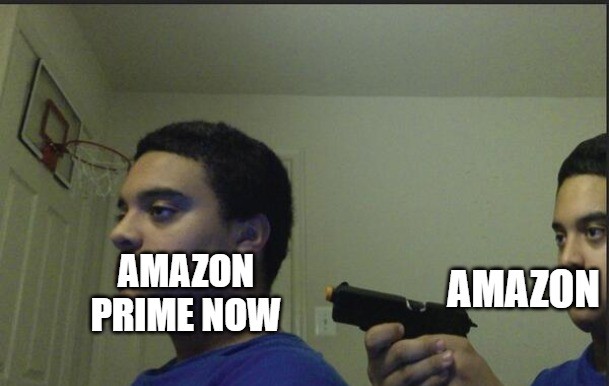
So when Amazon announced 1-hour and 3-hour delivery in March 2026, the reaction was as you’d expect:
What changed?
Actually... quite a lot. Same-day delivery at Amazon grew nearly 70% year-over-year in 2025. The consumer demand that wasn't quite there in 2014 has fully arrived. Amazon's same-day fulfillment infrastructure, which barely existed a decade ago, now covers over 9,000 cities and towns across the US.
And AI-driven inventory placement means your dishwasher pods are already sitting in a warehouse twelve minutes from your house before you even think about ordering them.
Maybe the bet didn't fail in 2014 because it was wrong but because it was early.
Yes, it’s a race.
And every q-commerce brand has to run.
Walmart already claims it can deliver to 95% of American households in under three hours. Now, that's a claim powered by the fact that Walmart has over 4,600 stores in the US, each one effectively functioning as a dark warehouse sitting minutes from millions of customers.
DoorDash and Instacart, who spent years proving that they’re faster than Amazon are now watching Amazon move directly onto their turf with 90,000 products and infrastructure that dwarfs theirs.
And it's not just a US story.
Just one day before Amazon's announcement, JD.com launched Joybuy, its full European e-commerce platform, in six countries including the UK, Germany, and France.
But guess what their core differentiator is?
Yep, it’s the same-day delivery.
Unlike Temu or AliExpress, which ship from China, JD built local warehouses and its own delivery network, JoyExpress, across Europe from the ground up.
When the second-largest e-commerce player in China expands into Europe leading with delivery speed as its headline feature, the game stops being on the easy mode.
The press coverage of Amazon's announcement focused on how great this is for consumers. That part is true. But the coverage mostly skipped the other half of the story.
The biggest losers here are not who you'd expect.
Drugstores and convenience retail are taking the first hit. Retail analyst Neil Saunders told CBS News it's "bad news for drugstores in particular," noting that Amazon's prices are already superior on everyday staples like toothpaste, toilet paper, and over-the-counter medication. The one thing keeping people walking into a CVS or Walgreens at 9 pm was that you needed it right now.
Amazon just made the move to stop that.
Quick-commerce players are next, of course. Instacart, DoorDash, and Uber Eats built their entire business model on the premise that they could get things to you faster than anyone else. That premise is under threat.
Prime members pay $4.99 for 3-hour delivery and $9.99 for 1-hour. Compare that to the average DoorDash delivery fee, which often lands around $9.75 before the service fee, the small cart fee, and the suggested tip that somehow add up to $14 on a $9 item.
Small and mid-size e-commerce businesses are facing a very similar version of this threat.
The advice for smaller retailers is increasingly clear: stop competing where Amazon wins by definition, and start competing where it can't: story, niche expertise, genuine customer relationships. These are things a logistics algorithm cannot replicate... but then again, even in these spheres, the landscape is changing.
Amazon's AI is already shopping on your customers' behalf, making purchase decisions without a human ever opening the app.
There's a 2012 film called Premium Rush, where Joseph Gordon-Levitt plays a bike messenger in New York City racing across the city against the clock, dodging traffic, taking every shortcut, cutting every corner, because being late is not an option. It's a thriller. It's supposed to be exciting.

For Amazon's delivery drivers, it's just another Tuesday.
And now, with 1-hour delivery windows, that Tuesday got shorter.
A Redditor on r/technology put it best:
"Amazon didn't learn s***t from Dominos' time-limited delivery structure."
Fair point.
Domino's once guaranteed 30-minute pizza delivery, watched their drivers crash cars trying to meet it, paid out lawsuits, and dropped the promise in 1993.
For Amazon workers, the cards are set the same way.
About 1 in 5 Amazon delivery drivers reported an on-the-job injury in 2021 - a figure that had already risen 40% since 2020. Research shows that pressure to work faster increased injury rates among workers by 53%. Some drivers are required to complete up to 400 deliveries in a single day. That gives a driver roughly two minutes per stop, with no margin for a slow elevator, a missed turn, or a dog that doesn't want to let them leave.
And these numbers hit harder when you realize that the average Amazon delivery driver earns just $19 an hour, compared to $35 an hour for a unionized UPS driver. Moreover, Amazon Flex workers, classified as independent contractors, are not covered by minimum wage protections, overtime law, workers' compensation, or unemployment insurance. They're not allowed to unionize. If the work dries up, there is no safety net.
No wonder that the voices from the Amazon Flex driver community on Reddit wasn't full of excitement when the news dropped:
“Guys make sure to not take these unless it pays well. We are working towards a future with no flex drivers and just automated delivery vehicles.”
When the clock on a delivery gets shorter, the only people who don't notice are the ones waiting on the other side of the door.
Now, what does this mean for your business?
If you're running an e-commerce business, delivery speed is now a ranking signal inside Amazon itself.
Products eligible for 1-hour or 3-hour delivery appear more prominently when customers filter by speed. If your product isn't enrolled in Fulfillment By Amazon (FBA) service, or if your inventory isn't positioned in Amazon's same-day fulfillment network, you are more likely to become less visible to a growing segment of shoppers. But here's the other side of that:
Also, as the delivery windows shrink and customer expectations reset upward, the post-purchase experience becomes your biggest differentiator. A customer who gets their order fast and then has a smooth experience if something goes wrong with their purchase covered under a protection plan with an easy claim is sure to remember your brand.
SureBright helps businesses build exactly that. We offer a layer of trust and protection that keeps customers coming back after the box is opened. In a world where the delivery race is won before your product even ships, how you make your next move for the win matters.
.jpg)


M Khizar is a writer enjoys making complicated things feel simple. He writes about warranties, ecommerce, and the small details people usually overlook, until they matter. His work focuses on clarity and helping readers make smarter decisions without overthinking it. Outside of work, he enjoys reading, writing personal blogs, and binge eating with friends.


.jpg)