

In his poem Mending Wall, Robert Frost once famously said: "good fences make good neighbors".
And for years, the US-Canada border has justified that proverb both in the physical and economic domains. Supply chains started in one country and ended in another, as if exchanging goods with the next-door neighbor. Canadian retailers built buying calendars around that exchange; a U.S. supplier was not just inventory, but the reliable middleman between a warehouse shelf and a customer's doorstep.
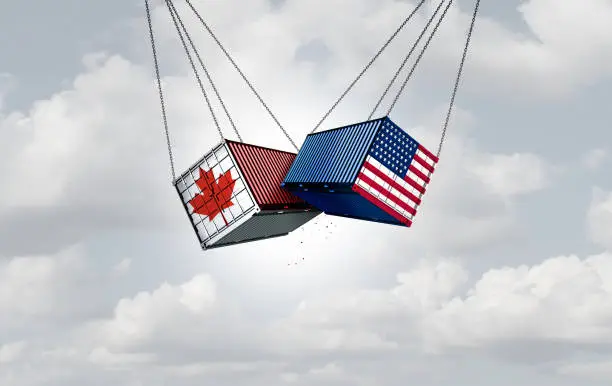
But then, the brotherly handshake turned into a tariff-war arm wrestle in 2025 when the US announced a 25% tariff on most Canadian imports. The recent failure of trade negotiations on the 21st of August 2026 has started a fresh exchange of tariff blows.
Washington has imposed 50% tariffs on C$27.6 billion worth of Canadian goods, while Ottawa has answered with duties of 15% to 50% on roughly 700 U.S. products, scheduled to take effect September 8.
The cross-border retail that once felt almost domestic now comes with a surcharge attached. And that is rewriting business plans, in some cases, shrinking forecasts before the year even plays out.
And that added cost eats into your margins.
Earlier tariffs have shown a trailer of how things can spiral out of control. Already, 55.3% of your brethren importing from the United States reported buying tariffed goods, and 36.4% expected profitability to shrink. Mind you, these estimates are even after the US courts have ruled those tariffs unconstitutional, showing there is no respite for most businesses.
You have the option to either absorb the extra cost and watch profit disappear, or pass it on and risk losing the customer who was already price‑shopping. That leaves you with a pressing question: How do you protect the value of every order when the economics beneath it has changed?
As a retailer, the immediate threat is not the higher cost. You have already dealt with that since the tariff war began. You might have raised prices, rerouted your supply chain, absorbed part of the increase, or used a combination of all three. But at the time of first wave of duties, you had the luxury to ask yourself: How much of this cost I can you carry?
The September measures, however, will disturb the pricing mechanism you built to survive the first round of tariffs.
Under new duties certain U.S.-origin furniture face a 50% surtax, while major household appliances fall into the 25% band. As a result, some products can suddenly become far more expensive than they were before, despite offering no new reason for the customer to pay more.
A Canadian buyer illustrated the risk merchants face with this sudden hike in prices. He wrote:
“Herman Miller are already fairly expensive, but adding another 50% to the already high price will essentially kill 99% of the orders.
I personally placed an order a couple of weeks ago for tens of thousands of dollars worth of HM merchandise but will be cancelling the order as I will not be paying 50% extra. I’ll be looking instead to order equivalent-quality products manufactured in either Quebec or Scandinavia.”
That complaint captures the essence of how most of your customers could be reacting. In most cases, they won’t necessarily abandon the category. They abandon the product whose price has suddenly lost its logic.
It’s a catch 22 situation- you can't pass the cost to the consumer, nor can you bear it without eroding all your margin.
The Bank of Canada’s analysis of the 2025 counter‑tariff episode shows how deep the squeeze already runs: even with a 25% duty, prices on affected goods climbed by only about 6%. Retailers absorbed most of the difference, but that “choice” came with a bill attached.
Responding to a discussion in a forum one merchant sums up the cost businesses pay during tariff wars:
“As a business owner who deals with an average middle-class consumer base I can tell you straight up that both the elevated fuel prices and the tarrifs are impacting consumer spending big time. Our sales are down 50% year over year and things have gotten weird.”
That cost is now visible in small‑business financials. A 2026 survey found that 41% of small businesses saw profit margins shrink over the previous 12 months as tariffs and trade disruptions pushed costs higher.
On top of that, about 32% of small businesses reported spending extra on tariffs and trade‑related fees in the past year. As another Canadian merchant shared his experience with tariffs :
“I run a small Canadian manufacturing company and sell a lot to the us. By the time our stuff goes through... it ends up being 45--47% worth of tariffs. We used to be able to send it across and let the customer pay them but now they all have to be prepaid by us...”
These numbers describe a sector that has already adjusted once, at real expense. But if you think only the margin takes the hit, you couldn't be more wrong.
Rising prices have also made consumers more conscious of the value of every dollar they spend, making it harder to convert a new customer.
Shoppers have already moved into a more defensive posture. A 2025 survey found that 77% of consumers changed their buying habits after tariffs were announced, with half of all respondents saying they were sticking to essentials and 30% holding back on discretionary purchases.

That shift lands directly on your sales floor. A U.S.-made product that used to sell on brand and specifications now has to justify a price that no longer matches the customer's mental map. You are competing against last year's price, against non‑U.S. alternatives, and against a shopper who is ready to trade loyalty for an economic deal.
Every conversation takes more work. You spend time explaining the price, energy defending the value, and margin on discounts to bring the final number into a range that feels acceptable.
In an already price-inflated environment, where consumers are already cautious, they want certainty and assurance that whatever they purchase is worth the value. One way to give them that confidence is through extended warranties.
A tariff makes the purchase price harder to defend. A warranty changes the conversation after the price has been defended.
Think of it this way. A shopper considering a costly appliance or piece of equipment is already asking whether it is worth the money. The tariff has made that question louder. A protection plan gives the merchant something concrete to offer: a clear route for repair or service when a covered failure occurs.
It also creates a revenue stream tied to a sale you have won, without requiring another unit of inventory to be bought, stored, delivered, or discounted. At a moment when product margins are under siege, that matters.
For the merchant, the value lies in what happens after checkout. A product breakdown can turn an already thin-margin sale into an expensive customer-service episode. The customer wants an answer. The manufacturer may point to its own terms. The merchant is left protecting a relationship that has suddenly become far more costly to keep.
This is exactly what happened to a consumer who was left with no answer when his refrigerator broke down. He wrote:
“Repair company did a part swap that accomplished nothing, then on their third visit noticed that the refrigerator is leaking coolant. They did not attempt to find the source/cause of the leak, and just ordered a part. That part will take weeks to come in, and the tech said they are not certain if it will even solve the issue. The repair company has refused to look into what is causing the leak until after the next part-swap (which is weeks away).“
As the cost of acquiring a new customer keeps rising, protecting the existing loyal customer becomes the top priority. Had the retailer offered a structured warranty program, they might have able to prevent this customer's negative experience altogether, the very experience that pushed him to write a review capable of deterring even the few new customers the retailer had a chance to convert.
A warranty cannot erase a tariff. But it can make a high-stakes sale feel less like a one-time gamble for your customers while giving you some breathing space on shrinking margins. .
The next customer who hesitates over a newly inflated price is not asking you to explain trade policy. They are asking whether this purchase is still worth the risk.
SureBright can help you answer that without asking you to stake anything further on it. The coverage sits at checkout, and if a covered product fails down the line, the bill doesn't land on your margin, which previous tariffs have already stretched thin, with new ones set to add further pressure.
That matters most in exactly the categories tariffs have hit the hardest. A customer considering a U.S.-made appliance or piece of furniture may still balk at the price, but protection gives the conversation somewhere useful to go: from “Why does this cost more?” to “Can I avoid future expenses in case something goes wrong?”
Sennheiser saw the same opportunity. For a brand built around premium, long-lasting products, protection gave customers confidence that the ownership experience would continue after the manufacturer’s coverage ended. It became another way to reinforce the value of a high-ticket purchase.
So give your customers a safer bet on every tariff-hit purchase at checkout with SureBright.


Pushpender enjoys exploring the stories behind everyday decisions. He writes about warranties, ecommerce, and the psychology of buying. He draws on internet research, lively conversations, and a curiosity for the details most people overlook. With a background in English Literature, he believes good writing isn't measured by how complex it sounds, but by how effortlessly it helps someone understand a complex idea. Outside of work, you'll usually find him reading fiction and history, striking up conversations with people from different walks of life, or jotting down ideas inspired by both.


.png)
