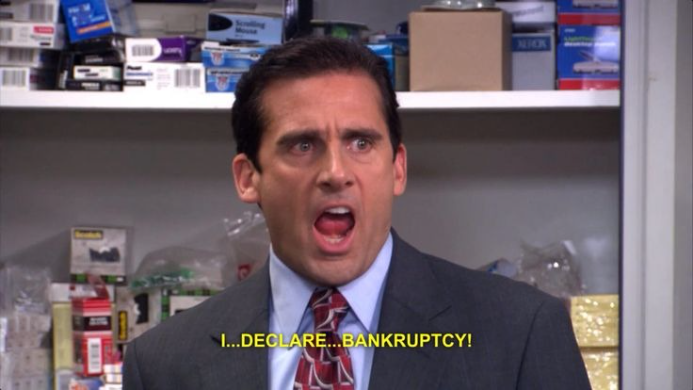
Remember that episode of The Office, where Michael Scott walks into the middle of the room, cups his hands around his mouth, and shouts, “I declare bankruptcy?” Oscar, the accountant, has to gently explain that saying the word out loud does not make the legal thing happen.
A customer emailing you about their home warranty coverage is often Michael Scott declaring bankruptcy. Picture this: fourteen months after purchase, their dishwasher stops draining. They email you because you sold it. They mention, almost in passing, that they also have a home warranty, so this should be straightforward either way.
It’s anything but straightforward. The slip that came with the dishwasher covered that serial number for twelve months since purchase, i.e. the manufacturer warranty. The home warranty covers the building, belongs to a company that has maybe never heard of your store, charges them seventy-five dollars for the technician to show up, and will decline anything it decides was installed badly by whoever your customer hired.
One contract follows the machine. The other stays with the house. Your customer has been calling both of them a warranty for two years.
But it’s not your customer who invented that habit. Home warranty providers run a $4.6 billion business in the US, advertising coverage for dishwashers, refrigerators, and washers by name. The idea that a contract on the house takes care of the machine you sold them was marketed to your customer, repeatedly, for years by an industry you have never had any dealings with.
That’s why it’s important to understand what actually separates a contract on a house from a contract on a machine and how to deal with it without damaging your brand’s reputation.
So, let’s get down to business.
If I had a dollar for every time the warranty fine print meant something completely different to everyone involved, I would be retired before 35. It doesn’t take more than ten minutes of your day on any appliance forum to see that confusion play out:
“Home warranty or extended warranty?
Had the pleasure of owning a Whirlpool Cabrio washer which broke down after three years. The hinge that supports the hinge broke due to apparently a design flaw and Whirlpool would only offer a loyalty coupon to compensate my loss. Now I'm questioning my whole life.”
If you’d sold that washing machine, it means your customer is currently sitting in their laundry room trying to figure out which contract was supposed to protect a three-year-old machine. And once they figure out who is responsible, a "loyalty coupon" feels like adding insult to injury.
On many mainstream appliances, the manufacturer’s full parts-and-labor coverage lasts just one year. For example, Whirlpool's major-appliance warranty provides one year of parts-and-labor coverage for qualifying defects, subject to its terms. Bosch's US warranty information similarly lists one year of parts-and-labor coverage for many major appliances, with longer terms for certain components or parts.
That “long term” distinction is especially tricky.
Five years of coverage on a refrigerator’s sealed refrigeration system doesn’t automatically mean five years of coverage for all parts of the appliance. The compressor and refrigerant lines may be covered under specific terms, while components such as the ice maker, dispenser or control board may fall outside that extended coverage.
Even inside that initial twelve-month window, factory policies routinely exclude repairs if there is improper installation, improper maintenance, or cosmetic damage reported past thirty days.
Then comes the home warranty subscription, which can cover appliances that come with the building, but that obviously doesn’t mean it pays for every failure of every appliance in the house. It covers the items and circumstances specified in the contract, and it may impose service-call fees, coverage caps and other conditions.
One homeowner commenting on FTC guidance described trying to get a broken refrigerator ice maker serviced:
“And the last issue was the ice maker on my frig went out. I was told because it was wiring inside of the refrigerator door— they could not repair. I then read the contract which stated if the appliances could not be repaired they would replace. When I pointed that paragraph out to the rep I was ghosted!”
They eventually called a local technician, who resolved the issue in less than five minutes.
And surprise surprise, that compounding gap between promises and payouts has already drawn regulatory heat.
In February 2026, the Arizona Attorney General finalized an $11.8 million consumer fraud settlement against Choice Home Warranty after receiving over 1,500 complaints about systemic claim denials on advertised coverage.
Headlines boldly call this "the largest settlement with home warranty company.”
Given their scale they may be able to withstand such scrutiny once every few years. Though in your case, even something as minor as a negative review can harm your store’s reputation and bottom line.
If you look closely, most of these exclusions are your typical everyday scenarios - a dishwasher installed by a customer’s hands-on cousin, a control board fried by a power surge during a summer storm, a refrigerator scratched while being hauled up a tight staircase, or an ice maker whose door wiring has given out.
But when the claim comes in, the manufacturer may point to an expired 12-month warranty or the fact that the damage isn't a factory defect, making it out of scope of coverage.
On the other hand, the home warranty company may point to one of its exclusion clauses.
Neither outcome is guaranteed, of course, and that’s precisely the problem - your customer has no idea which contract holds up until something breaks. Yours is the name on the order confirmation in their email, which makes your support queue the default court of appeal.
.jpg)
Research has shown that 78% of major-appliance shoppers get pitched a service plan at checkout, but less than one in five buys them. A massive chunk of that gap can be delivered with complete confidence that comes with buyers assuming home warranty covers them.
And your Shopify dashboard isn’t out there flagging those lost transactions as "Lost to a Home Warranty provider." It simply logs a declined protection plan and moves on. The high-margin attach revenue vanishes, and the order leaves your warehouse without the add-on.
A salesperson can explain the difference between a refrigerator's capacity, energy rating and installation requirements without breaking much of a sweat. Ask them to explain why a home warranty company won't pay for the control board, though, and suddenly they're expected to know the finer points of a contract they didn't sell.
That isn’t a fair position to put your employees in.
When coverage is confusing and claim resolutions feel messy, even sales reps stop pitching plans altogether.
Studies have shown that sales teams routinely avoid offering protection plans when they cannot explain what happens after the sale. Nobody wants to sell a plan on Monday and spend Friday apologizing for a claim denial decided by some random home warranty company.
The friction hits your helpdesk just as hard. A customer emails demanding to know why an external claim was denied. Your support agent has to hunt down receipts, verify purchase dates, read third-party contract exclusions, and explain who actually owns the claim.
Your team becomes an unpaid switchboard for a dispute your business does not control.
The FTC explicitly warns consumers that home warranty contracts carry limitations and fees that make repairs difficult to get. For an e-commerce retailer, that means your support queue absorbs the administrative drag because your reputation is attached to the appliance.
But every minute spent untangling someone else’s contract is a minute not spent helping high-intent buyers. And unlike a protection sale, that support work comes with zero margin attached.
A panic return is one of the most expensive outcomes here. Okay, maybe less than a chargeback (which aren’t rare these days).
When a customer loses faith in the protection they thought they had, an otherwise working appliance becomes a purchase they want to undo. If that realization hits inside your 30-day return window, an administrative headache turns into direct financial damage.
Appliance margins leave no room for that kind of volatility. On an $1,800 refrigerator sold at a 25% gross margin, your store makes $450 in gross profit before overhead, software, and labor.
If that customer returns the unit and you mark it down 25% to clear it as open-box stock, the resale price drops to $1,350 - exactly what you paid the distributor. Your $450 profit disappears completely. And that is before paying for two-way freight, bench testing, repackaging, or restocking labor.
An appliance failure, and the claims process that follows, won't politely wait until everyone's paperwork is in order.
To put the repair risk into perspective, Yale Appliance, which performs more than 33,000 service calls a year, reports an 8.3% first-year service rate across its appliance categories. For integrated professional refrigeration, that figure rises to 32.5%. Average repair labor for that category is $255, with labor costs on built-ins reaching $900 or more.
So where does that leave a retailer who wants to offer customers more protection without taking on the job of administering another contract?

One option is to work with a specialist that manages the program and its claims, while bringing you a hefty revenue-share. That's the model 500+ merchants have opted for with SureBright. Retailers can offer protection at checkout while SureBright handles the financial risk and program operations. The store can offer customers an additional layer of protection without having to go through pain of building the whole operation in-house.
There’s a commercial upside, too. With SureBright, one premium appliance retailer reported a 23% protection-plan attach rate on appliances priced above $1,500. Their customer ratings rose from 3.7 to 4.1, while protected buyers made repeat purchases at a rate 21% higher than other customers.
Additionally, third party protection plans can cover some of the gaps we mapped in the exclusions list earlier, such as accidental damage or power-surge damage, where the plan explicitly includes these benefits, along with certain mechanical and electrical failures after the manufacturer’s warranty expires.
Curious what that could look like for your store? Run the numbers with our warranty revenue calculator.
.jpg)





.png)