


Every few years, the internet declares that something fundamental is dead. Emails, Search, and now websites seem to have joined the list.
.jpeg)
This time, the panic is being fueled by Google’s launch of the Universal Commerce Protocol. The update, which launched just 10 days ago, is being hyped up and hated in equal parts by people online.
“Gonna be honest this sounds like every "this changes everything" google announcement that quietly dies in 2 years. Remember google+ being the future of social? Also, this assumes people want to give an AI their credit card and trust it to not buy stupid things. I don't even trust myself to shop drunk.”
- A skeptical user on Reddit.
In fact, most of AI shopping has been thriving on hype. There haven’t been any groundbreaking results (so far).
“Way more hype than reality. OpenAI made several insane, groundbreaking, revolutionary announcements in the last 1 year. How many have truly transformed your life/ecommerce?”
- A merchant questioning the update on Reddit
But all these divisive comments online mean nothing if people don’t understand what’s going on.
As a merchant, if you give into the hype too quickly, you may have too much to lose. Full details below.
Before we define the protocol, let’s get one thing straight: UCP is not Google becoming the Seller of Record. Merchants still own pricing, inventory, fulfillment, customer support, returns, chargebacks and compliance.
Payment may happen through Google Pay, but the merchant still owns the transaction.
Additionally, you can CHOOSE to opt-in for it by filling in an interest form. Just remember that opting/not opting for the protocol has its own set of challenges.
So even though ecommerce is more uncertain with UCP, it’s your choice whether to join in or not (for now).This is a better option than Amazon’s Buy For Me program, which scraps catalogs of merchants without asking.
.jpg)
Universal Commerce Protocol is a Google-led open-source standard that lets AI systems talk directly to merchant commerce platforms across the entire shopping flow. That includes finding products, checking inventory, comparing prices and variants, completing checkout, and handling post purchase steps.
In their press release, Google confirmed that they’re working on adding UCP checkout inside their AI Mode and the Gemini app. According to them, this is how an average AI shopping experience with UCP could look like:
It’s surprisingly efficient, though quite risky as well.
UCP creates a shared language between AI agents and commerce systems so that agents can talk to every retailer without any custom integrations. Instead of every platform building its own connectors, everyone communicates across the same protocol.
If that sounds boring, it should. Boring infrastructure is usually the most powerful kind. For example, Shopify’s dashboard doesn’t have swanky animations or big bold text; it just gives you the data you need.
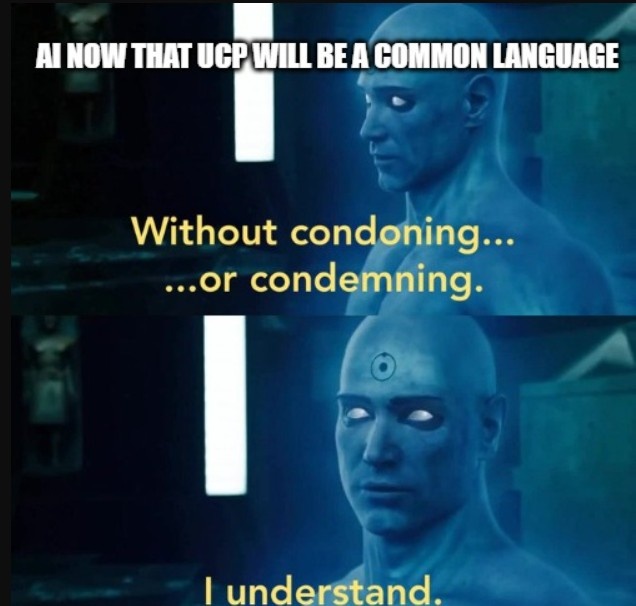
At Retail’s Big Show 2026, Vidhya Srinivasan, VP of Google Ads and Commerce said, “It’s very important to have a standardized way so we can scale these things, and everyone can be prepared for all the various steps to happen. Businesses can pick and choose what they want so there’s flexibility for them.”
They’re basically saying, “Things are about to change fast, so buckle up.”
.jpeg)
UCP seems to be an industry-wide initiative too; Google partnered with Shopify, Etsy, Wayfair, Target, and Walmart, and the update is being supported by companies like Visa, Mastercard, Stripe, Best Buy, and American Express. All the big guns assembled to make this protocol together.
.jpeg)
UCP is not a ranking signal, so it’s not relevant for SEO. All the takes about how it will affect Search are currently unfounded.
When an SEO professional posted about how worried they were about UCP killing SEO, John Mueller, Google’s Senior Webmaster Trends Analyst said this:
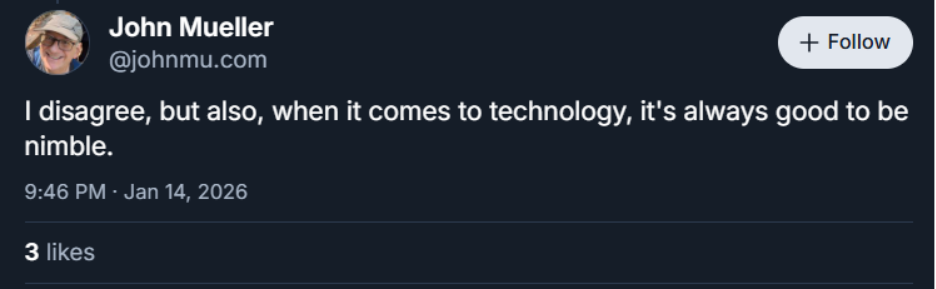
This also means you can’t optimize for UCP the way you optimize for keywords or links.
You’ve got to remember that a lot of the louder takes online are built to increase hype. This isn’t our first rodeo. People said the same things for OpenAI’s Instant Checkout, and see how that played out.
Traditionally, ecommerce followed a predictable pattern:
UCP introduces a parallel path.
Now, when a shopper asks Google’s AI for a product, it can query merchant systems instantly for availability, pricing, variants, shipping options, and eligibility. It can assemble a cart and complete checkout without handing the shopper off to a site.
So the steps become:
If you opt for it, your website may never be visited, but the sale still happens.
This is Google adding a conversion layer to discovery. It does not replace ecommerce. It’s nothing new either. OpenAI, Perplexity, and Amazon got to this first.
The reason the update adds to the uncertainty is because of how much control Google has over SEO, and well, the internet as we know it.

AI models will now interpret product data directly, not just page copy. Clean titles, accurate attributes, and consistent feeds matter more than just having good storytelling.
Yes, that means in the very short-term people may manipulate their product page copies to get more sales. Though, because the end buyer is also a human, you can never discount returns or chargebacks either.
If the protocol is widely adopted, discovery, comparison, and checkout would happen in the same interface. It would blur the traditional funnel stages or at least modify that in a big way.
Clicks, time on site, and assisted conversions can become less reliable if checkouts go through AI interfaces. We’ve already seen how AI has already led to zero-click marketing across industries.
“I don't think UCP kills SEO. It doesn't solve discoverability, but it does reduce the value of store front and its UI/UX. Now users can simply checkout from the chat using Google pay and never see the website. This is great for revenue but probably not so great for long term branding for a store.” A digital marketer on Reddit
“Not so great for long term branding” is also what the experts said right before the Dotcom Bubble burst. Even today, every new promise about AI seems reminiscent of the early internet days, with all its naive optimism.
If you were working back in the 2000s, you’d remember that we were supposed to get a marketing-free utopia. Instead, we have the same big tech companies dangling a new, shiny toy to bait people. Walmart, Target and Etsy wouldn’t have been eager to onboard if UCP was revolutionary for everyone.
AI agents and crawlers will hit commerce systems more frequently. UCP might increase machine-driven access to pricing, inventory, and availability endpoints.
Bots scraping ecommerce catalogs for AI use is becoming more common regardless of UCP. Earlier this month, Amazon’s Buy For Me program began listing products from sellers who never consented to it in the first place. Hundreds of chargebacks later, many complain that they are still suffering.
.jpeg)
The Agentic AI crowd is pushing for purchases within the AI chat. This means that checkout can occur inside Google surfaces using Google Pay or Apple Pay, but merchants will still be the ones fulfilling the order. Their goal behind UCP is to ensure that customers opting for AI shopping won’t use your site to checkout products.
Merchants remain the seller of record. Like we said earlier: inventory, fulfillment, returns, and customer support stay with you, the merchant.
Google is not generating your catalog for you. If the data is wrong, incomplete, or misleading, that’s more indicative of missing product descriptions on your end.
Pricing engines, inventory systems, fraud controls, and order management do not disappear just because checkout moves closer to discovery.
Taxes, disclosures, and consumer protection rules still apply exactly as they did before. The medium’s changed for the purchase, but all the product and the info on it are still on you.
Faster checkout leaves less room for friction and verification. If fraud rises, you’ll end up absorbing the cost, not the protocol.

Sales would happen without site visits, which puts pressure on existing analytics models and performance reporting. You might be going into it blind for a while.
AI systems aren’t known for being correct all the time. If a model misunderstands variants, compatibility, or usage constraints, you’d be in hot soup. Returns and negative customer experiences would end up rising quickly.

When customers buy without seeing a familiar product page, accuracy and consistency become the only trust layer left.
A lot of commentary frames UCP as the arrival of autonomous AI commerce. That framing gets ahead of the evidence.
What we are seeing today is AI mediated checkout, not AI decision making.
All these powerful tech companies keep pushing agentic AI without any proof to back up their claims.
The main thing they’re counting on is giving you FOMO. They’re essentially saying: “if you don’t opt for UCP or AI shopping initiatives, you might be skipping out on customer traffic.”
Allegedly, AI agents can summarize options, compare structured attributes, and execute transactions. They cannot understand personal context, edge cases, or real-world constraints the way humans do. In fact, we don’t even know if we can take Google’s word on UCP; they’re known to exaggerate features and capabilities.
Adobe’s own reports show that traffic from generative AI sources was “23% less likely to convert" than non-AI traffic. Even if this gap closes in the future, it still isn’t important enough for you to change up your entire marketing strategy right away.
It would be great if UCP is as legendary as Google says it is, but for now, we’ve got to wait in this awkward limbo.

If you opt for the UCP protocol blindly, you’ll have new problems to solve along with the old ones.
When checkout friction goes down, expectations go up.
When a shopper spends less time on product pages, fewer details are absorbed. When an AI summarizes a product, nuance is often lost. When the purchase happens quickly, misunderstanding becomes more likely.
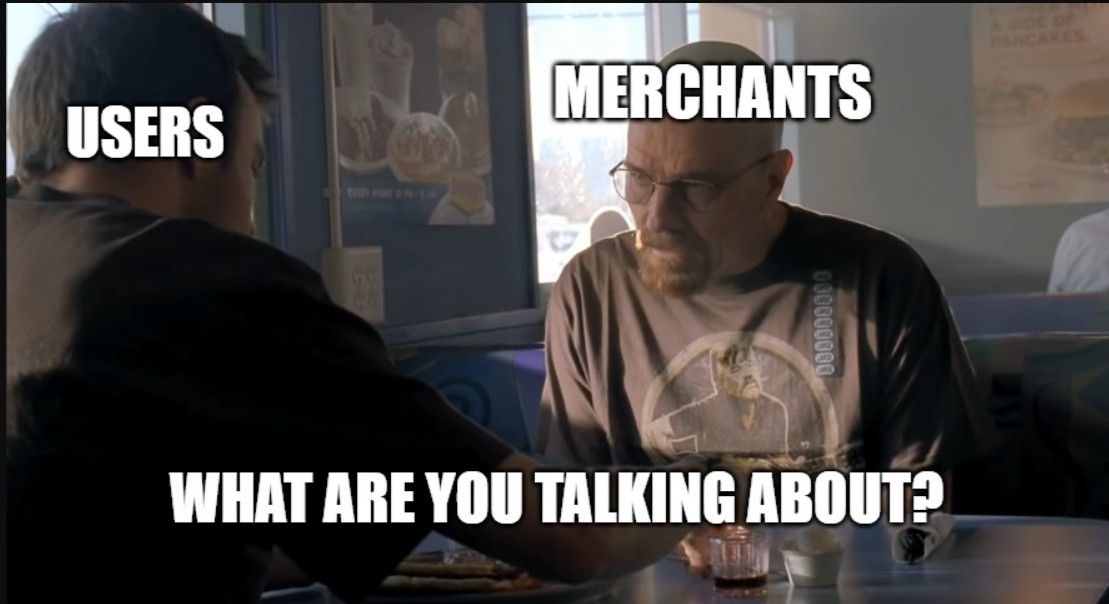
Returns, support tickets, and post-purchase dissatisfaction do not disappear just because the checkout was fast. In many cases, they increase.
And to be fair, for most things in life, some resistance is always healthy. What happens in this case? We may only get a clear picture in 3-6 months.
UCP speeds up the front of the funnel. It does not eliminate what happens after the transaction.
And because the merchant remains responsible for fulfillment and support, any gap between what the AI communicated and what the product actually delivers lands squarely on you, the merchant.
The AI wouldn’t take any responsibility for this. The neat little disclaimer below the chat bar protects them, not you. This is especially true when most banks and payment gateways are happy to take the customer side.

This is why clean data and clear policies matter more with UCP, not less.
If you strip away the hype, UCP rewards two things merchants have always struggled with. It’s good practice to follow these steps regardless of whether you get into agentic commerce or not.
Check every product and page on your site, and don’t leave any fields empty. If the information on shipping policies is too vague or unclear, define it. If you haven’t already, add FAQs to your pages.
AI agents do not infer, they execute commands the users put out.
If inventory data is stale, pricing is inconsistent, or variants are unclear, the agent won’t recommend your items when someone asks for product recommendations. In many cases, it will simply talk about a merchant whose data was easier to gather.
Google has already begun surfacing Merchant Center warnings related to missing structured fields like return policies and shipping details.
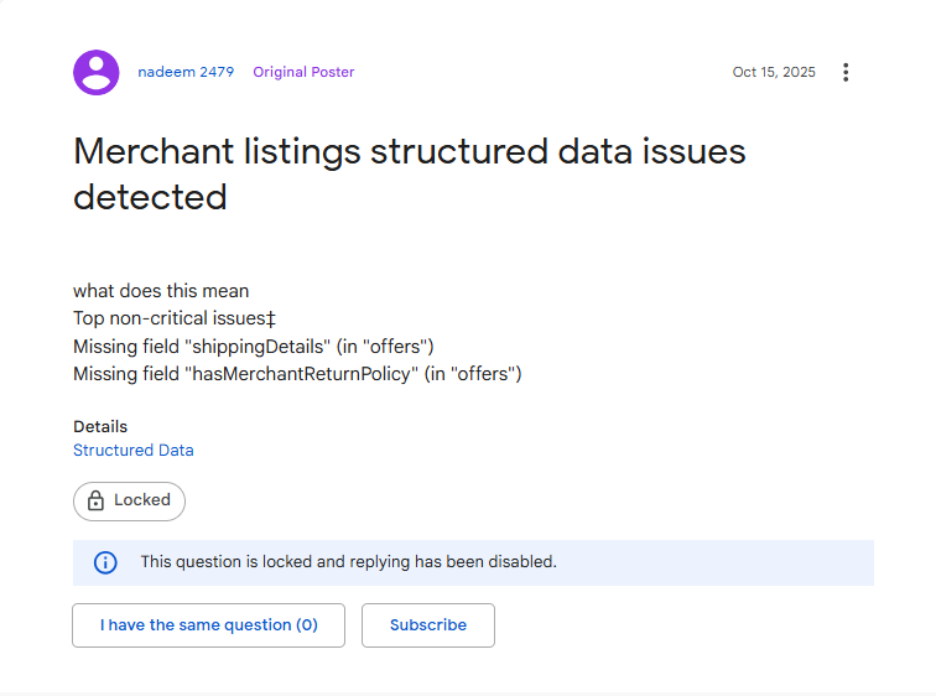
Merchants on Reddit and in SEO forums have reported that incomplete attributes directly affect eligibility for AI mediated surfaces.
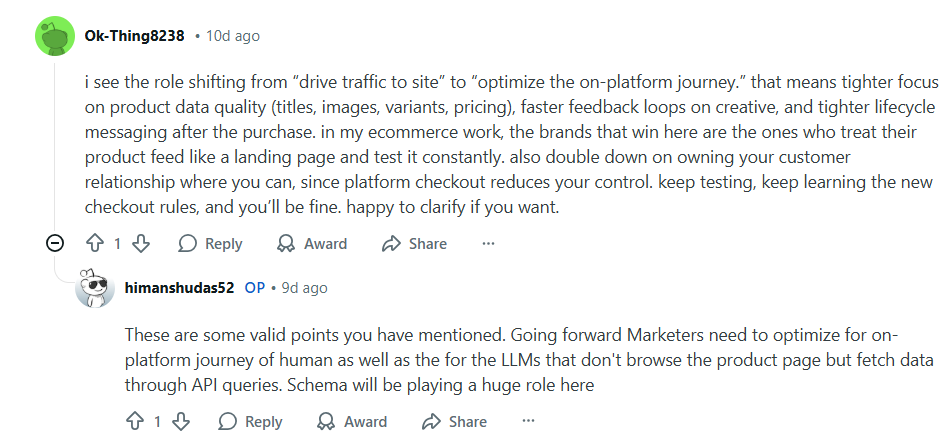
This is more about being readable, rather than just ranking.
Check your existing processes in terms of the number of returns and refunds you’ve had to dish out. Look at improving your chargeback rate, regardless of whether it’s your fault or not. Make warranty policies obvious.
UCP does not just expose your catalog. It exposes your operational maturity.
Inventory mismatches, fulfillment delays, and unclear policies become visible to systems designed to minimize risk. Over time, that feedback loop matters.
AI commerce systems prioritize merchants that reduce post-purchase friction because that friction degrades user trust in the AI itself.
In other words, bad merchant behavior does not just hurt the merchant; it also hurts the platform. So why would they want to recommend you if they think it’s too risky?

One of the quiet consequences of UCP is the further breakdown of attribution. We mentioned how each stage of the funnel gets blurred earlier; Now we’ll explain how.
With no proper pageviews, no sessions, and no obvious campaign source, every sale would have the least amount of context.
And we all know that this is not new. AI simply accelerates a trend that already existed.
Salesforce’s much publicized claim that AI influenced 20% of Cyber Monday sales in 2025 doesn’t show the full picture.
Their definition of influence included AI powered recommendations, chatbots, and automated emails, not autonomous checkout. Adobe, on the other hand, just measured ALL AI traffic, including people just looking things up.
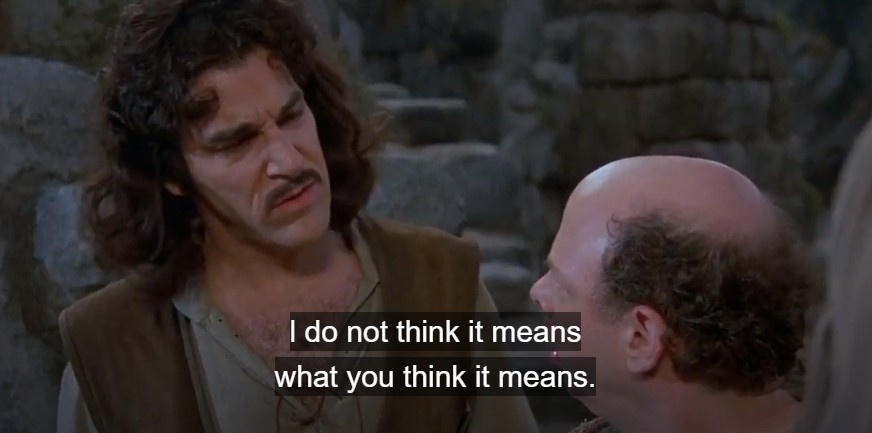
We can’t treat UCP as something to chase or build a playbook around yet. That would be a costly mistake.
-909720459.jpg)
UCP is about infrastructure. It’s the plumbing that makes sure that when customers test the waters of AI shopping, they don’t get mud.
In order for your business to grow further, you’ll need to sort out your site’s foundations too. That’s how you’re perceived as clean water, i.e., recommendable by the AI.
Universal Commerce Protocol has yet to prove whether it will change everything about e-commerce as we know it. However, like John Mueller said, it’s better to be nimble with updates that matter.
With every company launching some new “game-changing” solution, it’s impossible to break apart your site and then “fix it” every single time. This isn’t a new lesson, but differentiating between hype and helpful solutions just keeps getting harder.
For now, until solid evidence of improvement is released, just stick to the basics.
Maintaining good site hygiene is important regardless of whether you opt for the protocol or not. This is true for every store online. But rushing into UCP as the latest, most powerful update revolutionizing ecommerce- can lead you to get a lot of returns, chargebacks and AI-hallucination induced bad reviews.
If you’ve got friends in the industry, send this article their way before they wreck their website to no avail.




.jpg)