

You're packing for a business trip, carefully placing your CPAP machine in your carry-on. Three days later, TSA screening, a clumsy moment, and your $2,000 machine hits the floor. Screen cracked. Won't power on.
You call your insurance company, confident they'll cover the replacement. After all, they helped when you bought it, and you need this machine to breathe safely at night.
Then you hear it: "I'm sorry, but we only cover device replacements every 5 years. You received yours 15 months ago."
.jpg)
Close to 30 million Americans and 5.4 million Canadians suffer from sleep apnea, and CPAP machines help alleviate the issue. Once you have insurance, getting the device shouldn’t be too much of a headache.
The tough part is that once you have the machine, it can get damaged in a variety of ways: through the humidifier, sudden bumps, coffee spills, and more. Depending on the insurance provider you have, you won’t get another device until years 3 to 5. So, if you break, lose, or damage your machine before then, you're paying out-of-pocket for a replacement.
“I have resmed S9 purchased 3 years ago. The electric power supply got broken (the pin broke) so i couldn't use it for a while. DME said $400!”
- A panicked patient shared on ApneaBoard
Let’s go over why insurance can fail you when it comes to accidental damage, and how CPAP warranties fit into this picture.
Medicare and most private insurers classify CPAP machines as "durable medical equipment" (DME). This means that the device is expected to last for a few years, and replacements would be considered after a pre-decided period set by the insurance company.
In US, the standard coverage timeline usually goes like this:
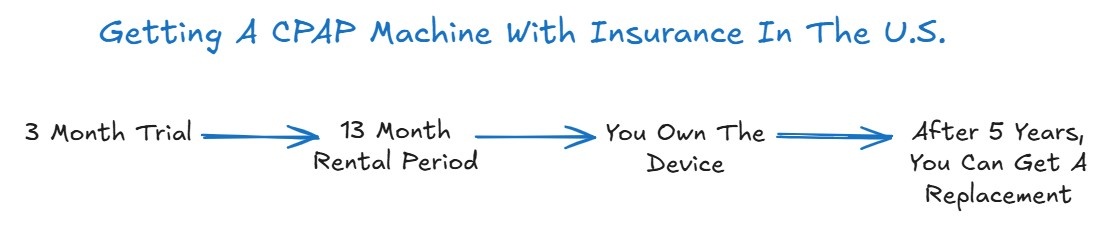
Unfortunately, since replacement coverage only kicks in every 5 years, you’re pretty much done for if you break your device.
There are exceptions, of course. You can get an early replacement if your device gets stolen or if it’s got “irreparable damage.” For your machine to be considered as the latter, the repair costs just have to be much more than what the insurer says is the limit.
Now, if there’s accidental damage while traveling? If the device somehow works, but it just kills you to use it, your insurance provider isn’t going to consider giving you a replacement.
.jpg)
From the moment you buy your machine, your likelihood of getting a replacement dwindles as the months go on, until you hit year 5.
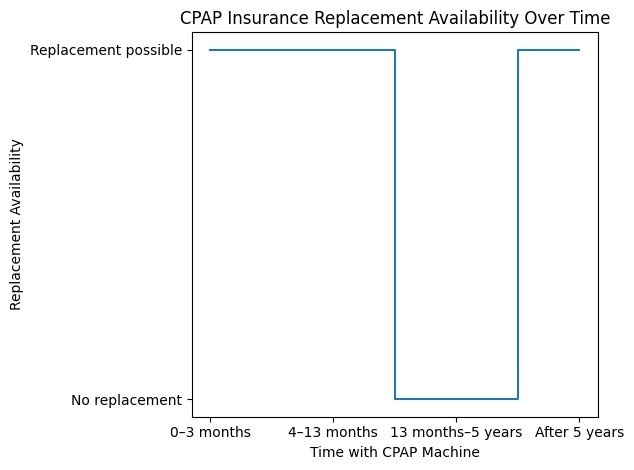
The replacement criteria usually looks like this:
The reality is, you’re on your own for a good 4 years with zero coverage for accidental damage.
Most people dealing with sleep apnea have to buy the machine themselves and then have to apply for a reimbursement with their insurance.
If you accidentally damage your device or if you lose it? It’s your headache to deal with.

“I’ve been using a CPAP since 1998 and have owned and used several models of both. All of my Philips machines had to be repaired in year one or two. I’ve had much better luck with the Resmed.”
- A battle-hardened sleep apnea patient on Reddit.
Medicare will covers 80% after Part B deductible and has the standard 5-year replacement cycle. If you have documents to prove that the device got stolen or irreparably damaged, they can potentially cover an early replacement for you.
In terms of documentation, to get proper coverage you will need:
There are a ton of steps involved in getting another device, and if you’re already losing out on your sleep, this feels like a nightmare.
If your machine breaks because of typical use, you can get another device earlier if you send in a letter, a new prescription, and get approval from your doctor and the insurer.
Canadian insurers don’t cover loss, theft, or accidental damage. A replacement is only covered for worn-out equipment after 5 years or equipment failures.
Getting accidental damage protection can save you a lot of trouble, especially if:
You don’t need to worry about any night-time accidents like pushing or pulling the machine off the table, any beverage spills, or power fluctuations. And if you channel Pitbull as Mr. Worldwide and travel all the time, you don’t need to worry about airline staff playing basketball with your luggage.
.jpg)
Trusted CPAP warranty providers like SureBright will cover all of these, along with covering the cost of pickups and/or labor, so you don’t need to check your bank account in a frenzy.
And compared to insurance, these plans make a lot more sense financially:
Insurance companies across the US and Canada have a massive coverage gap which doesn’t account for real world scenarios.
For CPAP users who travel frequently, have active households, or own premium machines, you’re basically on your own if you break your machine before the insurance replacement timeline.
As someone looking to not spend unnecessary money (because this economy is hitting everyone hard), it’s important for you to assess your risk, understand your coverage, and protect your investment before you need it.
Your CPAP machine helps you breathe at night. Accidental damage protection helps you breathe easier about the investment.
And if you’ve got other medical equipment to deal with, you should probably look into their warranty policies too.



.jpg)
.jpg)

.png)