


How dayparting, seasonality, and device-specific campaigns can help improve ROI
This white paper provides merchants with a data-driven framework for optimizing paid advertising campaigns based on insights derived from an analysis of more than 1.1 million e-commerce orders.
The analysis incorporates hourly shopping behavior percentages, seasonal volume distribution, device-specific peak timing, and cross-border market differences across US and Canada to help merchants maximize advertising efficiency and return on investment.
Data source- SureBright's proprietary dataset’s sample of one million+ transactions across both markets. All data has been fully anonymized with industry-standard privacy practices.
Note- Times presented throughout this analysis are based on each order's local timezone at the merchant's location within US and Canada, not UTC or a single standardized timezone.
The most effective e-commerce advertising strategies focus on three key areas: concentrating budget during Q4 when shopping volume peaks, increasing bids during high-conversion hours, and optimizing campaigns separately to resonate with mobile and desktop shopping peaks.
The data shows that December captures 19.9% of annual e-commerce volume, while November captures 16.7% of annual volume. Combined, these two months represent 36.6% of the year’s orders.
At an hourly level, bid adjustments should use 2.0x multipliers during the peak 11 AM - 3 PM window, which captures approximately 36% of daily orders, and 1.2x - 1.5x multipliers during morning hours, which capture approximately 23% of daily orders.
Device-specific strategies should segment campaigns to optimize separately for mobile peaks, which occur between 6-8 PM and capture 6.5%-6.7% of daily orders, and desktop peaks, which occur between 5-8 PM and capture 7.9%-8.4% of daily orders.
For merchants operating in both the US and Canadian markets, the campaign strategy should combine a universal midday focus with market-specific morning campaigns in the US, where morning hours account for 23% of orders, and evening campaigns in Canada, where evening hours account for 24% of orders. Device segmentation is especially important in the US market because mobile and desktop peak times differ more meaningfully there.
Analysis of monthly order distribution from April through December reveals that e-commerce order volume steadily climbs from a spring baseline before surging into a major Q4 peak.
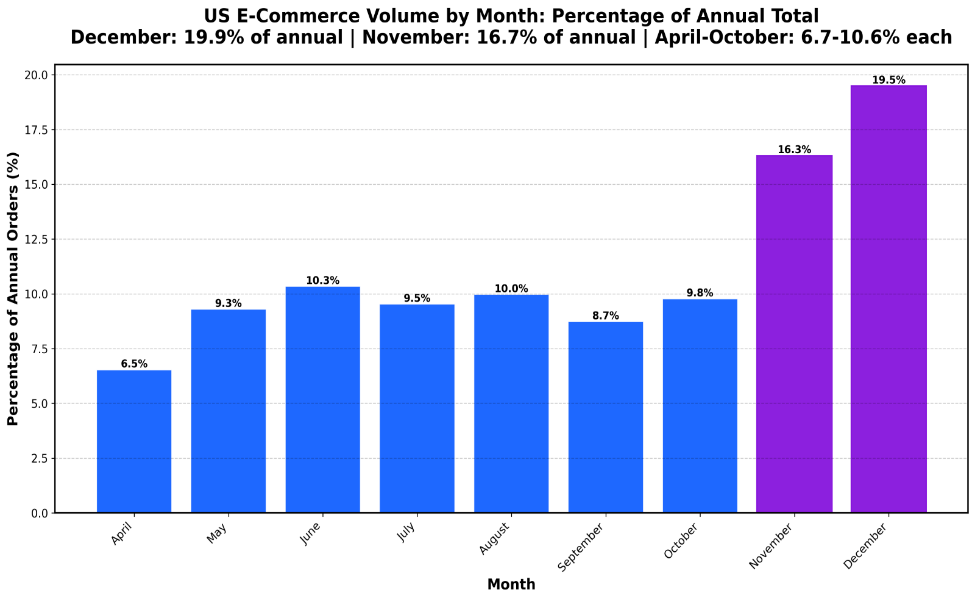
April establishes the baseline at 6.7% of annual volume. From May through October, monthly volume remains relatively stable- ranging from 8.9% to 10.6% of annual orders and averaging 9.6% per month. November increases substantially to 16.7% of annual volume, representing a 75% increase above the standard monthly baseline. December peaks at 19.9% of annual volume, representing a 2x increase above April baseline.
This concentration has direct implications for advertising budgets. Merchants that distribute advertising spend evenly throughout the year systematically underinvest during November and December. Both these months together account for 36.6% of annual orders. Under-investment means missed opportunities during the highest-volume, highest-intent shopping period of the year.
Caveat- yes, advertising becomes much costlier during year-end because of much higher competition. But skipping the season with lower ad spends doesn't seem like a good strategy based on customer buying behavior.
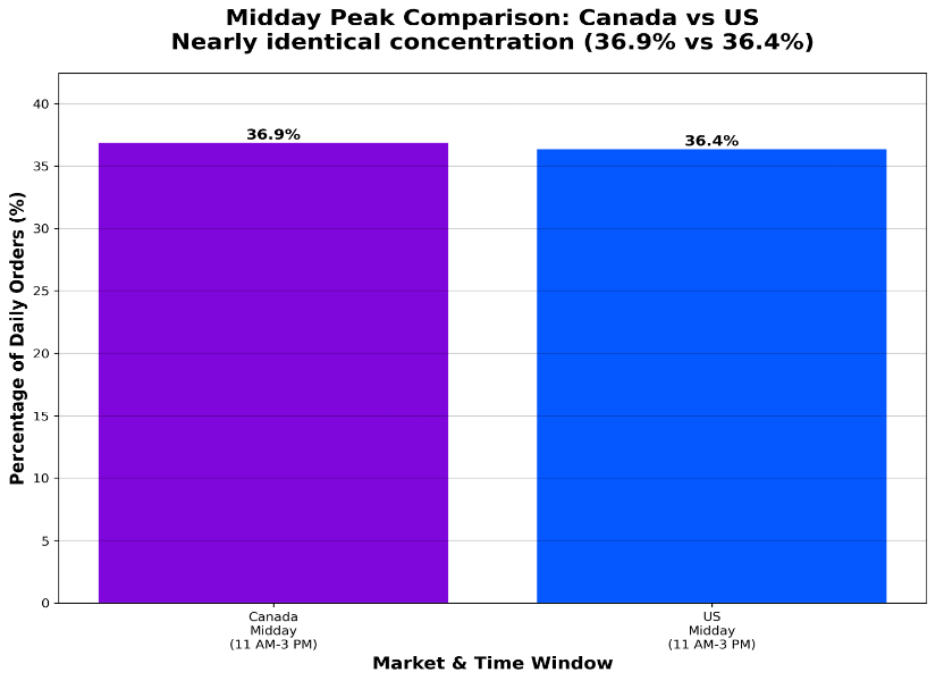
Across all months, one thing stands out. There’s a universal mid-day peak across US and Canada around noon, i.e.- 11 AM-3PM. US midday concentration accounts for 36.4% of daily orders, with noon and 1:00 PM each capturing 7.5% of daily volume. Canada shows a similar pattern, with midday accounting for 36.9% of orders and noon reaching 7.68% - marginally higher than the US noon peak.
Beyond total monthly volume distribution, the percentage of daily orders concentrated in the peak hour (noon) increases significantly in Q4. For instance in April, the noon hour accounts for 5.36% of daily orders. That figure rises to 7.70% in December - a 44% increase in peak-hour concentration.
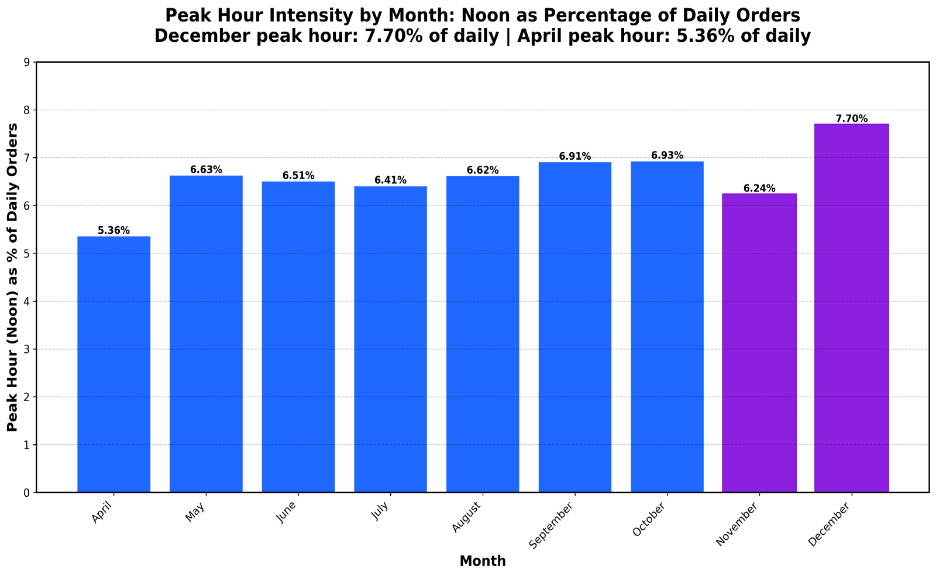
This shift means that advertising spend and operational resources must scale for both higher overall volume and greater concentration of demand during midday hours. Additionally, seasonal growth is not distributed evenly throughout the day; it becomes increasingly concentrated around peak shopping periods.
The monthly data reinforces this trend. Decembers show substantially elevated peak hour concentration- 7.70%, indicating that seasonal shoppers concentrate their purchases even more heavily during traditional lunch hours than baseline months.
These results suggest that as overall shopping volume increases during the holiday season, purchasing activity increasingly peaks around traditional lunch-hour shopping windows.
Dayparting means adjusting advertising bids on an hourly basis, and it represents the most important daily optimization lever.
Rather than distributing budget evenly across 24 hours, merchants should vary bid multipliers to align advertising spend with actual shopping behavior through the day and the percentage of orders occurring during each period.
Midnight-6 AM (0.5x bid multiplier)
This is a low-activity period, accounting for 8.6% of daily orders. A limited shopping volume essentially justifies reduced investment, which makes it an appropriate window to lower bids or pause campaigns to minimize spend during low intent hours.
6-11 AM (1.2-1.5x bid multiplier):
In the US market, there is a strong morning with the window capturing approximately 23% of daily orders. The morning ramp-up shows increasing volume percentage through the window, from 2.5% at 6 AM through 7.0% at 11 AM. Elevated bids justified by demonstrated higher volume concentration and buyer intent.
11 AM-3 PM (2.0x bid multiplier):
This is the most important shopping window of the day, capturing approximately 36% of daily orders. Individual hours within this period account for 7.3%-7.5% of daily orders, making it the highest-volume and highest-ROI period for advertising investment. Approximately one-third of all daily purchases occur during these four hours, supporting maximum bid levels and peak operational readiness.
3-6 PM (1.3x bid multiplier):
This window captures approximately 19% of daily orders. While volume declines from the midday peak, shopping activity remains elevated enough to justify higher bids than baseline levels.
6-10 PM (1.3-1.4x bid multiplier):
Evening shopping represents approximately 18% of daily orders. The period is particularly important in Canada, where it captures 24% of daily orders, compared to 19% in the US. Elevated bids can help maintain visibility during this secondary peak shopping window.
10 PM-Midnight (0.7x bid multiplier):
Late-evening activity represents approximately 7% of daily orders. Lower shopping volume supports reduced bids or campaign pausing as purchase activity declines.
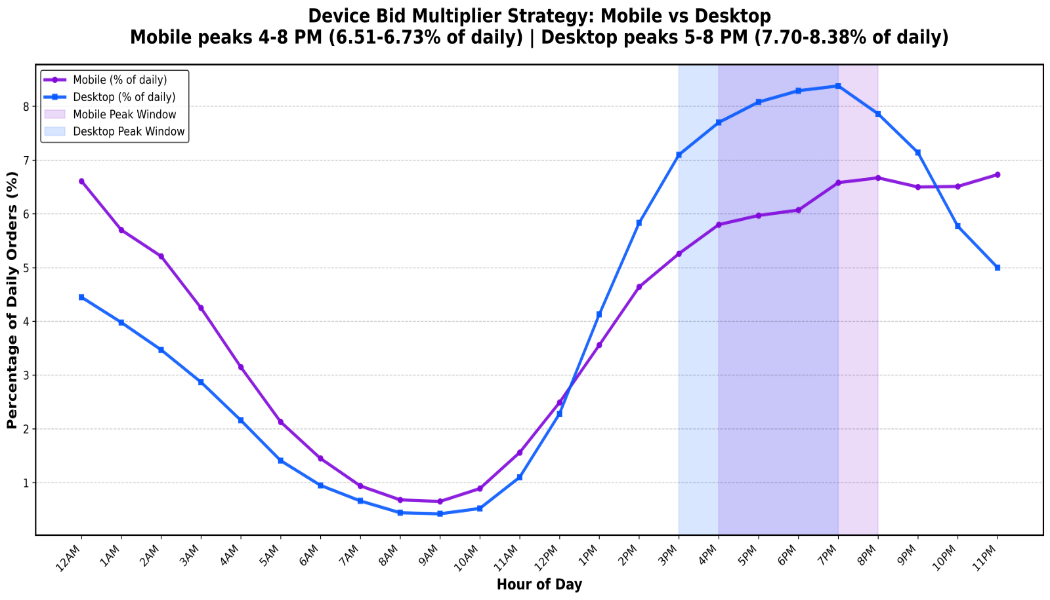
Within the US market, device-specific dayparting is essential because desktop and mobile shopping behavior peak at different times.
Desktop orders concentrate between 3PM and 7PM, with the four-hour window capturing 25% of daily desktop orders. Desktop activity peaks at 8 PM representing 8.38% of daily desktop orders.
Mobile orders concentrate between 4PM and 8PM, with this window also capturing 25% of daily mobile orders. Mobile activity peaks at 8 PM, representing 6.73% of daily mobile orders.
However, the percentage distribution differs significantly: mobile maintains elevated percentages (above 6.5% of daily orders) through 10-11 PM, while desktop declines sharply after 7 PM, dropping below 6% by 9 PM.
As a result, desktop and mobile campaigns should use different bid schedules. Desktop campaigns should emphasize the 3 PM-7 PM period, with maximum bids between 5 PM and 8 PM. Mobile campaigns should maintain elevated bids through 10 PM to capture sustained evening shopping activity. A unified campaign built around a single peak time will systematically under-serve one device segment, reducing exposure during 20%-30% of its peak opportunity.
This framework allocates approximately 40-50% of daily advertising budget to the peak midday window, 25-30% to morning and late afternoon periods combined, and 20-25% to evening and early morning hours combined.
Platforms like Google Ads and Meta Ads support automated dayparting rules that can be configured to implement these percentage-based bid adjustments.
Merchants operating in both US and Canadian markets must balance campaign efficiency with market-specific optimization.
While both markets share the same midday concentration - approximately 36% of daily orders occurring between 11 AM and 3 PM - they differ meaningfully in their morning and evening percentages.
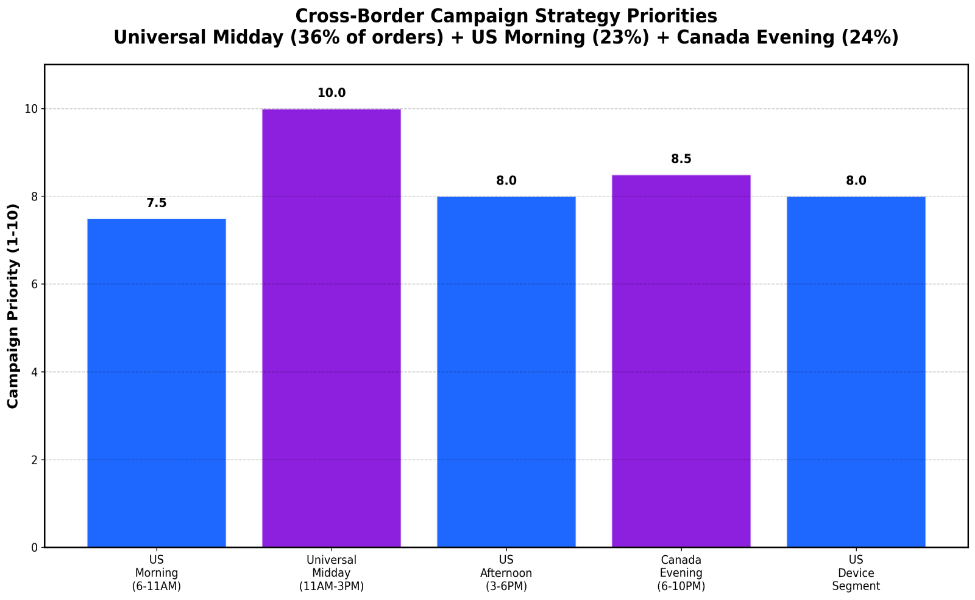
This window should be deployed identically across both markets. A single campaign structure can efficiently reach US and Canadian audiences while capturing approximately 36% of daily orders in each market. Because this period represents the highest concentration of shopping activity, it should receive maximum bids, primary budget allocation, and peak operational support. The consistency of midday behavior across both markets makes this the most scalable cross-border campaign window.
Morning campaigns should be segmented and targeted primarily toward US audiences. This window captures approximately 23% of US daily orders, supporting elevated bid levels and dedicated budget allocation.
In contrast, morning hours account for only 17.6% of Canadian daily orders, suggesting a lower-priority role for morning-focused campaigns targeting Canadian traffic.
Evening campaigns should be segmented and prioritized for Canadian audiences. Elevated bidding to capture 24% of Canadian daily volume concentrated in evening. By comparison, evening hours account for 19% of US daily orders, suggesting a lower-priority allocation for evening-focused campaigns targeting US traffic.
Within the US market, mobile and desktop campaigns should operate with separate dayparting schedules. Mobile captures 6.5-6.7% of daily orders at peak (6-8 PM); desktop captures 7.9-8.4% at peak (5-8 PM). Canada can consolidate device campaigns due to minimal device peak timing gap (only 1 hour between desktop at 11 AM and mobile at noon).
Create seven ad schedules corresponding to dayparts: Midnight-6 AM (0.5x multiplier), 6-9 AM (1.3x multiplier), 9-11 AM (1.5x multiplier), 11 AM-3 PM (2.0x multiplier), 3-6 PM (1.3x multiplier), 6-9 PM (1.4x multiplier), 9 PM-Midnight (0.7x multiplier).
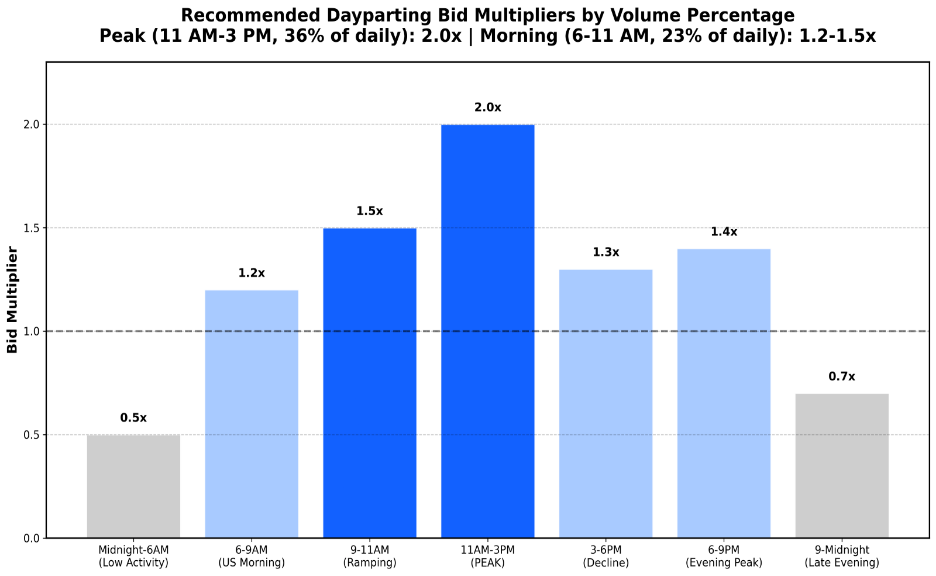
Apply these multipliers within campaign settings. Because dayparting operates alongside geographic and device targeting, schedules can be combined with location (US versus Canada) and device filters.
Promotional emails should align with peak advertising windows to maximize impact.
Morning sends (8-9 AM) align with US morning activity, which captures 23% of daily orders. Midday sends (11 AM-noon) align with the universal midday peak, which captures 36% of daily orders. Evening sends (7-8 PM) align with Canada's evening peak, which captures 24% of daily orders, and with US evening advertising schedules.
Coordinating email and paid advertising increases audience exposure during peak shopping periods.
Use daypart performance data to guide creative testing. Develop morning-specific creative emphasizing work-hour convenience for 6-11 AM campaigns, which capture 23% of daily orders. Develop midday creative emphasizing lunch-hour engagement for 11 AM-3 PM campaigns, which capture 36% of daily orders. Develop evening creative emphasizing after-work leisure for evening campaigns. Creatives should align with the timing and shopping behavior of the audience being targeted.
Merchants implementing comprehensive dayparting, seasonal budget allocation, and device-specific campaign strategies can significantly improve advertising efficiency and boost key performance indicators.
Cost per acquisition (CPA) should typically improve by 15%-25% as bids become concentrated in higher-volume shopping windows rather than being distributed evenly across low-activity periods.
Return on advertising spend (ROAS) typically improves by 20%-35% through more closely aligning advertising investment with actual customer demand.
These strategies also improve campaign scalability. By allocating budget in proportion to seasonal demand, merchants can support higher order volume during peak shopping periods without encountering budget constraints. For example, increasing investment in December helps campaigns capture demand during a month that accounts for 19.9% of annual orders, reducing the risk of budget saturation during the year’s highest-volume period.
Operational efficiency benefits as well. Because the 11 AM-3 PM window captures approximately 36% of daily orders, customer service, fulfillment, and support teams can concentrate staffing during the highest-demand hours. Aligning resources with actual purchasing patterns improves labor efficiency while supporting a larger share of daily revenue during peak shopping periods.
Effective e-commerce advertising depends on aligning spend with when customers actually shop. The data shows that demand is concentrated across three dimensions: seasonality, time of day, and device behavior. Merchants that adjust budgets for Q4 demand, apply dayparting based on hourly shopping patterns, and optimize separately for mobile and desktop audiences can improve advertising efficiency while capturing more high-intent traffic.
For cross-border operations, the most effective approach combines a shared midday strategy with market-specific optimization. While both the US and Canada concentrate approximately 36% of daily orders between 11 AM and 3 PM, meaningful differences in morning, evening, and device-specific behavior require targeted campaign adjustments.
Ultimately, the advantage comes from aligning advertising investment with observed customer behavior rather than distributing budget evenly across months, hours, devices, or markets.

