


This comprehensive analysis compares order timing patterns, conversion rates by device, and day of week variations between the United States and Canadian markets, revealing both striking similarities and critical differences.
Data source- SureBright's proprietary dataset’s sample of one million+ transactions across both markets. All data has been fully anonymized with industry-standard privacy practices.
This report provides merchant-focused insights on timing optimization, resource allocation, and market-specific campaign strategies.
Note- Times presented throughout this analysis are based on each order's local timezone at the merchant's location, not UTC or a single standardized timezone.
For merchants operating in both US and Canadian markets, understanding the behavioral differences in purchasing patterns is essential to maximizing revenue and operational efficiency.
Both markets concentrate 36-37% of daily orders in the 11:00 AM to 3:00 PM window, establishing midday dominance as a North American constant rather than a market-specific phenomenon.
The US captures 23.4% of orders during morning hours (6-11 AM) compared to Canada's 17.6%, representing a 5.8 percentage point gap that reflects different workplace shopping behaviors.
Conversely, Canada captures 24.3% of orders during evening hours (6-11 PM) compared to the US's 19.2%, a 5.1 percentage point evening advantage that suggests sustained after-work shopping activity.
Device timing reveals the most significant cross-border difference: US mobile shoppers peak at 4:00 PM while Canadian mobile shoppers peak at noon- a four-hour reversal in behavior for the same device type across adjacent markets.
Before examining where US and Canadian markets diverge, it is essential to establish where they align. The four-hour window from 11:00 AM through 3:00 PM represents the single most important commonality for cross-border merchants: both markets concentrate their purchasing activity at nearly identical rates during this period.

US midday concentration accounts for 36.4% of daily orders, with noon and 1:00 PM each capturing 7.5% of daily volume. Canada shows a similar pattern, with midday accounting for 36.9% of orders and noon reaching 7.68% - marginally higher than the US noon peak.
This near-perfect alignment resolves a fundamental question for cross-border operations: whether unified timing strategies can work across both markets.
For midday-focused initiatives, the answer is definitively yes- the behavioral patterns during these four hours overlay almost perfectly, indicating that whatever drives midday shopping-lunch breaks, workplace browsing patterns, optimal decision-making windows-operates consistently across the border.
The midday consensus provides merchants with a universal anchor point for North American campaigns. Product launches, flash sales, high-stakes promotions, and time-sensitive offers can all center on 11 AM-3 PM timing with confidence that the window delivers maximum reach in both markets without timing compromise.
The most common strategic error is not misunderstanding the midday peak but ignoring it entirely. Many merchants default to evening-focused schedules based on assumptions that e-commerce shopping occurs primarily after traditional work hours. Campaigns launching at 7:00 PM Eastern enter the market when approximately 75% of the day's shopping activity has already concluded in both the US and Canada.
The morning period from 6:00 AM through 11:00 AM reveals the first major cross-border divergence. US shoppers demonstrate significantly stronger morning intent, creating a 5.8 percentage point advantage that compounds across this five-hour window.
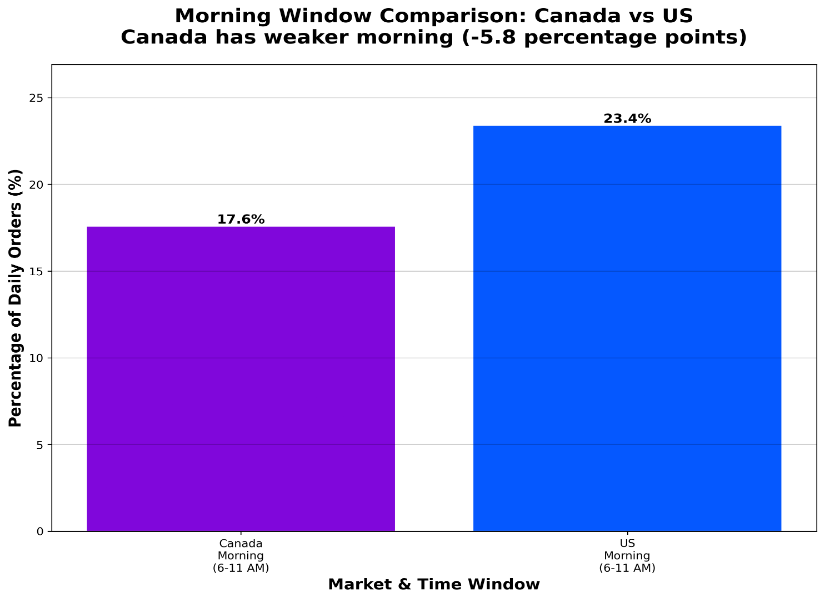
US morning activity (6 AM-11 AM) accounts for 23.4% of daily orders. The pattern shows steady volume acceleration, with each hour building progressively stronger activity from 6:00 AM (2.5%) through 11:00 AM (7.0%). Canadian morning activity accounts for 17.6% of daily orders. While Canada exhibits a steeper acceleration curve-climbing faster from a lower base-total morning capture remains 5.8 percentage points below US levels.
The underlying behavioral difference likely centers on workplace shopping. US workers appear more willing to conduct personal e-commerce transactions during morning work hours, either during commute times via mobile devices or during early office hours via desktop. Canadian morning weakness suggests either different workplace norms regarding personal online activity during work hours, later work start times, or reduced mobile shopping during morning commutes.
For merchants with balanced US-Canadian traffic processing 50,000 daily orders (25,000 per market), the morning differential represents approximately 1,450 order-timing misalignments when identical schedules are deployed across both markets. This translates directly to reduced conversion rates in Canada during morning campaign windows and underutilized US morning capacity when evening-weighted strategies are applied universally.
The evening period from 6:00 PM through 11:00 PM presents an inverse pattern. Canadian shoppers sustain elevated activity through evening hours while US shopping volume declines more rapidly after the traditional workday ends.

Canadian evening concentration reaches 24.3% of daily orders, with hours from 7:00 PM through 9:00 PM each maintaining above 5.0% share. In contrast, US evening concentration measures 19.2% of daily orders, declining steadily after 6:00 PM. By 9:00 PM, US hourly activity drops to 3.4%- approximately half the midday peak rate.
The sustained Canadian evening pattern differs qualitatively from US evening behavior. US data shows a brief post-work spike followed by rapid decline, suggesting catch-up ordering immediately after leaving work. Canadian data shows a sustained plateau from 6:00 PM through 9:00 PM before gradual decline, suggesting deliberate evening shopping sessions rather than quick transactions between work and dinner.
This 5.1 percentage point Canadian evening advantage represents the flip side of the morning gap. Where the US captures more orders during morning hours, Canada recaptures that volume plus additional margin during evening hours, creating a temporal rebalancing across the day rather than one market simply outperforming the other.
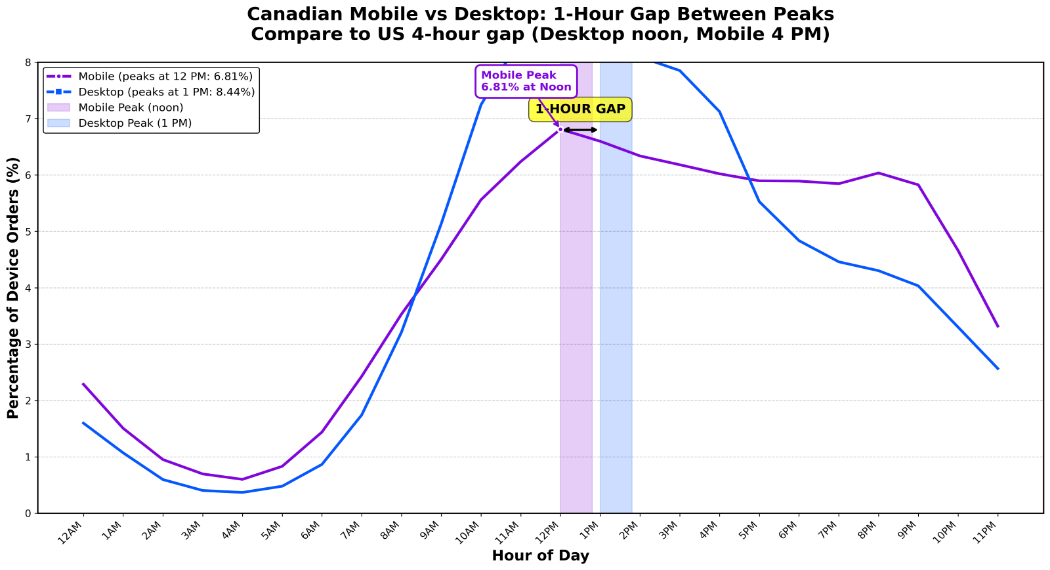
Analysis of device-specific timing patterns reveals the most significant cross-border difference affecting campaign strategy. The US market exhibits a four-hour gap between desktop and mobile shopping peaks. The Canadian market exhibits only a one-hour gap. This fundamental difference in device behavior demands completely different approaches to device-specific scheduling.

US desktop orders peak at noon, capturing 8.35% of desktop orders during that single hour. US mobile orders peak at 4:00 PM, capturing 6.75% of mobile orders. This four-hour separation indicates that desktop and mobile shopping occur in fundamentally different temporal contexts within the US market. Desktop concentration during midday lunch hours suggests workplace browsing and lunch-break transactions. Mobile concentration at 4:00 PM suggests post-work, pre-dinner shopping sessions or late-afternoon mobile browsing.
Canadian desktop orders peak at 11:00 AM, capturing 8.44% of desktop orders. Canadian mobile orders peak at noon, capturing 6.81% of mobile orders. This one-hour separation is operationally minimal-both devices peak within the same midday window, suggesting that Canadian shoppers transition more fluidly between devices during concentrated shopping periods rather than segmenting shopping by device and time of day.
In the US market, device-specific campaign scheduling is not optional- it is essential. A desktop-optimized campaign centered on noon systematically underserves mobile traffic that peaks four hours later. A mobile-optimized campaign centered on 4:00 PM launches after desktop activity has already declined 24% from peak levels. US merchants require separate device schedules with differentiated dayparting strategies.
In the Canadian market, unified device timing is viable. The one-hour gap between desktop (11 AM) and mobile (noon) peaks permits single campaign schedules centered on 11 AM-1 PM that capture both device segments at near-peak timing. This simplifies Canadian campaign operations while US operations demand increased complexity to achieve comparable optimization.
Mobile shopping patterns represent the most dramatic cross-border divergence in the dataset. Canadian mobile shoppers peak at noon. US mobile shoppers peak at 4:00 PM. This four-hour difference in mobile behavior between adjacent markets indicates fundamentally different mobile shopping contexts.

The noon peak in Canadian mobile shopping aligns with overall midday concentration, suggesting that Canadian shoppers use mobile devices during lunch breaks and midday work interruptions in patterns similar to desktop usage. The 4:00 PM peak in US mobile shopping occurs well after the midday concentration has begun declining, suggesting that US mobile shopping serves a different function-post-work browsing and purchasing during commute or transition times between work and home.
For merchants deploying mobile campaigns across both markets, this represents the single highest-risk timing error. A mobile campaign optimized for US patterns and launching at 3-4 PM to capture the 4:00 PM US peak enters the Canadian market after the noon mobile peak has already passed. Conversely, a mobile campaign optimized for Canadian patterns and launching at 11 AM-noon enters the US market three hours before mobile shopping reaches its maximum intensity.
Day-of-week analysis reveals that weekday versus weekend distinctions operate similarly in both markets, establishing this as a North American behavioral pattern rather than a market-specific phenomenon.

Weekdays in both markets produce sharper, earlier peaks with more concentrated volume during midday hours. US weekday orders peak at 1:00 PM (7.48% of weekday orders), while weekend orders peak at 2:00 PM (7.01% of weekend orders). Canadian weekday orders peak at noon (7.86% of weekday orders), while weekend orders also peak at noon but with a flatter distribution (7.23% of weekend orders).
The weekday concentration pattern likely reflects workplace shopping behavior-employees browsing and purchasing during lunch breaks and work interruptions. Weekend distribution patterns suggest more leisurely shopping sessions spread across afternoon hours rather than concentrated lunch-hour activity.
Tier 1-Universal Midday (11 AM-3 PM): Deploy identical timing in both markets. Maximum bids, peak staffing, primary budget allocation. This window works universally.
Tier 2-US-Weighted Morning (8-11 AM): Elevated resource allocation for US market. For merchants with 50-50 traffic distribution, allocate 60-70% of morning budget to US campaigns, 30-40% to Canadian campaigns.
Tier 3-Canada-Weighted Evening (7-10 PM): Elevated resource allocation for Canadian market. Extend customer service coverage, schedule email campaigns, and maintain promotional activity through 9:00 PM Canadian time.
Tier 4-Device-Specific Scheduling: In US, implement aggressive device separation (desktop 11 AM-2 PM, mobile 2-5 PM). In Canada, unified device timing centered on 11 AM-1 PM captures both segments effectively.
Mobile campaigns demand market-specific timing more than any other segment due to the four-hour peak reversal. US mobile campaigns target 2-5 PM with maximum intensity at 4:00 PM. Canadian mobile campaigns target 11 AM-2 PM with maximum intensity at noon. Deploying identical mobile timing across both markets guarantees systematic underperformance in one market or the other.
Customer service staffing patterns must reflect actual demand curves. US customer service should peak-staff from 9:00 AM through 3:00 PM with elevated morning coverage. Canadian customer service should maintain coverage through 9:00 PM with reduced morning staffing compared to US baseline.
Fulfillment center operations face different afternoon-evening loads. US facilities can implement same-day shipping cut-offs at 4-5 PM knowing that evening order volume is comparatively light. Canadian facilities should extend cut-offs to 6-7 PM to capture the stronger evening order flow before transitioning to next-day processing.
Timing optimization implementations across SureBright's merchant network demonstrate consistent improvement ranges following comprehensive timing strategy overhaul.
Conversion rate improvement during optimized windows typically ranges from 8-15% relative improvement compared to baseline. This gain reflects reaching customers when intent is highest rather than when campaigns are most convenient to deploy.
Revenue per employee hour for customer service improves 12-20% by concentrating staffing during actual peak order windows rather than traditional fixed schedules.
Email campaign performance shows 10-18% improvement in engagement metrics when send times align with demonstrated shopping behavior versus default morning-only sends.
Infrastructure cost efficiency improves 15-25% by sizing capacity for actual peak patterns rather than distributed load assumptions, reducing over-provisioned capacity during low-activity hours.
The analysis of US and Canadian e-commerce timing patterns reveals a clear strategic framework: deploy midday-first strategies universally (11 AM-3 PM), layer market-specific morning and evening optimizations where behavioral gaps exist, and recognize that device timing-particularly mobile-requires fundamentally different approaches between markets.
The four-hour gap between desktop and mobile peaks in the US market demands device-specific campaign scheduling. The one-hour gap in the Canadian market permits unified approaches. The four-hour reversal in mobile shopping patterns (Canadian noon peak versus US 4 PM peak) represents the highest-risk timing error for cross-border mobile campaigns.
These patterns are derived from over one million real transactions across both markets. Implementation requires deliberate market segmentation in areas where behavioral differences exist-morning hours, evening hours, mobile timing-while maintaining unified approaches where markets align-midday concentration, weekday patterns, desktop concentration.
For merchants operating in both markets, the path forward is clear: align operational resources and campaign timing to demonstrate behavioral patterns rather than assumptions about when customers should shop. The data has established what actually occurs. Strategic advantage belongs to merchants who adjust to reality rather than attempting to impose unified assumptions on divergent markets.

