.jpg)


Tl;dr - Shopify has two AI problems. The support chatbot traps merchants in loops with no human exit. Sidekick and Magic hallucinate data, ignore instructions, and weren't built for precision work. The fix is to use Magic for drafts only, never for exact data, and keep "speak to agent" option ready for when the bot gives up before you do.
Dear Shopify,
We need to talk about your AI problem... both of them.
See, last year, a merchant tried to do something pretty ordinary:
“We are dealing with a minor issue I couldn't solve this morning so I reached out to the AI support chat. After a few minutes when the AI couldn't solve the problem it suggested I talk with a human and provided me a link to talk with human support. Seems simple enough, right? WRONG!”
It took them to another bot. Which in turn transferred to another bot.
And twenty attempts later, they still hadn't spoken to a human.
The support AI kept acknowledging it couldn't solve the problem. Then, instead of connecting them to someone who could, it suggested they draft a better message to itself to increase their chances of eventually reaching a human.
A bot. Telling you to write a more persuasive email. To the bot.
That's going overboard, mate!
But this isn't just a customer service problem. Shopify has two very different AIs, and according to the Shopify community and other forums- they're both failing merchants in very different ways.
There's the support AI - the one that traps you in a loop when something breaks. And then there's Sidekick and Shopify Magic - the AI tools built to help you actually run your store. One can fail you when you need help. The other can break the thing you needed help with in the first place.
Built on the same ideas, ending in two very different failures.
Before anything else (and this is important) "Shopify's AI" is not one thing. Here's the actual breakdown:
To understand why Shopify’s support chatbot is the way it is, we have to go back a couple of years.
It is 2022, the post-COVID era has just started, and companies are trying to cope with volatile market conditions. So, Shopify ends up laying off 10% of its workforce, with the support team hit the hardest. Then, in May 2023, it did it again to 20% of its staff, including more support workers.
The support division, by most accounts, was now already on fire. So, Shopify decided to create a makeshift fire extinguisher by launching an internal initiative called "Code Yellow" in the first half of 2023. It was supposed to help the department, and the use of AI for merchant support was a core part of that effort.
Does that mean AI was simply brought on board to patch a broken system?
That’s a question for another time. What we should be asking instead is...
To put it simply, merchants are increasingly reporting that automated systems intended to assist them are instead trapping them in loops that prevent access to human involvement.
It might sound scary, like the beginning of a real-life terminator franchise. But in reality, it is pretty basic, as explained by this Redditor:
“They often pull from a really wide, sometimes outdated knowledge base, so they end up hallucinating answers for specific technical questions.”

Interestingly, it's not just budget-tier merchants either.
Olivia Sawyer, CEO of Kush Queen, a CBD boutique paying Shopify tens of thousands of dollars a year for 24/7 help and a dedicated support representative said her team hadn't heard from their Shopify rep in about two years, with all requests now filtered through the chatbot.
Even Shopify Plus customers paying premium fees report declining support quality, with live agents described as under-informed and reliant on scripted FAQs rather than offering meaningful help.
There's also an absurd footnote buried in how this all developed. An early version of Shopify's AI support chatbot made merchants so angry that developers had to build in a feature that connected them to human help faster if they started swearing at it.
Yep. You read it right.
And that’s exactly what this poor Redditor should have done:
“Literally, how do I get past this freaking AI support?!!?!?? It keeps asking me to describe my issue, so I do, and it asks if I want to talk to support, and when I click on it, the button just keeps duplicating, and I can't get past it!”
When the magic word is a swear word, the system’s casting the wrong spell.
Maybe that’s why the Better Business Bureau agrees, in its own way. Shopify currently holds an 'F' rating with the BBB, with over 1,100 complaints filed in the last three years alone. This is mainly because (now tighten your seatbelts) sudden account holds, impossible billing disputes, and customer service that goes nowhere.
Now, if you are wondering if the technology to do this better exists... it clearly does. It just hasn't been prioritized in this case.
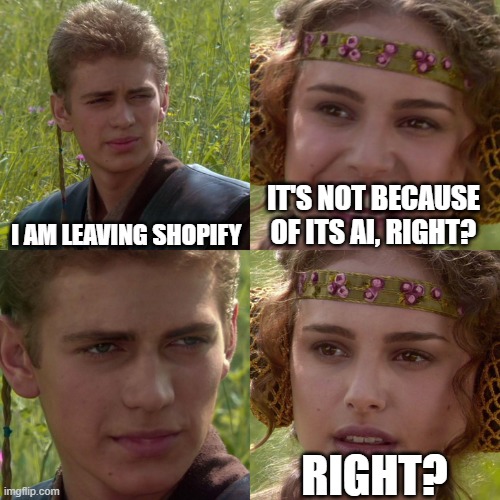
Well... no.
To be fair, the pitch for these tools is genuinely compelling. Shopify Magic is described as "AI that accelerates your ambition", integrated across the platform, powering product descriptions, email campaigns, image editing, customer inbox replies, and the whole shebang.
Sidekick is framed as your "24/7 commerce expert," able to analyze your store data, generate content, automate workflows, and even build custom admin apps.
Then where’s the magic and... uhh... the sidekick? This user’s experience might helps you understand it all better:
“I am posting this as a final warning to other merchants. After 5 months of struggling with Shopify’s AI tools (Sidekick and Shopify Magic), I have decided to migrate my store to another platform. The AI has proven to be not only unreliable but actively detrimental to my brand’s management and SEO strategy.”
The specific problems they outlined were: the AI hallucinating and inventing alphanumeric product codes, corrupting their catalog organization; ignoring explicit "negative constraints" terms that must never appear in their brand copy; repeatedly reverting Spanish content back to English despite clear instructions; and forcing them to manually audit over 80 products because the AI couldn't follow basic rules like "keep it under 160 characters."
The Sidekick and Magic tools weren’t supposed to do that. So why did they do it?
Let’s discuss it all, but before that we must get one thing out of the way...

We all know that the internet sometimes disproportionately amplifies frustration.
If you think about it when Shopify Magic writes you a solid product description and saves you 20 minutes, you don't post about it on Reddit. When it hallucinates your product codes and ruins your afternoon, you absolutely do.
Complaints travel but satisfaction stays in the background.
This doesn't mean the problems aren't real. The documented incidents in this blog are real, sourced, and well-attested. But it does mean the overall picture is probably more mixed than a tour through r/shopify would suggest.
The more honest take is that Shopify's AI tools are genuinely useful for a specific range of tasks, and genuinely problematic for a different range. The issue is that the marketing doesn't always make clear where one ends, and the other begins.
Now comes the part where I advice you to "use it carefully!" and call it a day. But this time, that’s not going happen because that's not helpful. Here's what to actually do:
The most reliable way to escape the loop is persistence with specificity.
Typing "speak to agent" or "human support" repeatedly does eventually force an escalation. Even the bot has limits before it has to hand off. You can also state the financial impact immediately. Phrases like "this issue is directly costing me sales" or "I am losing money every hour this is unresolved" are documented to get faster escalation.
Document everything with screenshots and screen recordings. If all else fails: filing a BBB complaint is a legitimate pressure lever. Shopify's F rating there means they take incoming complaints seriously as a reputational matter.
And then there's the community. This is genuinely useful: r/shopify's 300,000+ member community has, somewhat ironically, become a more reliable place to get real answers than Shopify's official support.
Use it for drafts, not finals.
Shopify Magic is genuinely good at getting you 70% of the way to a product description or email subject line. It is not reliable enough to be the last step before publication, especially for anything SEO-sensitive, data-specific, or brand-critical.
Never trust it with exact data. As the community forum incident above showed, Shopify's own support admitted Sidekick is designed for "prose," not exact data. Shopify Community Alphanumeric codes, character-limit-sensitive meta descriptions, multilingual content that needs to stay in a specific language, verify all of it manually before it touches your store.
For customer-facing support, don't rely on Sidekick at all. Use a purpose-built tool. Gorgias and Tidio are both well-integrated with Shopify and designed specifically for the customer support workflows Sidekick wasn't built to handle.
Shopify's AI problems aren't really about the technology. The technology is fine... sometimes good. The problem is the gap between what's being promised and what's being delivered, and the fact that when things go wrong, the safety net isn't there.
But Shopify is moving fast to improve things. The Winter 2026 release brought over 150 new features, with Sidekick significantly rebuilt, now capable of generating custom admin apps, simulating buyer behavior, and operating more like a proactive business advisor than a reactive chatbot. The trajectory is upward.
Until then, keep "speak to agent" in your copy-paste clipboard.
.jpg)


M Khizar is a writer enjoys making complicated things feel simple. He writes about warranties, ecommerce, and the small details people usually overlook, until they matter. His work focuses on clarity and helping readers make smarter decisions without overthinking it. Outside of work, he enjoys reading, writing personal blogs, and binge eating with friends.


.jpg)

.png)
