


Tl;dr - Traditional advertising is dead. Hyperlocal marketing is what replaced it. The technology is already in your pocket and on your ad platforms. Geofencing, real-time GPS targeting, near-me SEO, and a fully optimized Google Business Profile can drive more foot traffic and conversions than any billboard campaign ever did and at a fraction of the cost. And no, pincode targeting on Facebook and Google isn't the same thing. That tells you where someone sleeps. Hyperlocal tells you where they're standing right now.
Thank you for coming to the funeral of traditional advertising. We have snacks, beverages, and most importantly its replacement – Hyperlocal marketing.
You might know its sibling, local marketing.
But this isn't that. This is sharper, faster, and frankly my dear, more powerful than anything most businesses have tried before.
Sure, traditional advertising had a good run. Billboards, TV spots, mass email blasts... all were really effective, but it is time to say goodbye to them all.
Why?
Well, simply because today, 98% of users searching location based queries choose a business on the first page of local search results. And 76% of people who search for something nearby on their phone visit a business within a day.
So, as a marketer or a merchant, what you can do to get ahead in this increasingly phygital (physical + digital) world is to go hyperlocal.
Yes, we're talking about targeting people on a specific street, inside a specific neighborhood, sometimes within a few hundred meters of your front door. While mass marketing or even local marketing is similar to shouting into a crowd; what hyperlocal marketing does is tap exactly the right person on the shoulder to get their attention.
And the brands that are using it are seeing better engagement. They're seeing foot traffic, calls, and conversions that mass marketing could never touch, just read what this Redditor has to say:
“We faced the same uphill battle. trying to get distributors to take us seriously when we had solid consumer feedback but not enough scale. We leaned hard into hyperlocal ads and -honestly saw some traction once we dialed it in right.”
So, if you've been spending money on ads that feel like they're disappearing into the void, keep reading. This is the playbook you didn't know you needed.
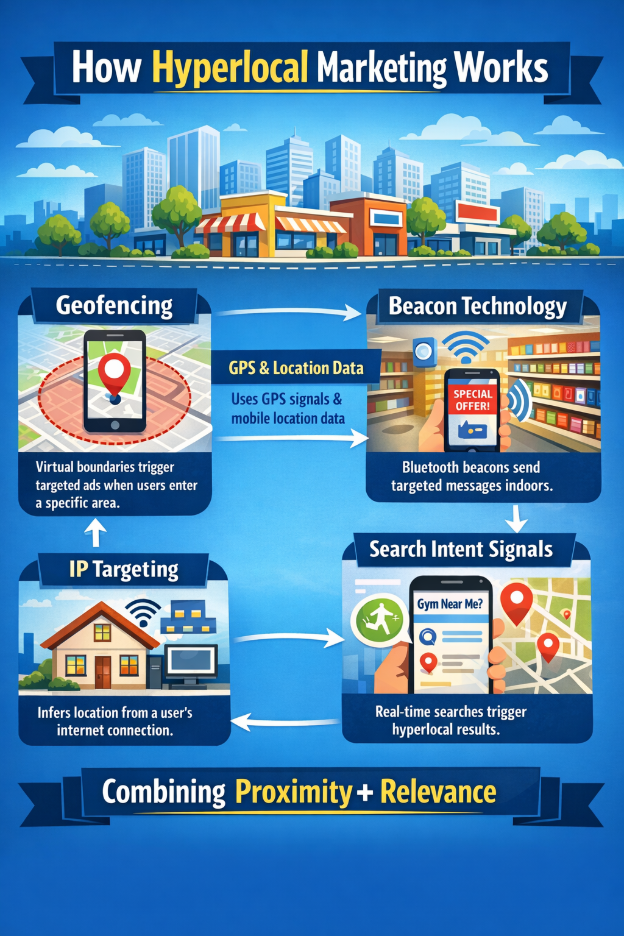
Short answer: it involves targeting potential customers in a very specific, tightly defined geographic area like a single neighborhood, a few city blocks, or even a radius of a few hundred meters around a specific location.
Hyperlocal Marketing combines location data, behavioral signals, and real-time context to reach people at the exact moment they're most likely to act.
Many people use these terms interchangeably, but there’s a lot of difference between both:
In essence:
Local marketing shows that you exist in the city.
Hyperlocal advertising shows that you’re 300 meters from where your customers are standing, and you have exactly what they’re looking for.
“I started specializing in hyperlocal real estate about 6 years ago. The method works amazing... I used video to take over visibility in every area in a city overnight, works great.”
And that’s not just one Redditor - many other users across multiple platforms and industries have said the same thing.
So, why is this strategy becoming such a sweetheart for marketers? There are several reasons behind it:
That is why, not only smaller brands, but big sharks have adopted this channel too. For instance, here’s CEO of Mercedez-Benz Dimitris Psillakis talking about how it is used in their marketing approach:
With such a wide traction, the question we must now ask is...
You can try hyperlocal advertising if you are tired of shouting into the crowd, running ads that get clicks, but not foot traffic, calls, or actual sales, or are ready to reach high-intent customers.
When used properly with the right data to back it up, this strategy can help you get:
Yeah, that is a fair and important question to ask.
Both Meta and Google have offered pincode-level advertising for years. You can target by zip code, city district, or draw a radius on a map. So what exactly is new here?
To answer honestly pincode targeting was a massive step forward, but it's not the same as true hyperlocal marketing. Here's the difference:
Interesting, isn’t it? Now let’s talk about how you can enforce it successfully in your marketing.
Knowing what hyperlocal marketing is and actually executing it well are two different things. So, to help you all throughout your endeavors, we’ve pulled together hyperlocal ad strategies that consistently deliver results.
This is non-negotiable and, surprisingly, still underused. Your Google Business Profile is the single most powerful hyperlocal asset you have as it controls how you appear in local search, Google Maps, and the local pack (the three business listings that show up above organic results). Keep it updated with accurate hours, photos, services, and most importantly, actively collect and respond to reviews. Businesses with a rating above 4.0 and regular review responses consistently rank higher in local search. This costs nothing except attention.
Organic social content that references your neighborhood, local events, and community creates a kind of hyperlocal signal even without paid targeting. When someone in your area sees your post mentioning their local market or upcoming festival, the relevance becomes immediate.
For businesses with a mobile app or loyalty program, proximity-triggered push notifications can be powerful tool to garner leads. A notification that fires when a loyalty customer comes within 500 meters of your store, offering them a personalized deal, converts at significantly higher rates than a generic mass notification.
Use geofencing to target people within a defined radius of your location, or around competitor locations or high-footfall points nearby (markets, transit stations, malls). Run these campaigns on Google Ads, Meta, or programmatic display platforms.
Optimize your website and content for near-me and location-intent searches. This means having location-specific landing pages if you have multiple locations, using structured data markup (schema) to help Google understand your business's location and services, and producing content that's locally relevant.
A bakery in Vegas, for example, could write about the best breakfast spots in Vegas and naturally appear in searches made by people already in that neighborhood.
Use location-based and proximity targeting to reach people based on where they are, where they’ve been, or even where they’re heading using tools like WeatherAds.
Now layer in weather-based targeting. This strategy serves ads based on real-time weather conditions in a user’s area. Something like “enjoy the rain with our coffee” for a cafe.
The funeral of traditional advertising really means that mass reach was never the goal. Reaching the right person always was.
But here's something most hyperlocal marketing guides won't tell you: getting the customer through the door is only half the battle. The other half is making sure they come back and more importantly, that they trust you enough to tell their neighbors about you.
This is where the smartest local businesses are pulling ahead. They're pairing sharp location-based marketing with an equally sharp post-purchase experience by offering trust and peace-of-mind through product protection plans.
By including, warranties on your products you can make sure your customers keep coming back to you. And that’s just what SureBright helps you do.
SureBright lets retailers and brands embed warranty coverage seamlessly into the purchase journey, turning a one-time transaction into an ongoing relationship. The customer who bought from your store and got a warranty they actually used won’t need to be geofenced again.
So, take a step towards that step and book your demo with an expert.
1. What is the difference between geofencing and geotargeting?
A. They're related but distinct. Geotargeting means serving ads to people in a specific location. It's based on where someone is or where they've indicated they are. Geofencing goes a step further by creating a virtual boundary around a physical space and triggering an action.
2. How small can a hyperlocal target area be?
A. Technically, you can geofence an area as small as a single campus or a radius of about several hundred meters on most platforms. In practice, the sweet spot for most businesses is a 500 meter to 2 km radius, depending on the density of the area and what you're selling.
3. Is hyperlocal marketing only for small or local businesses?
A. Not at all. Large national and global brands use hyperlocal strategies extensively, particularly for product launches, event activations, and competitive conquesting. Quick-service restaurant chains, for example, routinely geofence competitor locations and transit hubs.
4. How much does hyperlocal marketing cost?
A. There's no fixed answer, but the entry point is lower than most businesses expect. A geofenced Google or Meta campaign can be started with a few hundred dollars per day.
5. Does hyperlocal marketing work for service businesses, not just retail?
A. It works exceptionally well for service businesses. Plumbers, electricians, salons, clinics, tutors, home services - any business where the customer's location determines who they can realistically hire is a natural fit.
6. What metrics should I track for a hyperlocal campaign?
A. The metrics that matter most are store visits or foot traffic (available through Google Ads and Meta for eligible accounts), click-to-call rate, direction requests on Google Maps, local search ranking position, and conversion rate from location-based ads. Impressions and reach matter less in hyperlocal than in broad campaigns. After all, you're optimizing for action, not awareness. But if your campaign is generating direction requests and calls from people nearby, it's working.
.jpg)


M Khizar is a writer enjoys making complicated things feel simple. He writes about warranties, ecommerce, and the small details people usually overlook, until they matter. His work focuses on clarity and helping readers make smarter decisions without overthinking it. Outside of work, he enjoys reading, writing personal blogs, and binge eating with friends.



.png)