


This white paper examines Canadian e-commerce order timing patterns based on a representative sample of 1 Million+ anonymized orders collected through SureBright's merchant network. The analysis reveals that Canadian purchasing behavior closely mirrors the US pattern in its fundamental structure - midday business hours dominate order volume - but with notable differences in the strength of morning and evening windows that have specific strategic implications for Canadian merchants.
The central finding is that 36.9% of all Canadian e-commerce orders occur during the four-hour midday window from 11:00 AM to 3:00 PM. This concentration is nearly identical to the US figure of 36.4%, establishing the midday peak as a North American behavioral characteristic rather than a country-specific pattern. However, Canadian morning hours are weaker (17.6% versus 23.4% in the US), while Canadian evening hours are proportionally stronger (24.3% versus 19.2% in the US), creating market-specific optimization opportunities.
This research is based on a representative sample drawn from SureBright's proprietary dataset of real Canadian merchant transactions spanning multiple e-commerce categories. All data has been fully anonymized to protect merchant and customer privacy, with industry-standard data security practices applied throughout collection, analysis, and reporting. The sample analyzed includes a large volume of Canadian orders segmented by hour of day, price tier, and day of week.
Times presented throughout this analysis are based on each order's local timezone at the merchant's location, not UTC or a single standardized timezone.
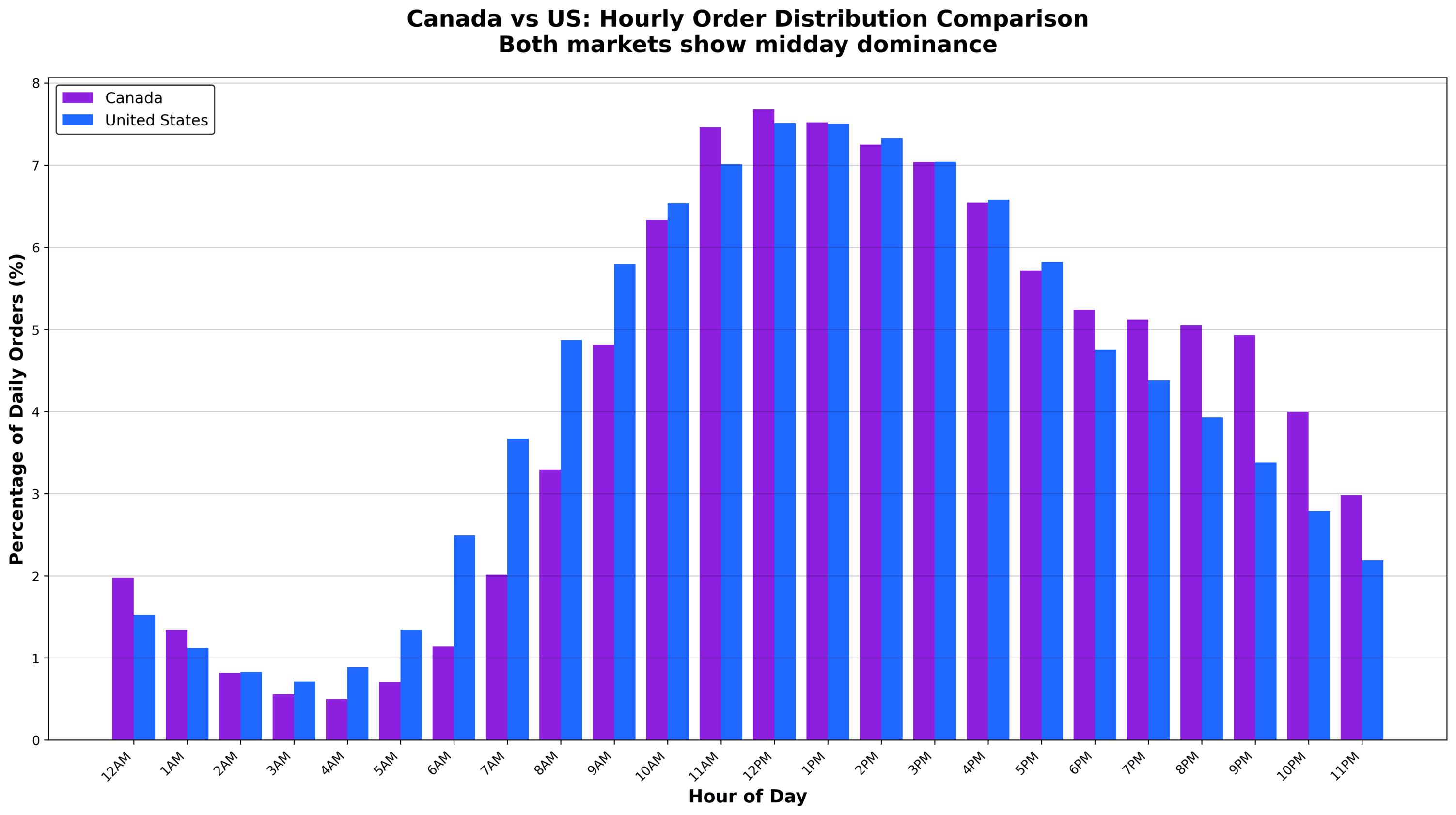
The hourly breakdown of Canadian e-commerce orders shows the same fundamental structure as the US market: a morning build, a sustained midday peak, and an evening decline. However, the Canadian pattern exhibits a sharper morning ramp and a slower evening decline, creating a distribution that is simultaneously more concentrated at the peak and more extended into evening hours.
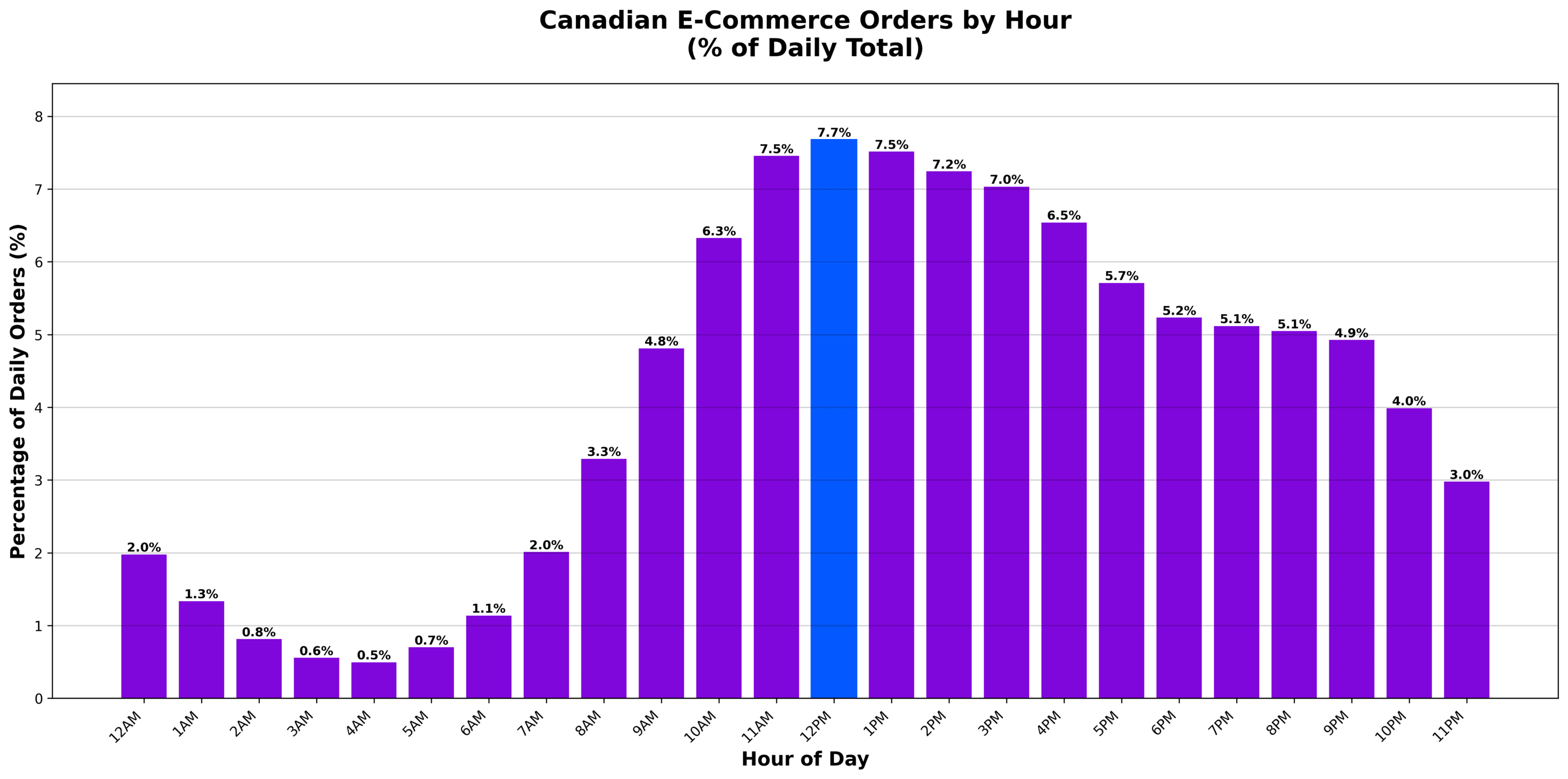
From midnight through 5:00 AM, Canadian order volume follows the expected overnight lull, representing a minimal share of daily activity. What distinguishes the Canadian pattern is what happens next. Beginning at 6:00 AM, volume ramps up more sharply than in the US. By 9:00 AM, Canadian orders have reached 4.8% per hour; by 10:00 AM, 6.3%. The morning acceleration is faster, but the total morning contribution (6 AM-11 AM at 17.6%) is lower than the US equivalent (23.4%).
This suggests that Canadian shoppers are not spreading their morning activity as broadly as US shoppers. Instead, they are compressing their pre-peak activity into a tighter late-morning window. The Canadian pattern shows less gradual build and more sharp ramp directly into the midday plateau.
Canadian orders reach their maximum concentration from 11:00 AM through 3:00 PM, collectively capturing 36.9% of daily orders. Noon is the single highest hour at 7.7% - marginally higher than the US peak of 7.5%. The four consecutive hours from 11 AM to 2 PM all exceed 7.2%, creating a sustained high-intent window.
The near-identical midday shares between Canada (36.9%) and the US (36.4%) confirm that this is not a US-specific pattern but a broader North American behavioral characteristic. Regardless of currency, geography, or slight cultural differences, consumers in both markets are shopping most actively during traditional business hours, not after work.
Where Canada diverges most noticeably from the US is in evening behavior. From 6:00 PM through 11:00 PM, Canadian orders represent 24.3% of daily volume compared to 19.2% in the US - a 5.1 percentage point difference. Canadian evening hours don't decline as sharply as US evening hours. The 7:00 PM, 8:00 PM, and 9:00 PM hours each maintain above 5% share, whereas US evening hours drop more rapidly after 6:00 PM.
This extended evening pattern may reflect several factors: different work-life rhythms, later dinner hours in certain regions, or simply a cultural tendency toward evening leisure activity that includes online shopping. Regardless of cause, the implication is clear: Canadian merchants should maintain elevated campaign presence through evening hours more aggressively than US strategies would suggest.
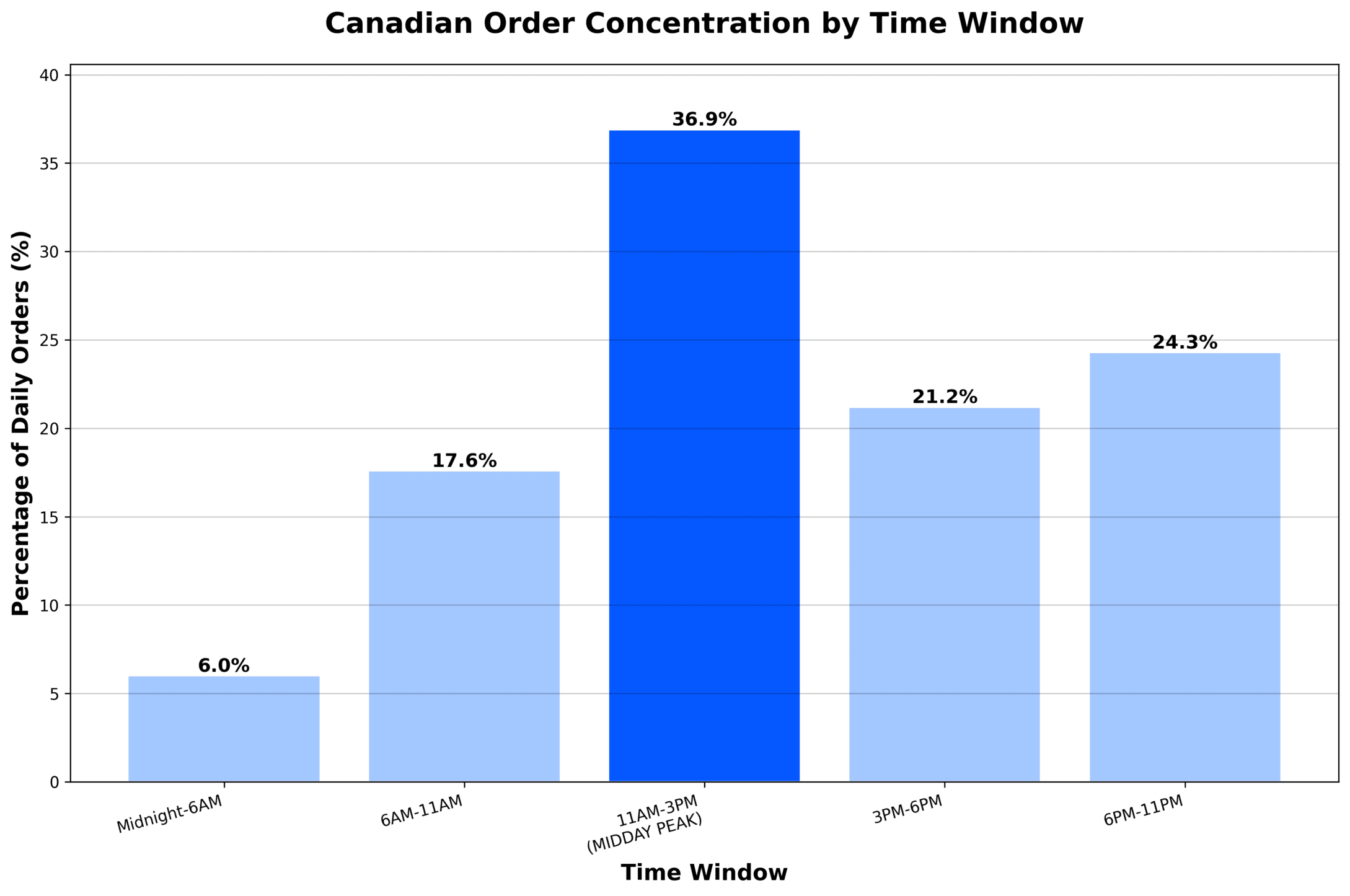
The shape of the Canadian distribution creates three strategic zones. The first zone is morning (6-11 AM at 17.6%), which should be treated as a ramp-up period rather than a primary target. Morning campaigns in Canada should be more conservative than US-calibrated strategies would recommend. The lower morning share suggests Canadian consumers are less likely to shop during early work hours.
The second zone is midday (11 AM-3 PM at 36.9%), which is the universal primary target for both Canadian and US merchants. Any time-sensitive campaign, product launch, or promotional activation should default to launching during this window unless specific data justifies an exception.
The third zone is evening (6-11 PM at 24.3%), which in Canada deserves more strategic attention than it does in the US. While still secondary to midday, the Canadian evening captures a meaningful 24% of daily orders and should not be deprioritized as aggressively as evening hours in US-focused strategies.
Understanding where Canadian timing diverges from US patterns is essential for merchants operating in both markets or for Canadian merchants adapting US-developed strategies to their local context.
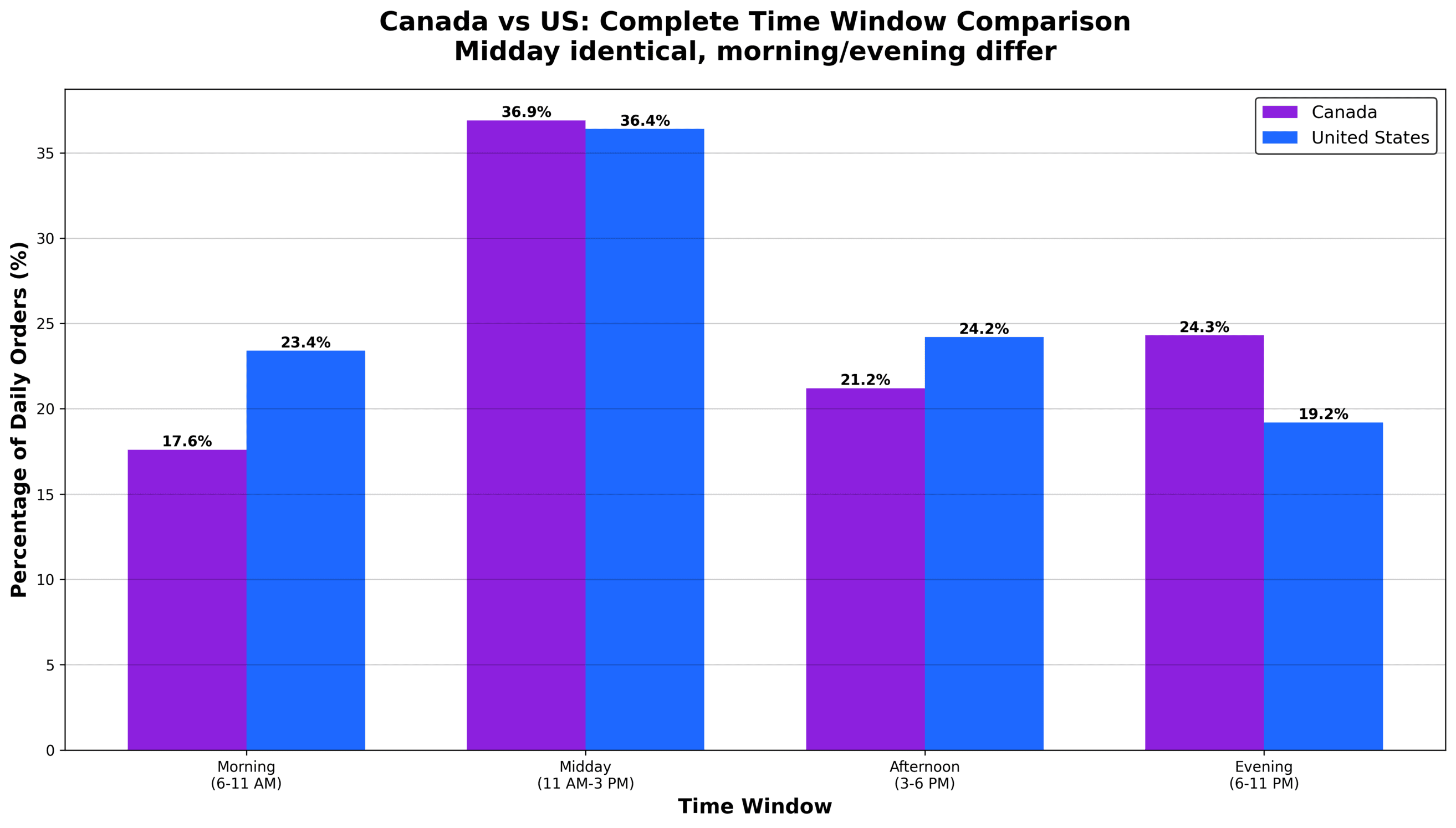
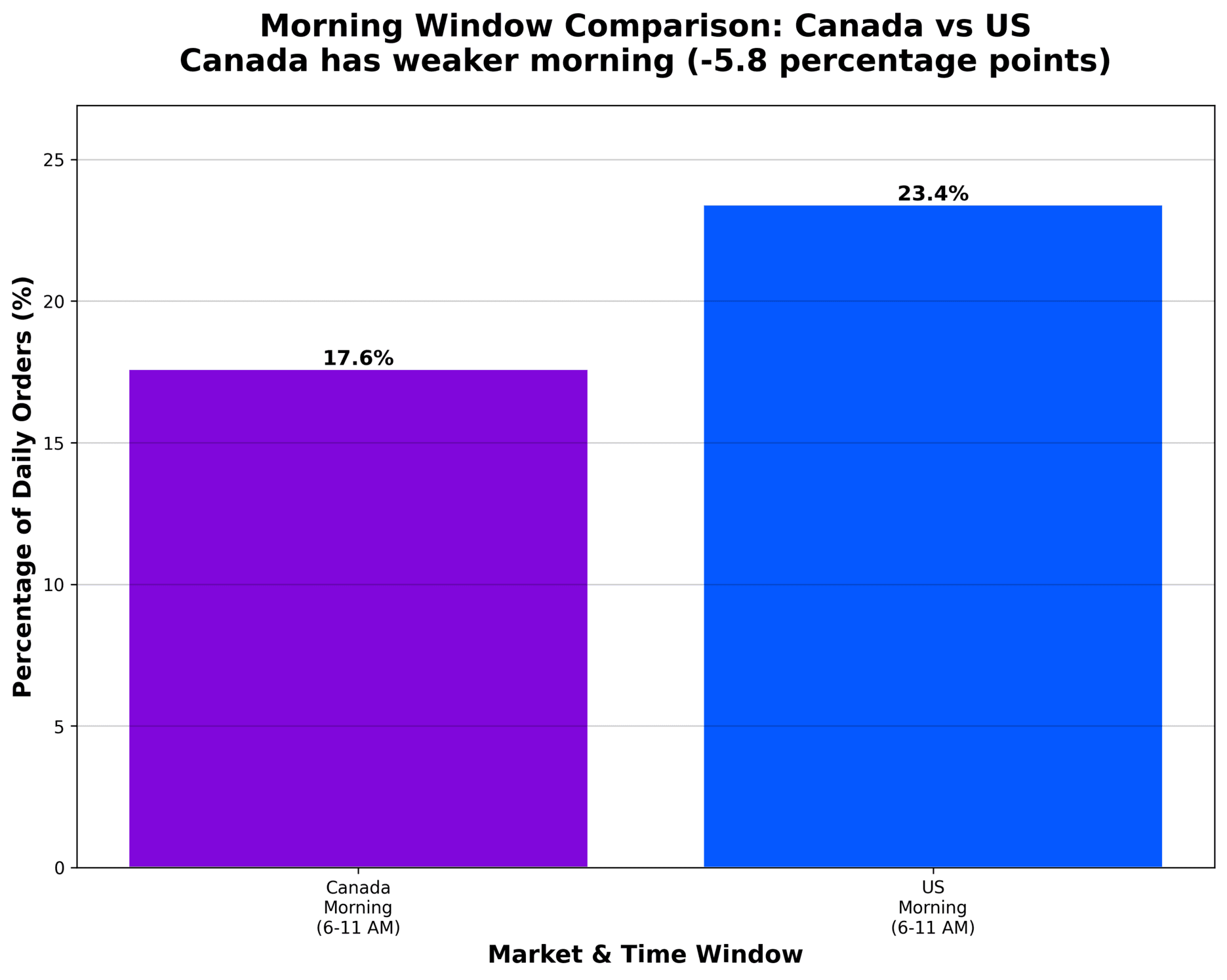
The 5.8 percentage point gap between Canadian morning (17.6%) and US morning (23.4%) represents the single largest difference between the two markets. This gap has direct implications for morning-targeted strategies. A US merchant running successful campaigns at 9:00 AM should not assume those same campaigns will perform proportionally in Canada. The Canadian market simply has less morning activity to capture.
Why this gap exists is less clear from the data alone, but possible explanations include different workplace cultures around personal browsing during work hours, later start times for online shopping activity, or demographic differences in when consumers are awake and active. Regardless of cause, the strategic implication is clear: Canadian morning campaigns should be allocated less budget relative to midday than US strategies would suggest.
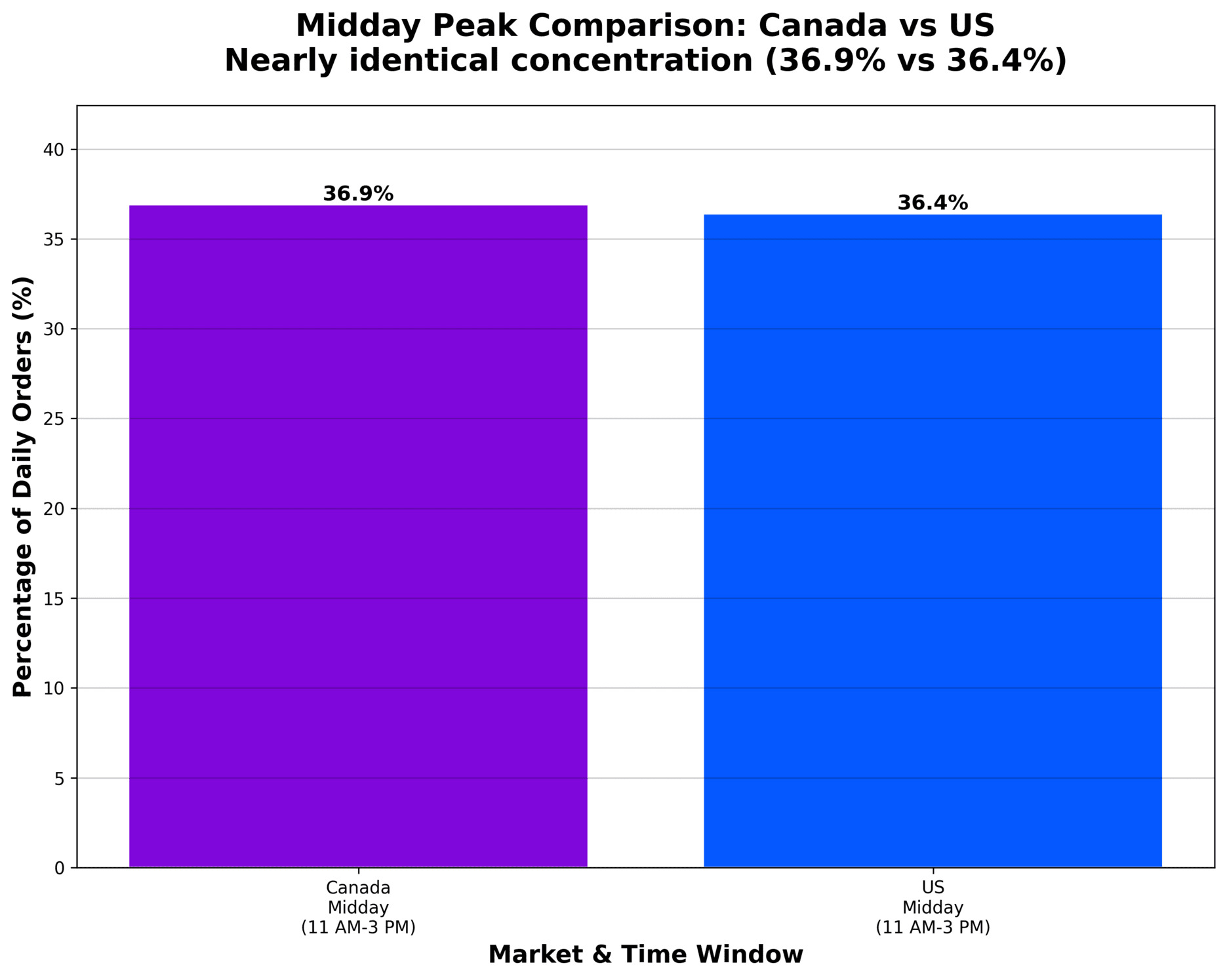
The 0.5 percentage point difference between Canada (36.9%) and the US (36.4%) in the midday window is effectively negligible. Both markets concentrate slightly over one-third of their daily orders in the four-hour 11 AM-3 PM slot. This consistency means that cross-border merchants can use midday as a unified target without material market-specific adjustments.
The Canadian peak hour (noon at 7.7%) is marginally higher than the US peak hours (noon and 1 PM at 7.5%), suggesting slightly tighter clustering in Canada. Canadian shoppers appear to concentrate their activity more sharply at the exact peak rather than distributing it across the full midday plateau. This is a marginal effect but suggests that in Canada, being present precisely at noon matters slightly more than being present at 1:00 PM or 2:00 PM.
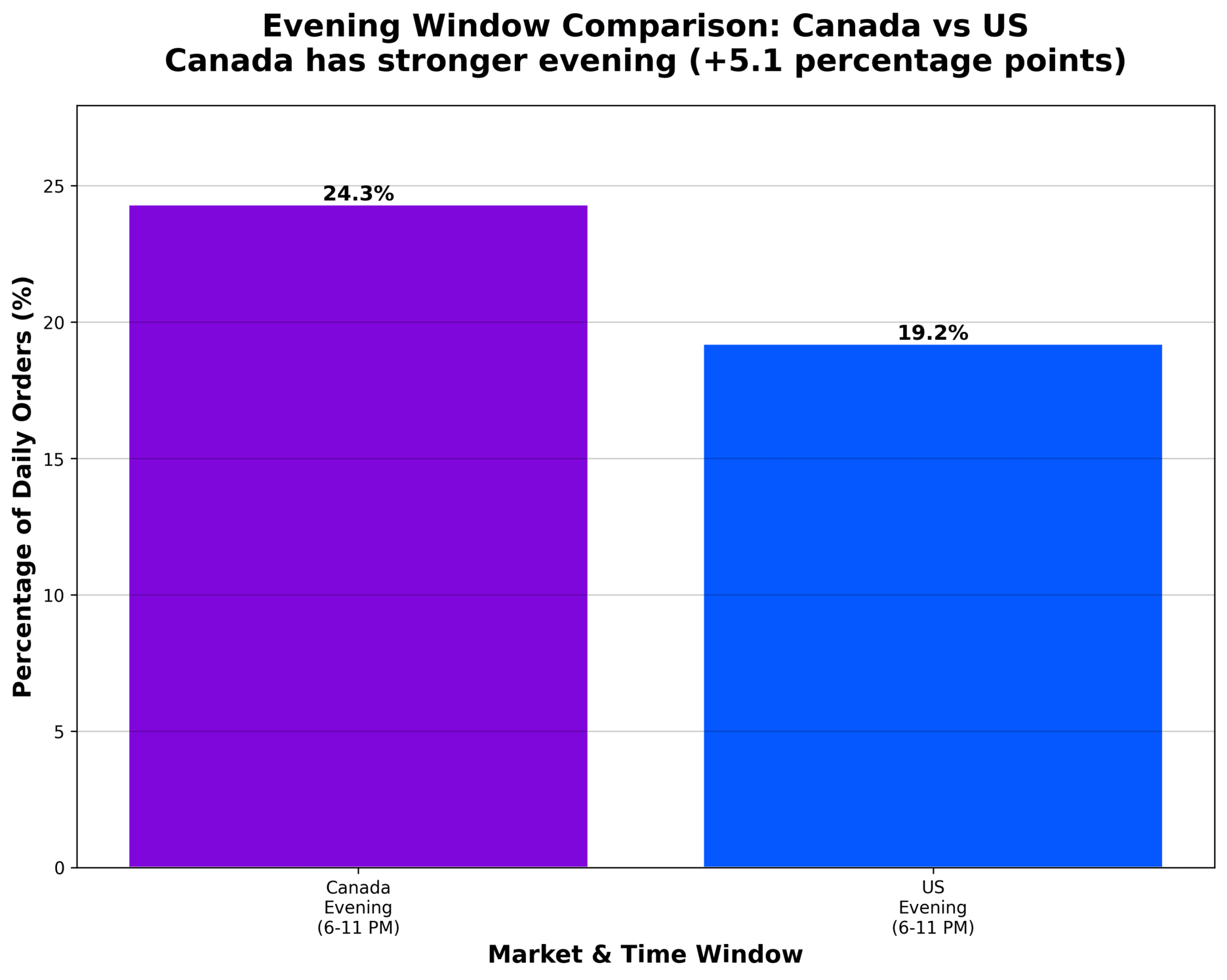
The 5.1 percentage point advantage Canada holds in evening hours (24.3% versus 19.2%) is the mirror image of its morning weakness. While Canadian morning captures 5.8 points less than the US, Canadian evening captures 5.1 points more, partially offsetting the morning gap.
For Canadian merchants, this means that evening campaigns should not be deprioritized as aggressively as they should be in the US. A US merchant might reasonably shut down paid campaigns at 6:00 PM when evening volume becomes weak; a Canadian merchant operating under the same assumption would be walking away from 24% of daily orders. Canadian evening is still secondary to midday (24% versus 37%), but it's substantial enough to warrant dedicated budget allocation and campaign management.
The following recommendations translate the Canadian timing data into specific operational and marketing guidance, accounting for the differences between Canadian and US patterns.
Universal Recommendation: The 11:00 AM to 3:00 PM window should be the foundation of all time-targeted strategies in Canada. Launch product drops at noon. Schedule flash sales for 1:00 PM. Concentrate paid media budgets in the 11 AM-2 PM slot. This is not a marginal optimization - it's the core principle around which all other timing decisions should be organized.
The 36.9% midday concentration means that campaigns missing this window are systematically absent during more than one-third of daily purchase activity. Even if a campaign performs well in other time windows, it cannot compensate for absence during the highest-intent period of the day.
Canada-Specific Adjustment: If you are adapting US-developed campaign schedules or following US best practices, reduce morning budget allocation by approximately 25-30% to account for Canada's weaker morning window. Where a US strategy might allocate 20% of daily budget to 9-11 AM, a Canadian strategy should allocate closer to 14-15%.
This doesn't mean ignoring morning entirely - 17.6% of daily orders still occur in the morning window. But it does mean recognizing that early-morning campaigns in Canada face lower absolute opportunity than they do in the US. The 9:00 AM hour in Canada captures 4.8% of daily orders; in the US it captures 5.8%. That's a 17% difference in addressable market at that specific hour.
Canada-Specific Adjustment: Canadian evening hours (6-11 PM) capture 24.3% of daily orders, making them the second-strongest time window after midday. This is substantially higher than the US evening contribution of 19.2% and requires maintaining elevated campaign presence through evening hours.
Recommended approach: Keep paid media campaigns active with moderate-to-elevated bids through 9:00 PM. The 7 PM, 8 PM, and 9 PM hours each individually contribute over 5% of daily orders in Canada - higher than any single morning hour except 10 AM and 11 AM. Shutting down campaigns at 6 PM, as might be appropriate in the US, would mean walking away from 15% of daily volume that occurs after 6 PM in Canada.
For email marketing, this suggests that evening send times (5-6 PM) may perform better in Canada than in the US, as emails sent in late afternoon will be opened during the sustained evening shopping window rather than during the sharp decline that characterizes US evenings.
Operational Requirement: Just as in the US, Canadian midday represents the highest-volume period for customer service inquiries, site traffic, and checkout activity. Customer support staffing, live chat availability, and site performance capacity should all be scaled to handle maximum load during the 11 AM-3 PM window.
Canadian merchants should not assume that evening represents the primary customer service window. While evening is stronger in Canada than in the US, it still represents only 24% of daily orders compared to midday's 37%. Staffing decisions optimized for evening volume create midday bottlenecks that impact the majority of daily transaction opportunities.
If you operate in both US and Canadian markets, the near-identical midday concentrations (36.4% vs. 36.9%) create a unified optimization opportunity. Use 11 AM-3 PM as the primary target for cross-border campaigns, product launches, and promotional activations. Both markets peak during this window, making it the most efficient schedule for unified strategies.
Apply market-specific adjustments only at the margins: extend US campaigns slightly into morning (9-11 AM) to capture the stronger US morning, and extend Canadian campaigns slightly into evening (through 9 PM) to capture the stronger Canadian evening. The core midday window remains the universal priority.
Canadian e-commerce timing follows the same fundamental structure as the US market - midday business hours dominate order volume in both geographies. The 11:00 AM to 3:00 PM window captures 36.9% of Canadian orders, nearly identical to the US figure of 36.4%.
However, Canadian-specific differences in morning and evening weight create optimization opportunities. Canadian morning is weaker (17.6% versus 23.4% in the US), suggesting that early-morning campaigns should be more conservative in Canada than US-calibrated strategies would recommend. Canadian evening is stronger (24.3% versus 19.2% in the US), suggesting that evening campaigns should be maintained more aggressively in Canada than they should be in the US.
The strategic takeaway is clear: Canadian merchants should center their timing strategies on the midday window, deprioritize morning relative to US benchmarks, and maintain meaningful evening presence through 9:00 PM. Cross-border merchants can use midday as a unified target across both markets, applying market-specific adjustments only at the margins.

