


TL;DR: Shopify secures the platform, but merchants are responsible for their own digital hygiene. While Shopify provides encryption and PCI compliance, phishing, unvetted third-party apps, and loose staff permissions create massive security gaps. To stay safe, merchants must enforce 2FA/passkeys, audit app access, and use Shopify Flow to automate fraud detection. Beyond hacking, rising threats like AI chatbot liability and automated bot traffic mean security must evolve into a broader strategy of bottom-line protection.
One Shopify merchant shared this on the community forum:
“This morning I randomly received two texts from a 5 digit number saying ‘Enter ###### as your Shopify authentication code.’ I did not request these codes. I go to my Shopify app and I have been logged out. I go to log in and my saved password is incorrect. I have not received any e-mails saying the password was reset... two-factor authentication is no longer turned on for either of the phone numbers we use.”
You’ll find variations of this story everywhere. Merchants getting phished. Customer data leaking through a privacy app that carried Shopify’s own “Made for Shopify” badge. Stores locked out, orders manipulated, trust shattered - and in almost every case, the merchant assumes that Shopify’s security mechanism will cover it.
But that’s not how it works.
Shopify is secure and the platform-level infrastructure is genuinely solid. But, your passwords, your apps, your staff permissions, your plan for when things go sideways is where you’re on your own.
In this blog, we break down where Shopify’s protection ends, what threats are actually hitting the stores right now, and the solutions that make a difference.
Let’s give credit where it’s due. Shopify’s platform-level security is not marketing fluff. It's battle-tested with over 6.5 million stores running and the platform never having been directly breached.
At the checkout level, every transaction runs through Shopify’s fraud analysis tools - address verification, CVV validation, IP checks, device fingerprinting, and velocity limits that flag when someone’s testing stolen cards at scale.
And even though most merchants don’t think it is effective, Shopify’s network intelligence scans across its entire ecosystem to check whether an email, shipping address, or credit card has been associated with fraud on other Shopify stores.
That’s a lot of protection. And for most merchants, it creates a very reasonable assumption: Shopify’s got this. I’m covered.
But Shopify only secures the platform: its infrastructure, servers, encryption layer, and the payment pipeline.

A merchant on Reddit shared:
“I worry about customer data breaches, possible GDPR or CCPA issues even for a tiny store, payment fraud or chargebacks wiping out profits, and having no real plan if we get hit.”
And their concerns are not isolated. In almost every Shopify security incident we looked at, a few common vulnerabilities appeared:
Imagine a situation where you install an app to help your store comply with privacy laws. It’s got a 4.9-star rating, thousands of installs, and Shopify’s own “Made for Shopify” badge. You probably won’t think twice.
That’s what over 4,000 merchants did with an app called Consentik.
However, they did not know that Consentik’s backend, an unsecured server, was broadcasting their Shopify admin credentials, Facebook ad tokens, and live store analytics to the open internet. For over 100 days. Anyone could have walked into their admin panel.
The app’s developer didn’t respond publicly. Shopify did not issue an official statement. Most affected merchants had no way of knowing their data was exposed until researchers found it. And thankfully, it was just researchers, not hackers.
Another plugin developer, Saara, left an unsecured database exposed for eight months - 25GB of customer data from over 1,800 stores.
When Innovate Cybersecurity investigated, they found plugins with no corporate website, no identifiable team, and no transparency about where customer data goes.
So, a star rating and a badge are not a security audit. And right now, the tools merchants rely on to vet apps weren’t designed to catch backend vulnerabilities.
A Shopify merchant shared:
"I received an email that I have never received before after 7 ish years on Shopify. It looked a bit fishy (phishy) so I started a chat with a Shopify support officer to check. They told me that the email was legit and that I could click on the link safely. However, I don't believe this is correct and when I asked more questions they were unable to answer."
81% of hacking-related breaches involve weak or stolen passwords. Credential stuffing, where attackers buy leaked databases and run automated tools against login pages works because people reuse passwords across platforms.
So if your Shopify admin password matches your personal email, that’s the only opening someone needs.

FYI, Shopify maintains a detailed phishing identification guide and accepts reports concerning the same. If your team hasn’t read it, that’s a problem worth fixing today.
For some reason, insider risk to store security is the most overlooked concern.
In 2020, Shopify disclosed that two members of its own support team had accessed transaction records from nearly 200 merchants.
Shopify terminated them and brought in the FBI.
For perspective, this was a situation where access was granted, not stolen.

Now think about your own store. How many staff accounts are active right now? When did you last check what each one can access? Is there a collaborator code still floating around from a freelancer who finished six months ago?
If you don’t know the answer. You might have a problem.
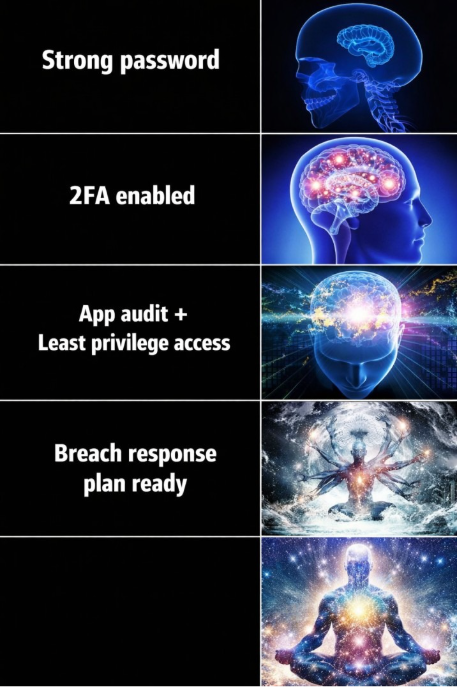
Most of the concerns we discussed so far are fixable. And the fixes that matter most aren’t expensive tools, they’re habits:
Turn on 2FA (Two Factor Authentication). On everything.
Not just your owner account, every staff account, every active collaborator. Shopify supports both two-step authentication and passkeys, and passkeys are the stronger option - tied to your device, resistant to phishing.
Use a password manager.
If your Shopify admin password exists anywhere else such as your email, a social login, a Notion workspace, you might be more susceptible to a leaked database. A password manager generates unique passwords for every account. A lot of these tools are free and several others with more advanced features- still cost much lesser than a single chargeback.
Audit your apps.
Go to Apps in your Shopify admin. For each one, ask: Am I still using this? Does it need the access it has? If either answer is No or “I am not sure, but I might need it someday," remove it. For the ones you keep, look past star ratings and check for a real company, a real team, a privacy policy that actually says something. That's the bare minimum.
Set staff permissions properly.
Shopify’s role-based access control lets you assign exactly what each person can see and do. Your fulfilment person doesn’t need financial reports. Your content writer doesn’t need checkout settings.
Have a breach checklist ready.
Just cover the basics: change all passwords (Shopify and the email tied to it), re-enable 2FA, review your activity log, check staff accounts and installed apps for anything you didn’t authorize, contact Shopify Support, and notify affected customers because several privacy regulations may legally require it.
Fraud is a whole another problem, requiring a different toolkit.
One Shopify merchant shared:
“I set up a rule for a specific customer that has made over 25 fraudulent purchases. Yes, the app canceled the orders but did not block them from happening.”
25 fraudulent purchases. And the system still let them through the door every time.
Now that’s a frustration most tools do not solve. Here’s what actually helps:
Setting up Shopify Flow.
Shopify sunsetted its Fraud Filter in January 2025 and moved fraud automation to Flow.
A merchant on Reddit vouches for Flow’s efficiency:
“Flow is class if you know how to use it. There's a few videos in the shopify academy on use cases.”
Using Flow, you can build rules that flag or cancel orders based on mismatched addresses, failed payment attempts, or suspicious purchase patterns.
Enabling 3-D Secure 2.0.
Probably the most underused tool available to Shopify merchants is 3-D Secure 2.0. It analyses 100+ data points per transaction in the background, adds near-zero friction for real customers, and shifts fraud chargeback liability from you to the card issuer.
A dedicated fraud tool at scale.
Shopify’s built-in analysis works for most stores, but it has limits at higher volumes. Tools like NoFraud, Chargeflow, SEON, and Kount add machine learning, device fingerprinting, and in some cases chargeback guarantees. They cost money but chargebacks cost more.
Staying current on compliance.
Nearly 6 in 10 consumers already worry about data breaches. Make sure you play close attention compliance policies to safeguard yourself.
Following what we’ve discussed so far is the baseline. But if you stop there, you’re only defending one part of the business.
Beyond that are risks similar to what one merchant recounts:
“During the last 3 years I have seen package theft from both the USPS and FedEx Ground system increase 400%... I am dealing with about 4-6 package thefts weekly where tracking shows an item delivered but the recipient is throwing a tantrum.”
Porch piracy alone costs merchants $12 billion annually. And when a package disappears, the customer blames you. Without shipping protection, every stolen package is either a refund out of your pocket or a chargeback.
Moreover, the risk doesn’t stop at stolen packages, chargebacks can hit you from multiple angles.
To help, we spoke to experienced merchants about the strategies actually working to tackle chargebacks - it's worth a read if this hits close to home.
Moving on, you also have stuff that didn’t exist two years ago, i.e. website embedded AI chatbots.
They end up making up return policies and promising discounts they shouldn’t. One merchant on Reddit shared
“A customer was chatting with it and managed to convince the AI to give them a 25% discount, then he negotiated with the AI up to an 80% discount.”

Absurd, right? Add to this the fact that if a customer files a case, the bot won’t get sued. You will.
Speaking of bots, bot attacks now account for over half of all ecommerce traffic. The cost isn't just the fake transactions. It's the downstream chargebacks and the wrecked data you're making decisions on.
And fraudulent orders tie it all together.
One merchant on Shopify’s community shared
“Seems Scammers are purchasing low priced digital products and then running chargebacks or maybe just testing fake cards leading to fraudulent orders. Our brands using GoodAPI have two trees for $1 product and our customers are getting many fraudulent orders.”
Things like these push your chargeback ratio toward the threshold where Visa and Mastercard start paying attention. Once you're on their monitoring programs, the fines hurt more than the fraud itself.
Every single one of these instances ends the same way: the merchant absorbs the damage.
This is why closing that gap between what platforms protect and what merchants still have to absorb matters. For instance, shipping protection can stop a stolen package from turning into a chargeback. And with safeguards like extended warranties or accidental coverage customers are far more likely to come to you for resolution instead of going straight to their bank.
Security keeps threats out of your admin. Protection keeps them from draining your bottom line. You need both.
.jpg)