Is AI visibility worth it for you to invest in? Here's what the latest research says
Overview of Contents
Ask ChatGPT for the best espresso machine under $500. Make a shortlist. Come back five minutes later and ask again. You'd be surprised that half of the brands that were there in the first search have disappeared.
That's exactly what Rand Fishkin’s research found in January 2026 - the same prompt produces the exact same brand list less than 1% of the time. That’s a headache for anyone treating AI recommendations as the next big marketing channel, all the hype notwithstanding
.
Now think of paying a tool every month to track that shifting list and report your “AI visibility” score down to the decimal.
The tools measure it by running their own list of prompts through AI and counting how often your name shows up. Given the espresso test, that’s a bit like rating a café when the barista switches beans every time you order.
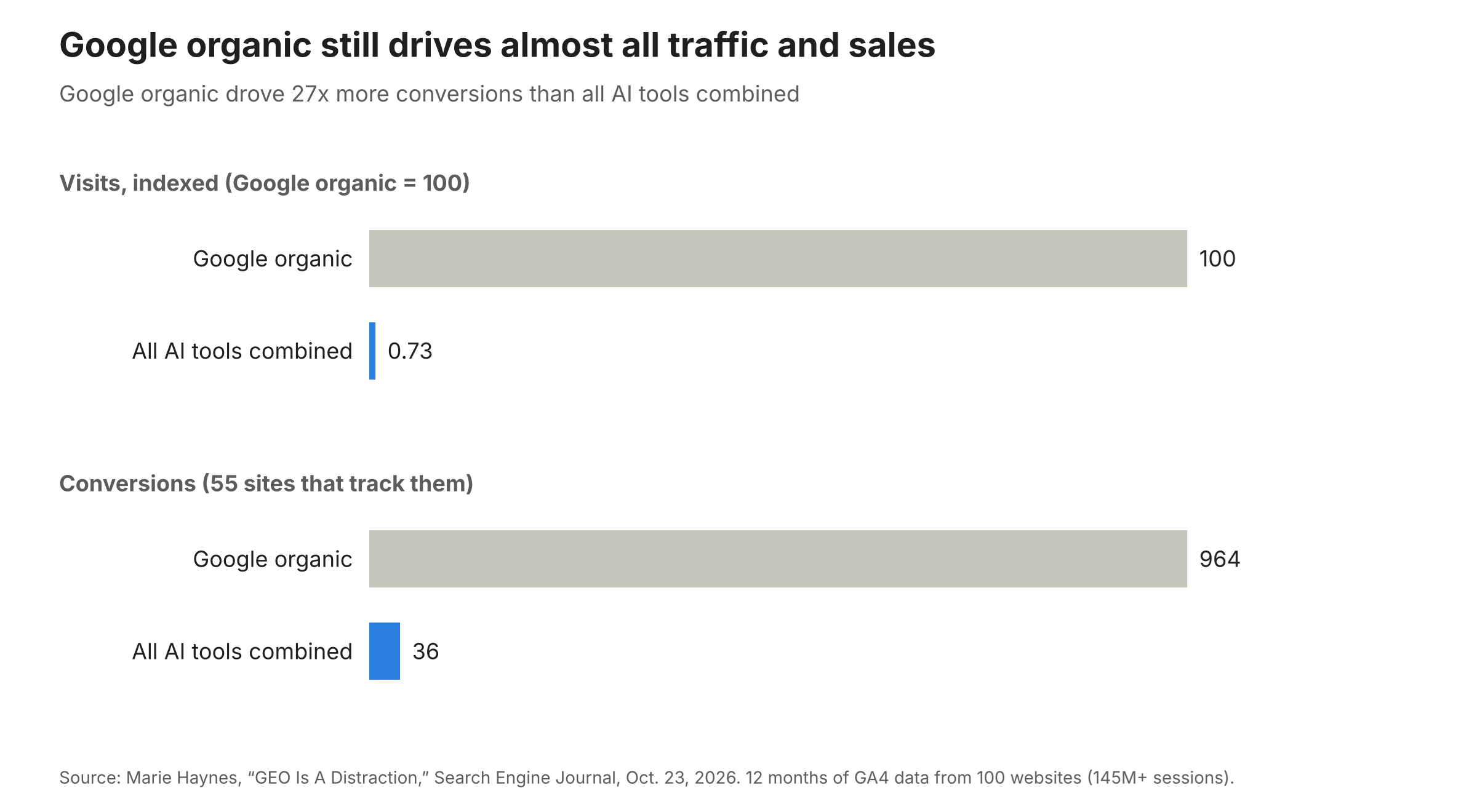
Then October happened, and three studies poured some cold brew on the whole idea. Marie Haynes went through a year of data from 100 websites and found ChatGPT sent just 0.62% of Google’s SEO traffic volume. And if you include all the other LLMs? Still only 0.73%. That’s less than DuckDuckGo, the search engine most people only remember during a privacy scare.
But could it be that despite minuscule traffic, AI caused a lot of conversions?
Kevin Indig went looking for shoppers who see your brand in ChatGPT and Google you later. He couldn’t find it. What he did find was a little scary. Direct traffic across his sample had jumped 140.9%, but when he counted only engaged visits (people who actually stayed and clicked around), it barely moved. On one site, GA4 logged 409,000 direct visits, and only 198 came from real, engaged people. The rest were most likely bots.
So Rand Fishkin asked the question out loud: Is AI visibility a marketing boondoggle? Some marketers have already answered. As one wrote on LinkedIn:
“There are bad marketing metrics. There are useless marketing metrics. And then there are metrics so fundamentally stupid that you almost admire the confidence required to sell them. AI visibility sits firmly in that final category.”
That’s a strong brew, and not entirely fair. For some stores there’s real caffeine in AI recommendations. For most, it’s decaf at espresso prices, and the people selling the trackers have good reason to tell you otherwise.

So in this guide, we’ll go through what the latest research found, why ecommerce numbers disagree so wildly, whether your store should spend on AI visibility, and where that money works better instead.
What the recent research says
Here's what the main studies found, in plain terms:
- AI is still a runner-up to Google - Across 100 websites and 145 million sessions over 12 months, ChatGPT sent 0.62% of the traffic Google organic sent. Add every other AI assistant, and it's still only 0.73%.
- The growth has stalled - Haynes found the fast growth in ChatGPT visits ended in August 2025, so the “it'll be huge next year” argument is getting harder to make.
- Google sends 39x more visitors - SEO Works looked at 95 websites over a year and found organic search sent 39 times more traffic than AI assistants.
- A small Google win beats a big AI win - In the same study, a 5% lift in organic search brought 10.3 extra conversions per site per month. Doubling AI traffic brought just 6.6.
- AI answers aren't stable - Rand Fishkin's research found the same prompt returns the same brand list less than 1 time in 100, so any single “ranking” is a snapshot at best.
- Most “AI optimization” is regular SEO - One agency strategist said that 80 to 90% of the tactics involved in AI optimization are the same ones you'd use for search.
- Experts now call it a brand channel - Fishkin, citing Mike King, says AI works more like a digital billboard and should be measured like one, by awareness rather than clicks. Search Engine Land says the same thing: it may shape which brands shoppers consider, but its traffic or conversion value is still uncertain.
In plain terms, a small win on Google beats a huge win on ChatGPT.
Does AI traffic convert better than Google traffic?
Per visitor, sometimes. In total sales, not even close.
This is the stat AI vendors love. In Haynes's data, ChatGPT visitors converted at 13.8%, against 3.02% for Google organic. That sounds like a reason to go all in, until you read the next line: Google still drove 96.5% of total conversions, and 27 times more conversions than all LLMs combined.
A great conversion rate on a tiny number of visitors is still a tiny number of sales. It's like the café that sells one perfect latte a day.
Even the conversion edge isn't consistent. SEO Works found AI traffic converted worse than organic on 23 of the 63 sites with enough volume to compare.
The fair counterpoint comes from a marketer on Reddit:
“What's interesting is that even if AI-driven traffic is smaller, it can feel more high-intent because users already saw your brand recommended before clicking anything.”
That's true. A shopper who clicks after ChatGPT recommends you has already been half-sold. It just doesn't happen often enough yet to pay for a dedicated budget.
But why do e-commerce AI traffic numbers still range from 0.1% to 5%?
Search for 'AI traffic stats for online stores’, and you'll find numbers that disagree by 50x. Here are the ones that come up the most:
Source | Who they are | What they measured | What they found |
|---|---|---|---|
Shopify agency | 10 stores, 94M sessions | 0.10% of sessions and 0.10% of revenue in 2026 | |
Ecommerce agency | 73 stores, 96M sessions | 0.21% of sessions and 0.26% of orders in 2026 | |
Academic, not peer-reviewed | 973 stores, $20B revenue | ChatGPT about 0.2% of sessions; organic converts about 13% better | |
Retail trade publication | Interviews with 4 retailers | About 5% of referral traffic |
After looking at the table, if you're wondering why these numbers look so different, there are three reasons:
- The denominator changes - The 5% figure is a share of referral traffic, which is only the visitors who came from another website. The 0.1% and 0.2% figures are shares of all sessions, which include Google, email, ads and direct visits. Same tiny stream of visitors, measured against a much smaller or much bigger pool.
- Some AI traffic is hidden - People who use the ChatGPT app often arrive with no referrer, so analytics files them as “direct.” Ethercycle tested the most generous version of that argument and found AI revenue rises from 0.10% to at most 0.16%.
- Some sources have something to sell - The most bullish ecommerce stats you'll see quoted tend to come from companies selling AI shopping tools or analytics platforms. The numbers in the table above come from agencies and researchers with no AI product riding on the answer.
One interesting detail that's easy to miss is that 85% of AI-referred revenue came from first-time customers. So AI may be small, but it seems to be introducing you to new people rather than recycling old ones.
Should your store spend on AI visibility?
Nick LeRoy, SEO and AI Growth Consultant, put it well: if leadership needs predictable acquisition growth, an AI visibility budget won't guarantee it. For a store owner, you are the leadership. If you need sales next quarter, AI visibility isn't the line item to bet on.
So exactly which stores should care now and which can wait
There is a very simple mantra to this: you should care if your product is expensive and well researched before a customer purchases it. These are your appliances, furniture, e-bikes, electronics or fitness equipment... practically anything where shoppers ask AI “which one should I buy?” before they ever open a store page. Even Rand Fishkin says AI is probably quite influential on some buyers in some sectors.
There's a hint it brings in shoppers less fixated on price, too. One digital executive even said that AI traffic “seems to be a little more immune to” consumers seeking lower-priced goods.
Some industries are further along, with a B2B tech marketer on Reddit opinionating:
“It's industry-dependent. I'm in tech B2B, and more and more of the buyer journey is moving toward LLMs. Don't quote me on numbers, but last I checked, something like 90% of our clients start their vendor search in an LLM.”
I did quote him on that, so treat that as one person's experience rather than a stat, but it also shows how much this varies by industry.
However, you can wait if you sell low-cost or impulse items, or if most of your sales already happen on Amazon or Walmart. Nobody asks ChatGPT for advice on a $12 phone case.

Can you trust AI visibility tools?
Let me make it clear right off the bat - agencies that sell AI visibility services admit the data is shaky.
Brainlabs opens its own guide by saying none of your AI visibility data is accurate. The “prompt volume” figures many tools show (meaning how many people ask a given question) are mostly estimated from Google search data, and the conversion from one to the other is largely assumed.
Then there's the espresso problem. If ChatGPT changes its mind every time you ask, one screenshot of it recommending your brand proves about as much as catching a fortune teller getting one prediction right. A score built on a few dozen screenshots doesn't make the prediction business any more scientific.
How to check your AI visibility for free
You can get most of what a tracker tells you in about an hour a month. Just do this:
- Count your AI visitors in GA4 - Create a segment for visits from chatgpt.com, perplexity.ai, gemini.google.com and copilot.microsoft.com. Watch the trend, and don't set targets on it.
- Ask your customers - Add “ChatGPT or another AI assistant” as an option in your “How did you hear about us?” field at checkout. This also catches the app traffic that analytics files as direct.
- Run your own espresso test - Write 10 questions your real buyers would ask, like “best standing desk for a small apartment under $400.” Run them in two assistants once a month and log whether you show up. Look at the trend over several months, not single results.
- Check Google Merchant Center if you run Shopping ads. Google added AI Performance Insights to help retailers see how products perform in AI shopping experiences.
Where to spend instead: The Double-Duty Test
The work that earns a Google ranking also earns AI mentions.
One study found the sites gaining AI referrals were the same sites improving in organic, with a correlation of +0.557. An Ahrefs study of 75,000 brands found that being mentioned around the web lines up with AI visibility far more closely than branded search does: 0.664 for brand mentions against 0.392 for branded search volume.
That's because AI tools learn about your brand from everywhere, not just your site. As one agency head said, “We're seeing owned, we're seeing earned, we're seeing social, we're seeing user-generated, we're seeing commerce. It's all influencing these answers.”
Here's what you can try:
- Collect more genuine customer reviews
- Get featured in real “best of” round-ups and trade press
- Work on accurate, detailed product titles, specs and policies in your feed
- Answer real buyer questions on product and category pages
- Show up helpfully where your buyers talk, like Reddit or YouTube
And a few tactics can actually backfire - Agency experts told Digiday that llms.txt files have shown little impact, and that Reddit has already started cracking down on AI marketing slop. Hiding instructions for AI in your pages is worse still, since it's the same trick hackers use.
Lastly,
If you’re still not convinced, I’ve got just the thing to help you with the budget for a new marketing effort.
Offer product protection plans at checkout.
See? It’s so simple. The shoppers buying expensive, researched products (the same ones asking ChatGPT 14 questions about a fridge) are already worried about what happens if it breaks. A protection plan answers that worry right at the moment they're deciding, and it adds high-margin revenue to sales you're already making.
It pays off after the sale, too. When something breaks, and the customer knows exactly who to call, they come back to you instead of leaving a one-star review. With SureBright, the plans carry your brand, and we handle the claims, so there's nothing new for your team to run.

Author
Khizar Mohd
M Khizar is a writer who enjoys making complicated things feel simple. He writes about warranties, e-commerce, and the small details people usually overlook until they matter. His work focuses on clarity and helping readers make smarter decisions without overthinking it. Outside of work, he enjoys reading, writing personal blogs, and binge eating with friends.