Damned if you discount, damned if you don't: 7 ways to grow profits without touching prices
Overview of Contents
Rachel Brown, owner of a small bakery called Need a Cake, wanted to drum up more business. She thought she'd come up with a brilliant plan. She reduced the prices of her cakes and soon 8,500 people signed up. She went on to sell 102,000 cakes in a month, but there was just one little problem. She was losing $3 on every batch.
Brown later called it “my worst ever business decision.”
So, if reducing your prices gets you more sales but leaves you with losses, instinct might tell you to increase them again.
However, that too can cause problems. Netflix tried a similar experiment, and consumers were anything but chill. When the company increased its subscription prices by just $2, it was expected to add 2.5 million new subscribers. Instead, they fell short by 32% of their target. And to rub salt in the wound, its share price crashed by 15%.
That's the dilemma store owners face every holiday season. One seller on Square's community forum described both sides of it:
"I felt the pressure to join in with sales around the holidays because that's what everyone is doing, right? I gave it a try. It did generate sales, but with less profit. The following year, I decided I would not offer sales and received several emails asking when I was going to offer sales for the holidays. I realized folks were intentionally waiting for sales."
And shoppers aren't exactly making it easier. BCG's survey of 10,220 consumers found that they expect around 30% off before considering something a good deal.
So, if discounting isn't the answer and raising prices is out of the question, what can you do to increase profits?
We compiled 7 ways to improve your profits without changing the price tag.
Know which products actually make money
It's easy to assume that the dish that sells the most at a restaurant is also making the owner the most money. But what if it's the one costing them the most? It might use the priciest ingredients or take the longest to prepare. When it’s done on purpose and crafted carefully, it becomes a clever marketing ploy; but in most cases- it's due to accounting errors.
The same can happen in your store. A product might bring in plenty of sales but leave very little behind once you account for everything (not just the buying price) it takes to sell it. Studies show in most stores, 20% of products generate 80% of the actual profit. So, if you assume your biggest sellers your biggest earners, think again.
One Redditor shared how badly this can go wrong:
“I watched one guy — $3.4M revenue last year, solid brand, good product — spend six months convinced his top-selling SKU was his hero. It was his most-advertised, highest-volume product. He was throwing serious ad spend behind it.
“Turned out, once you factored in the actual shipping weight, the return rate, the cost of reverse logistics, and what Meta was costing him per unit sold — he was losing money on every single sale of that product. Not breaking even. Losing. At scale. Millions in revenue, actively destroying cash.”
You wouldn't want to end up in this guy's shoes.
To find these Trojan horses in your store, you can use Iris Finance's formula for each product. Start with net revenue after returns, then subtract the cost of goods, fees, fulfillment, return handling and ad spend. Next, flag products that fall in the top quarter for revenue but the bottom quarter for contribution margin.
Once you've identified them, decide what needs to change. You could reduce the costs involved, cut back on discounts, reprice the product or stop selling it to free up the cash tied up in inventory.
But even a better product mix will only help if the profit it earns stays in your pocket.
It’s criminally under-rated but stop discounting people who'd buy anyway
Imagine you're ordering coffee at your favorite café. Just as you're about to pay, the cashier offers you 20% off. It's a nice surprise, you feel delighted, but it hadn't influenced you to make the purchase.
One merchant noticed the same thing when they looked at their repeat customers:
“I pulled every repeat customer and checked how many of their orders used a discount code.
A lot more of them than I expected barely use one. Most of their orders come in at full price on their own schedule, and the only time they use a code is when we put 15 or 20% off in front of them. That means a lot of what we’ve been handing out went to people who were going to buy anyway.”

Many retailers make this mistake. They give discounts to customers who were already planning to buy. It costs them double: the retailer doesn’t win an extra sale, plus reduces what they would have earned from a full-price purchase.
Studies suggest that 20 to 60 out of every 100 sales made with broad public discount codes would have happened at full price anyway. Targeted offers, such as abandoned-cart codes, have a smaller impact, at 10 to 25 out of every 100. The more precisely you target a discount, the less likely you are to give it to someone who doesn't need it.
So don't send the same offer to everyone. Give each discount code a clear purpose, whether it's winning a first order or recovering an abandoned cart. Set an expiry date and review your active codes regularly. An old code that's still circulating could be costing you margin without bringing in any extra business.
A discount at least needs your permission before it takes your margin. But a return just turns up at the door with a receipt.
Cut down your returns
Every return is a boomerang you paid to throw. You spent money getting the product to the customer, only to pay again when it comes back.
And it isn't cheap. Processing a return can cost as much as 30% of the product's value and online purchases had a return rate of 19.3% in 2025. That's almost one in every five sales coming back. You can imagine what numbers like those can do to your bottom line.
So stop treating every return as a one-off problem. Look at the reasons customers give (thought don’t always take them at face value) and see whether the same issues keep coming up with a particular product.
Once you have that data, review your 20 most-returned products every quarter. Then fix what's putting customers off. If sizing is the issue, use your own returns data to make the size guidance more accurate. If customers aren't happy with how the fabric looks, add a closer product image.
Better packaging can also make a difference when products are damaged in transit. This Redditor shared how it helped his returns:
“Noticed my return rate on one SKU was sitting around 9%... most of the return reasons cited "damaged" or "defective." Turned out it was packaging, not product quality… Switched from a single-wall box to double-wall corrugated… Added interior cushioning specifically at the two weakest contact points… (And in eight weeks) Return rate dropped from 9.1% to 4.8%”
Of course, you won't prevent every return. But when a customer does want to send something back, offer an exchange where it makes sense. That way, you may still be able to keep the sale.
Now that you have plugged leaks, it is time to cut down overhead costs.
Renegotiate your per-unit costs
If your store operates from rented space, you pay the same rent whether you sell ten orders a day or a thousand. But the cost of fulfilling those orders keeps climbing, much like a taxi meter ticking with every sale.
That's why getting your variable costs under control can make a bigger difference to your profits. An analysis of 2,463 companies found that a 1% reduction in variable costs increased operating profit by 7.8%. The same improvement in fixed costs lifted profit by just 2.3%. So before yet another AI bro starts pitching you to start cutting overhead, look at the breakup of your variable costs.
You can start by looking at your suppliers. Offer them a 12-month purchase commitment in return for a 4% to 6% price cut. A volume forecast can also help make your case.
The way you package your products can also bring down your per-unit costs. For instance, if you can somehow shrink a 14-by-12-by-8-inch box to 12-by-10-by-6 inches its dimensional weight comes down from 13.4 lb to 7.2 lb, cutting four billable pounds from every order shipped in that carton. But we know this isn’t an easy feat.
And don't assume a good deal will stay that way. Carriers raise published rates by about 5.9% a year, so it's worth checking whether your current rates are still profitable.
Cost cutting helps your margins, but bringing back shoppers who left items in their carts can help you make another sale.
Convert the traffic you already have
Getting shoppers to your store costs money. That's what makes it so frustrating when seven out of ten shoppers who make it to the cart leave without buying. A meta-analysis of 50 studies puts average cart abandonment at 70.22%.
The good news is, you don't need to do much to convince some of them to complete the purchase.
Just listen to why they're leaving. In one survey, 20% of shoppers said delivery seemed too slow, while 18% didn't want to create an account. You can address the first by showing a specific delivery date on the product page and at checkout, rather than leaving shoppers to guess. For the second, make guest checkout easy to spot. That's especially important when 62% of sites don't make it prominent.
And if shoppers are worried about sharing their card details, trust badges and a clear return policy can help put them at ease. That addresses the concern behind 19% of abandoned carts.
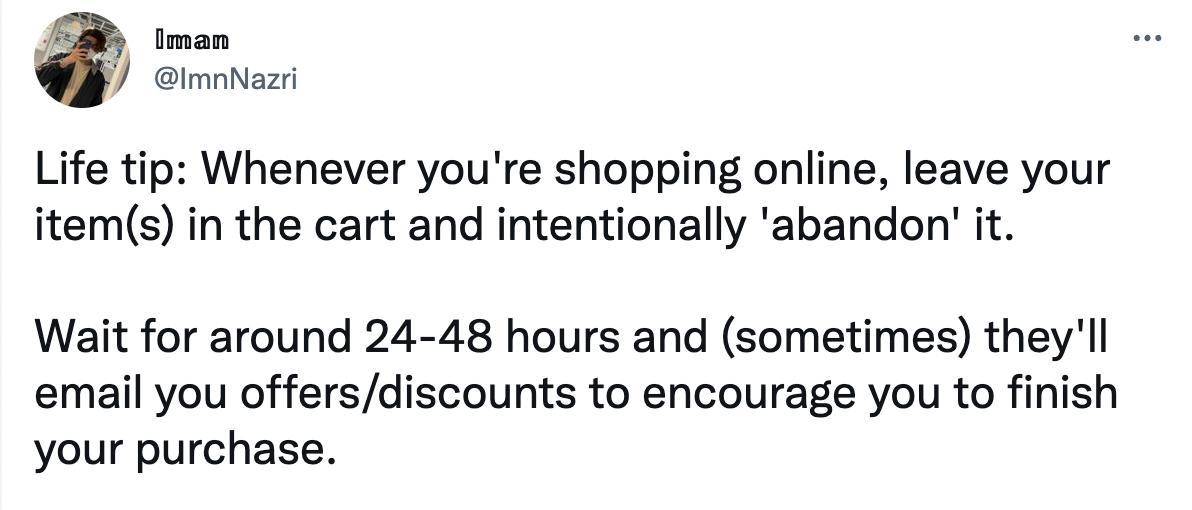
Of course, some shoppers will still leave. But that doesn't mean the sale is gone for good. Abandoned-cart email sequences typically recover 3% to 5% of abandoned carts. One retailer was surprised by how well they worked:
“Kind of assumed that it wasn't worth the setup time until we actually looked at how many carts were just sitting there and realized that its basically free money. Went with three emails instead of overthinking it into some huge sequence…Recovery ended up somewhere in the low double digits, which felt worth it for how little time it took to set up.”
The key is to make those emails useful by addressing the reason someone left. For example, link straight to guest checkout rather than sending them back to a login screen.
Winning back an abandoned cart is good, but getting the shopper to add one more thing to it is even better.
Bundle instead of discounting
Fast-food chains have been doing this for years. You go in for a burger, and before you know it, you're walking out with fries and a drink you hadn't planned to buy. They haven't made the burger cheaper. They've given you a reason to spend a little more.
You can do the same in your store with product bundles. Instead of cutting the price of something a shopper already wants, give them a reason to add something else to their order. Bundles can increase average order value by an estimated 10% to 30%.
The saving doesn't have to be huge to make the offer appealing. Take seven pairs of socks for $12 instead of $2 each. The shopper saves about 14%, but spends $12 instead of buying just one pair for $2.
You can build bundles by pairing a popular product with a low-cost accessory. Show the saving in dollars as well as a percentage. Shoppers may see it as a double deal: they save on each item and get an additional saving for buying them together.
One Shopify retailer shared how well this worked for its beard care brand:
“I've been running a small beard care brand on Shopify since 2018. One of the best things we ever added to our store was a Build Your Own Box experience.
Customers could choose any 3, 5, or 7 products, with bigger discounts as they added more. It worked incredibly well, with our bundle orders generating an average order value 66% higher than regular orders.”
You can also offer a free gift when shoppers spend above a set amount. Set that threshold just above your average order value to encourage shoppers to add a little more to their basket.
Just watch how much you're giving away. A bundle can still eat into your margin if the discount is too deep, so work out the contribution margin before putting it on sale.
Increasing AOV with customer benefit in mind
A shopper wants to enjoy their new purchase without worrying about what happens if it breaks. Protection against unexpected repair costs gives them a good reason to spend a little more at checkout.
That's where SureBright's extended warranty and accidental damage plans come in. They cover eligible repairs or replacements when a product breaks down or is damaged by a drop or spill. Customers get added protection, while you earn revenue from each plan sold.
Sennheiser saw this with its premium audio products. Warranty attach rates stayed between 28% and 31%, average order value increased by $4, and returns fell by 26%.
See what protection plans could add to your store. Try the SureBright warranty ROI calculator.

Author
Pushpender Singh
Pushpender enjoys exploring the stories behind everyday decisions. He writes about warranties, ecommerce, and the psychology of buying. He draws on internet research, lively conversations, and a curiosity for the details most people overlook. With a background in English Literature, he believes good writing isn't measured by how complex it sounds, but by how effortlessly it helps someone understand a complex idea. Outside of work, you'll usually find him reading fiction and history, striking up conversations with people from different walks of life, or jotting down ideas inspired by both.