
Black Friday and Cyber Monday are days away: How do you make shoppers believe your sale is real?
Overview of Contents
“It feels like November and December have turned into one long, non-stop sales commercial…This is just madness! ...To top it off, whenever I use price-history trackers for things I actually need, half the time those ‘unbelievable sales’ aren’t even real discounts anyway - they just bump up the price beforehand.”
This shopper has watched Black Friday and Cyber Monday offers flood their feed since before the Halloween candy ran out. By now, the fatigue it caused has hardened into suspicion.
Price-history trackers give shoppers a way to verify whether a deal is genuine. A few taps can reveal that a price was nudged up just before the markdown, so customers no longer have to take your word for it.
And this skepticism goes well beyond a few disgruntled buyers. In BCG’s sixth annual Black Friday consumer study of 10,220 shoppers, only 54% trusted that advertised prices were lower than usual, while 1 in 5 actively distrusted them.
That leaves honest merchants with a rather uphill task. You can offer a fair, substantial price cut and still watch shoppers scroll past because they have no reason to believe it. From a shopper’s screen, your markdown can look just like a competitor’s inflated discount. So you have to give them a reason to tell the difference.
This guide shows you how to make your discounts stand up to scrutiny before your first Black Friday banner goes live.
Show original price before shoppers dig it up
A crossed-out price without a believable price history is like a man showing off his six-pack abs but refusing to reveal whether he actually ever had a pot belly.
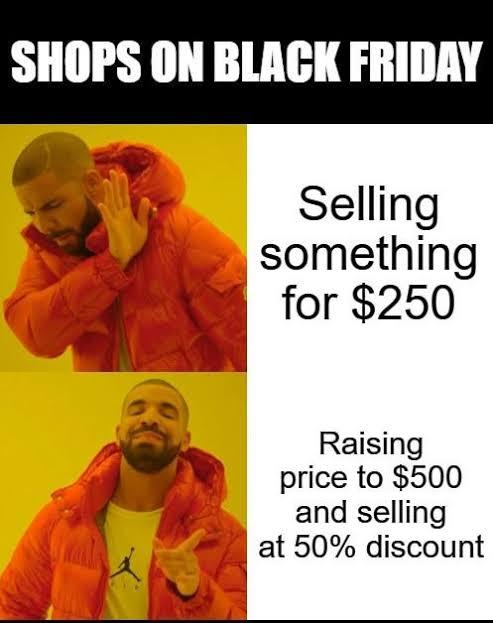
That’s the problem with retailers using an original price to calculate advertised discounts when shoppers hardly, if ever, paid that amount. What they overlook is that shoppers can compare prices for themselves. And some are diligent enough to keep their own records, like this shopper:
“Saw a Facebook ad from Staples featuring an office chair that I’ve been considering. I clicked it and was surprised to see the chair had an ‘original price’ of $319. I’ve never seen it even close to this price (it was being sold at $179.99). To confirm, I looked back at my notes and saw that I jotted down a Black Friday price of $119.”
Major retailers like Amazon, for instance, have started putting that missing context right beside the deal. Its Price History feature lets shoppers inspect 30-, 90- and 365-day price fluctuations on listings. It also flags products at their lowest prices over those periods. Newegg takes a similar approach with its Lowest Price in 30 Days shopping category.
You can take a page from Amazon’s book and introduce something similar on your own website. It builds trust and saves customers the detective work of figuring out whether your discount is genuine. And a shopper who can see the proof on your page has less reason to go looking for a lower price elsewhere.
An honest before-and-after only counts if the saving is still there when the cart loads.
Turn the percentage into a real basket
A discount banner can make shoppers feel like they’ve struck gold, but the checkout total is where they find out how much they’ve got in their gold pan. And sometimes, it’s sand that fills the pan, as this shopper found:
“I have a bunch of things in my cart that say ‘Extra 30% Off! Discount Taken at Checkout. Final Sale.’ but the discounts are not applying at checkout. I have 7 items in my cart that should be 30% off and it’s only applying the discount on one item.”
The offer itself is not dishonest, but the gap can leave customers feeling ripped off, especially when they discover it only at checkout.
So make the math visible earlier. Show which items qualify and the dollar reduction beside each item. Keep the figures live too, so they update when shoppers change a size or quantity. And make sure the sale price in your product feed matches your site, because Google Shopping can disapprove products whose prices don’t line up.
InsureandGo does this by automatically applying eligible promotions and explaining the discounts in the cart. And that’s no accident. In Baymard’s testing, several shoppers walked straight past a code that sat above the promo field.
Making customers hunt for a discount defeats the purpose of offering one. It also gives them another reason to abandon their cart, which is the last thing you want.
But a tidy total means little if the product in the cart isn’t the one shoppers think they’re buying.
Prove the sale item isn’t a stripped-down twin
Shopping for a Black Friday bargain can feel like choosing between two identical TVs. Except the cheaper one has a different model number and lesser features.

That’s the problem with derivative products. These are scaled-back versions of mainstream models, often made specifically for major sale events. They have different model numbers and may have fewer features, such as fewer HDMI inputs or a simpler remote control.
There’s nothing wrong with selling a cheaper version. The problem comes when retailers don’t make the differences clear, leaving shoppers under the impression that they’re getting the mainstream model. Finding that out after the purchase can leave them feeling cheated.
One Black Friday buyer described the experience:
“This. The last black friday LG tv I bought had a total of two hdmi inputs and speakers that were whisper quiet. I’ll never by a BF tv again.”
So don’t leave shoppers guessing. Show the exact model number and clearly disclose how a sale model differs from its mainstream counterpart. If it has missing features or different accessories, spell that out. And don't treat it as a favor to shoppers. It protects you, because the shopper who finds the gap after buying is the one who writes the angry review.
A full disclosure reassures the shopper who is still deciding, but someone who already bought has a different worry.
Tell them if they can get a price adjustment
Nobody likes finding out that the product they bought last week is now cheaper. From the shopper’s side, it feels like you rewarded them with a pricier deal for choosing you early.
This Sony buyer felt that sting twice:
“I purchased a Sony BRAVIA 7 II 65" (K65XR70M2) directly from Sony… for $1,799.99. At the time, $1,799.99 was already a discounted price, so I decided to purchase…Then… I found the same TV at Best Buy for $1,699.99… I contacted Sony and requested a $100 price adjustment…(but) Sony denied the request.”
A no like that doesn't always end there. An angry customer can return the product, leave a bad review or even file a chargeback.
So don’t leave buyers wondering whether they’ll get the same treatment. Target, for example, offers a holiday price match on purchases made between Nov. 1 and Dec. 24 if its own price drops later in the season. Notice that Target makes it clear that it will match its own lower price, not a competitor’s offer.
But that’s about your price. What about the shoppers who are jumping from one website to another?
Welcome the comparison with other stores
A competitor’s lower price is not something you’d want to show on your website. But assuming shoppers won’t find it is like an ostrich burying its head in the sand and hoping it won’t be caught.
On the contrary, shoppers leave no stone unturned when hunting for the best deal, as this shopper did last BFCM:
“I tracked price drops, lightning deals, hidden rollbacks, and bundle offers across all three retailers (Amazon, Walmart and best buy) for the past 9 hours.”
So why not keep them on your website by showing how your deals stack up?
You can start with what they will be paying. Let’s say your product costs $95 with free shipping, while another store lists it for $89 plus $10 shipping. Your price is $6 higher on the product page but $4 lower once delivery is included.
Show that difference and specify the delivery destination. Be fair about other details, too, such as free in-store pickup at the competing store.
You could also publish a simple side-by-side of what comes with your offer for a few popular products, such as the return window, delivery time, support hours and any warranty that's included. That shows shoppers what a faceless listing can't give them. Or invite them to ask with a simple "Not sure which store to pick? Tell us what you're comparing and we'll show you what's included."
Just be clear about what you do offer and what you don't. An honest comparison builds more credibility than one designed to make sure you always come out on top.
But a fair comparison only shows where your price stands, not how it got there.
Explain how you can afford to sell for less
A steep discount can leave shoppers questioning what has changed. Was the original price really that high? And how are you suddenly able to sell the product for so much less? A vague “passing the savings on to you” doesn’t answer much.
If you’re wondering who gives shoppers a clearer explanation, look at REI. Instead of generic catch-all line, REI’s Outlet describes its stock as “end-of-season closeouts and previous-year models.” That tells customers why those products are discounted, without pretending they’re identical to current-season models.
You can do the same on your product pages, provided the reason is genuine. Discontinuing a color? Say it. Offering a thinner margin for Cyber Monday? Be upfront about it. For example, “We’re discontinuing the olive color, so remaining olive units are reduced” gives shoppers a reason they can understand. This can save you from returns, refunds and ranting reviews later.
But keep it specific to the offer. A storewide banner saying “Making room for new stock” won’t tell shoppers why one particular product is cheaper. And don’t let your imagination run wild inventing stories about lower production costs or supplier savings that you can’t back up.
A good sale is only the handshake
A sale may win you a customer once, but what brings them back for a second purchase? Often, it's the experience they have after buying, especially if something goes wrong with the product.
That's where SureBright can help. Its extended warranty and accidental damage plans give your customers a simple way to get their products repaired. If a repair isn't possible, they can receive a replacement or a refund. There's something in it for you, too. You can earn high margin revenue share on every plan sold. Sennheiser is one example. With SureBright, its warranty attach rates reached 28% to 31%, surpassing expectations, in addition to reducing customer returns by 26% within an year.
Before your next sale, use SureBright's warranty ROI calculator to see what protection plans could add to your revenue.

Author
Pushpender Singh
Pushpender enjoys exploring the stories behind everyday decisions. He writes about warranties, ecommerce, and the psychology of buying. He draws on internet research, lively conversations, and a curiosity for the details most people overlook. With a background in English Literature, he believes good writing isn't measured by how complex it sounds, but by how effortlessly it helps someone understand a complex idea. Outside of work, you'll usually find him reading fiction and history, striking up conversations with people from different walks of life, or jotting down ideas inspired by both.