


This white paper presents a comprehensive analysis of US e-commerce order timing patterns based on a representative sample of 1 Million+ anonymized orders collected through SureBright's merchant network. The central finding challenges conventional assumptions about online shopping behavior: over 36% of all US e-commerce orders occur during a concentrated four-hour midday window from 11:00 AM to 3:00 PM, not during evening hours as commonly believed.
The implications for campaign timing, advertising spend allocation, customer service staffing, and infrastructure planning are substantial. Merchants operating under evening-centric assumptions are systematically missing the highest-intent purchasing window of the day.
This research is based on a representative sample drawn from SureBright's proprietary dataset of real merchant transactions collected across multiple e-commerce categories. All data has been fully anonymized to protect merchant and customer privacy, with industry-standard data security practices applied throughout the collection, analysis, and reporting process. The sample analyzed includes more than one million individual US orders, segmented by hour of day, device type, price tier, and day of week.
Times presented throughout this analysis are based on each order's local timezone at the merchant's location, not UTC or a single standardized timezone.
The complete hourly breakdown of US e-commerce orders reveals a pattern that contradicts the evening-shopping narrative common in digital marketing strategy. Rather than peaking after traditional work hours, US order volume builds steadily through the morning, reaches its maximum during midday business hours, and declines through the afternoon and evening.
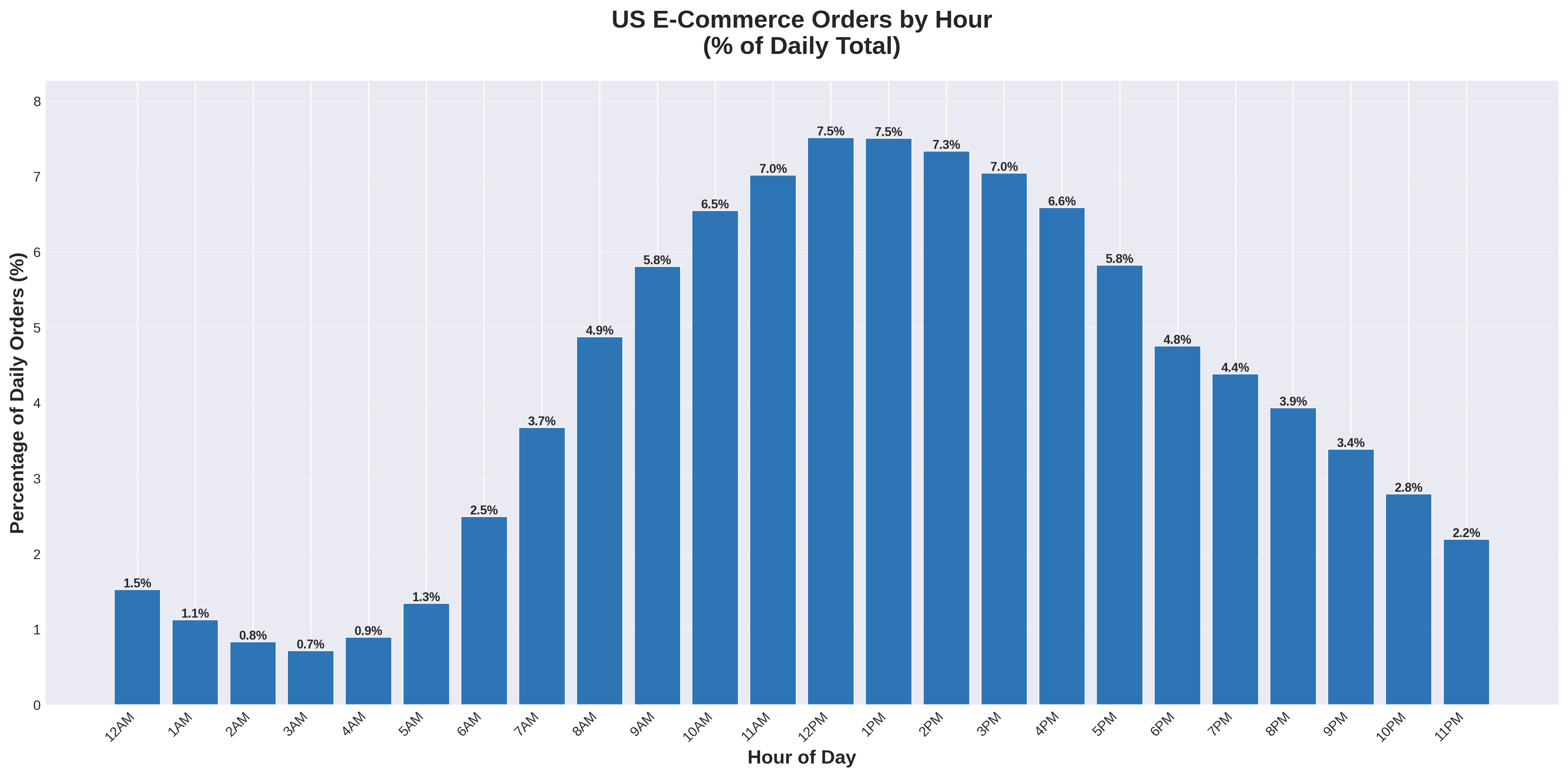
The visual distribution shows three distinct phases. From midnight through 5:00 AM, order volume is minimal, representing the natural overnight lull when most consumers are asleep. This night period collectively accounts for only 6.4% of daily orders.
Beginning at 6:00 AM, volume starts to build gradually. The morning ramp-up from 6:00 AM through 11:00 AM captures 23.4% of daily orders - a significantly higher share than most evening-focused strategies assume. By 9:00 AM, the market is already at 5.8% per hour, approaching the threshold of what many merchants would consider 'peak' activity.
The true peak, however, doesn't arrive until 11:00 AM. From 11:00 AM through 3:00 PM, order volume sustains at its highest levels of the day. Noon and 1:00 PM each individually capture 7.5% of daily orders - the two highest single hours in the 24-hour cycle. This four-hour midday window collectively accounts for 36.4% of all daily US orders.
After 3:00 PM, volume begins a sustained decline. The afternoon from 3:00 PM to 6:00 PM maintains moderate activity at 24.2%, but by 6:00 PM - the hour many merchants target as 'prime time' - orders have already fallen to 4.8%, barely more than half the noon peak. The evening from 6:00 PM to 11:00 PM contributes only 19.2% of daily orders, making it the second-weakest major time window after early morning.
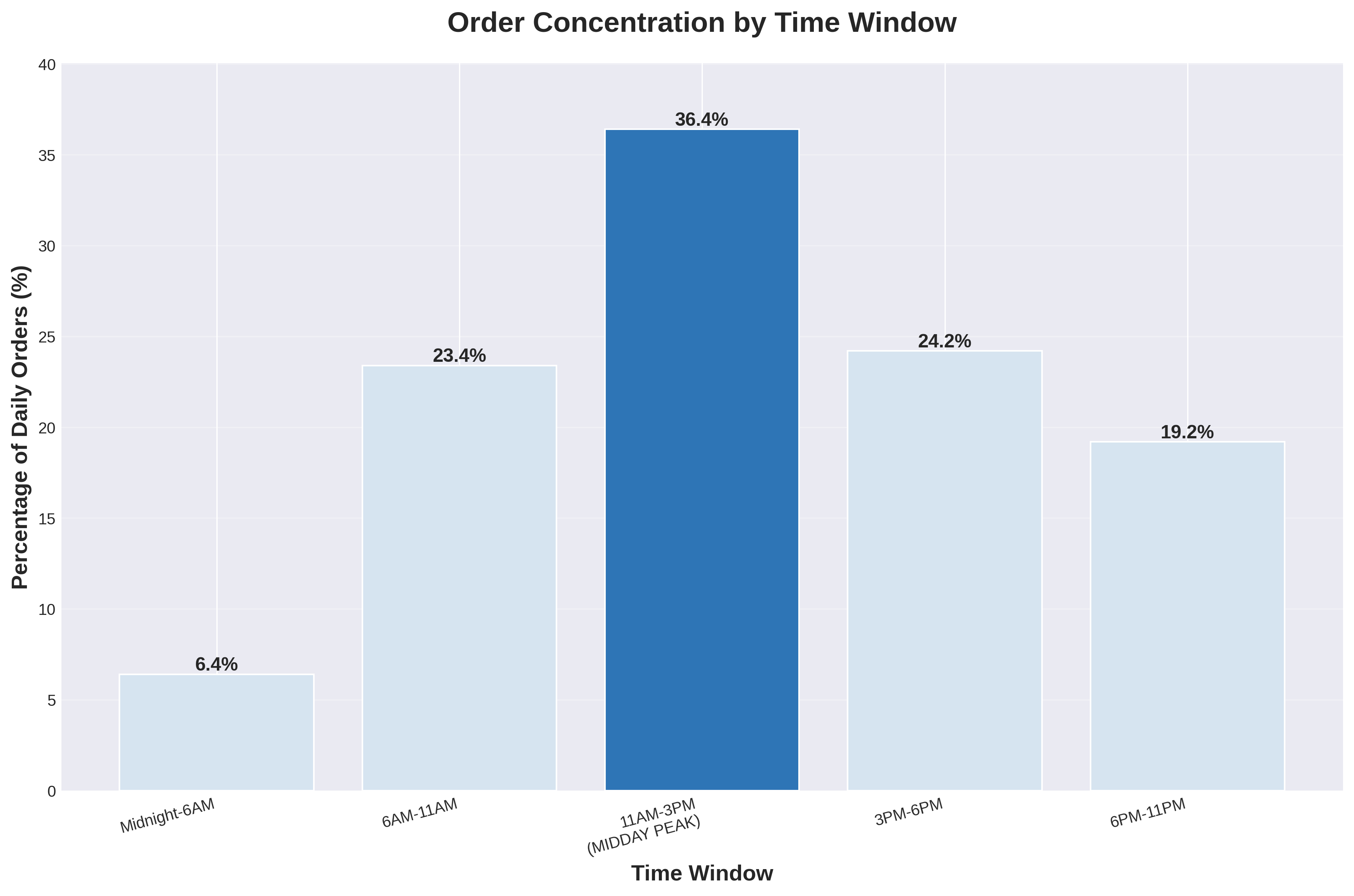
The concentration of 36.4% of daily orders in a four-hour midday window has direct strategic implications. First, it means that campaigns scheduled for evening hours are launching during a period of declining intent, not rising intent. A promotion that goes live at 7:00 PM is entering the market when only 4.4% of the day's orders are still to come in that hour, compared to 7.5% if it had launched at noon.
Second, the strength of the morning ramp-up (23.4% from 6-11 AM) suggests that US consumers are shopping during work hours far more than conventional wisdom assumes. This is likely enabled by mobile devices, workplace downtime, and the normalization of personal commerce during business hours. Merchants who ignore the 9:00 AM to 11:00 AM window are missing nearly 20% of daily volume that occurs before the midday peak even begins.
Third, the midday concentration creates a compounding advantage for merchants who optimize for it. If 36.4% of orders occur in four hours, and those are also the hours when consumers are most actively comparing options and making purchase decisions, then brand visibility, site performance, customer service responsiveness, and promotional messaging all have disproportionate impact during this window. Being present and optimized at noon matters more than being present and optimized at 8:00 PM, both because more buyers are active and because those buyers are in a higher-intent state.
Immediate actions US merchants should take based on this hourly distribution:
1. Audit Current Campaign Schedules: Review when your promotional emails, paid media campaigns, and product launches are scheduled. If a significant portion of your time-sensitive activity is concentrated in evening hours (6-11 PM), you are systematically underweighting the midday window where 36.4% of orders occur.
2. Shift Launch Times to Midday: For product drops, flash sales, limited-quantity promotions, or any campaign where timing creates urgency, default to launching between 11:00 AM and 1:00 PM. This positions your message to land during the peak intent window rather than during the decline phase.
3. Reallocate Paid Media Budgets: If your paid search, paid social, or display advertising is using even distribution across the day or is concentrated in evening hours, implement dayparting to increase bids and budget allocation for the 11:00 AM to 3:00 PM window. Even a 20-30% bid increase during peak hours is justified by the concentration of order volume.
4. Scale Customer Service for Midday: If your live chat, customer service phone lines, or support ticket response times are optimized for evening volume, they are likely creating bottlenecks during midday when more customers are actually active. Staff availability should match the 11 AM-3 PM peak, not traditional after-work hours.
When US orders are segmented by device type, the hourly pattern bifurcates into two distinct behavioral profiles. Mobile shoppers and desktop shoppers do not simply represent different form factors - they represent different relationships with time, different shopping contexts, and different peak hours that require separate strategic approaches.
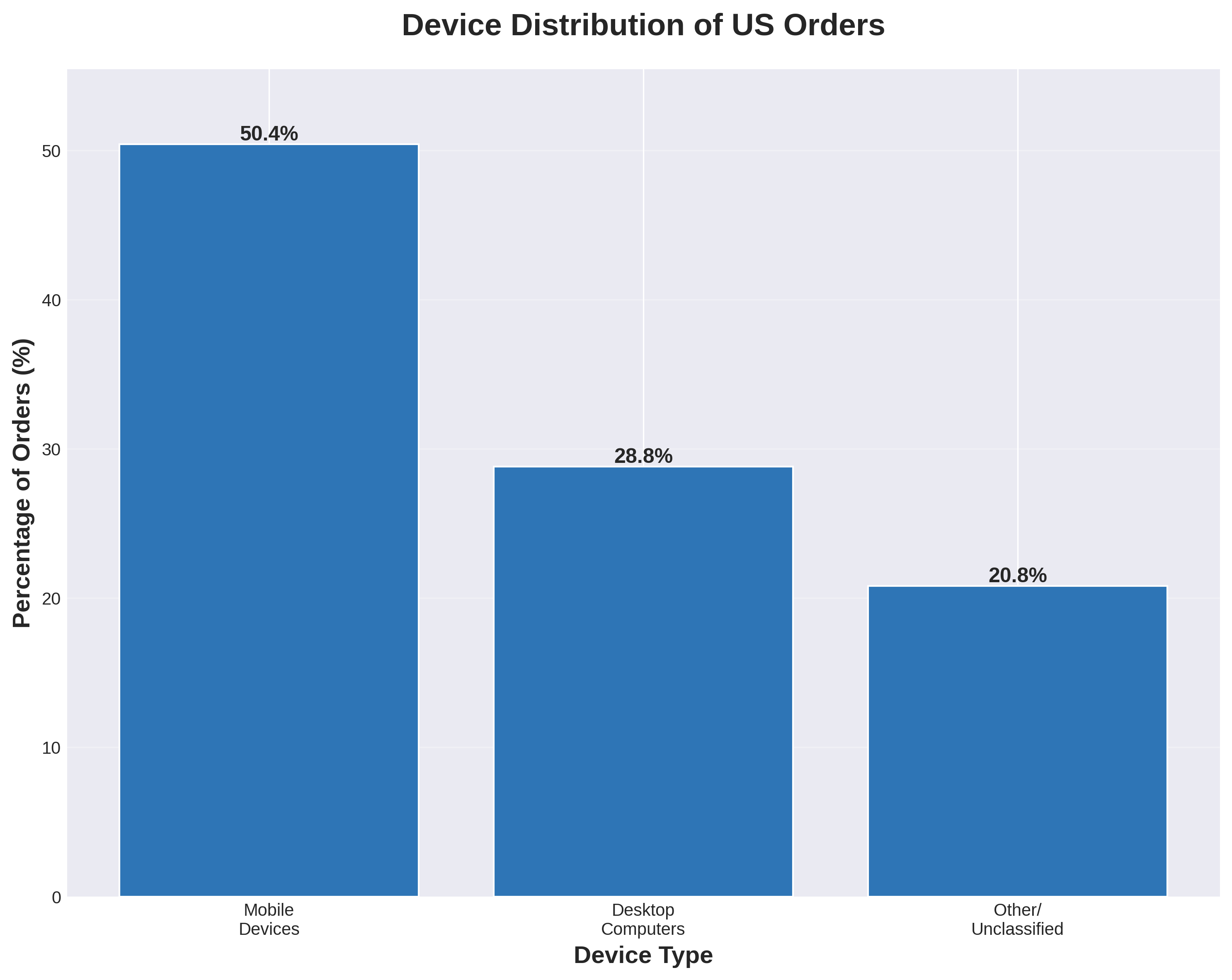
Mobile is the dominant channel, accounting for 50.4% of all US orders. Desktop represents 28.8%, with the remaining 20.8% attributed to devices that could not be definitively classified or represented tablets and other form factors. This distribution establishes mobile as the majority channel - any strategy that treats desktop as primary is fundamentally misaligned with market reality.
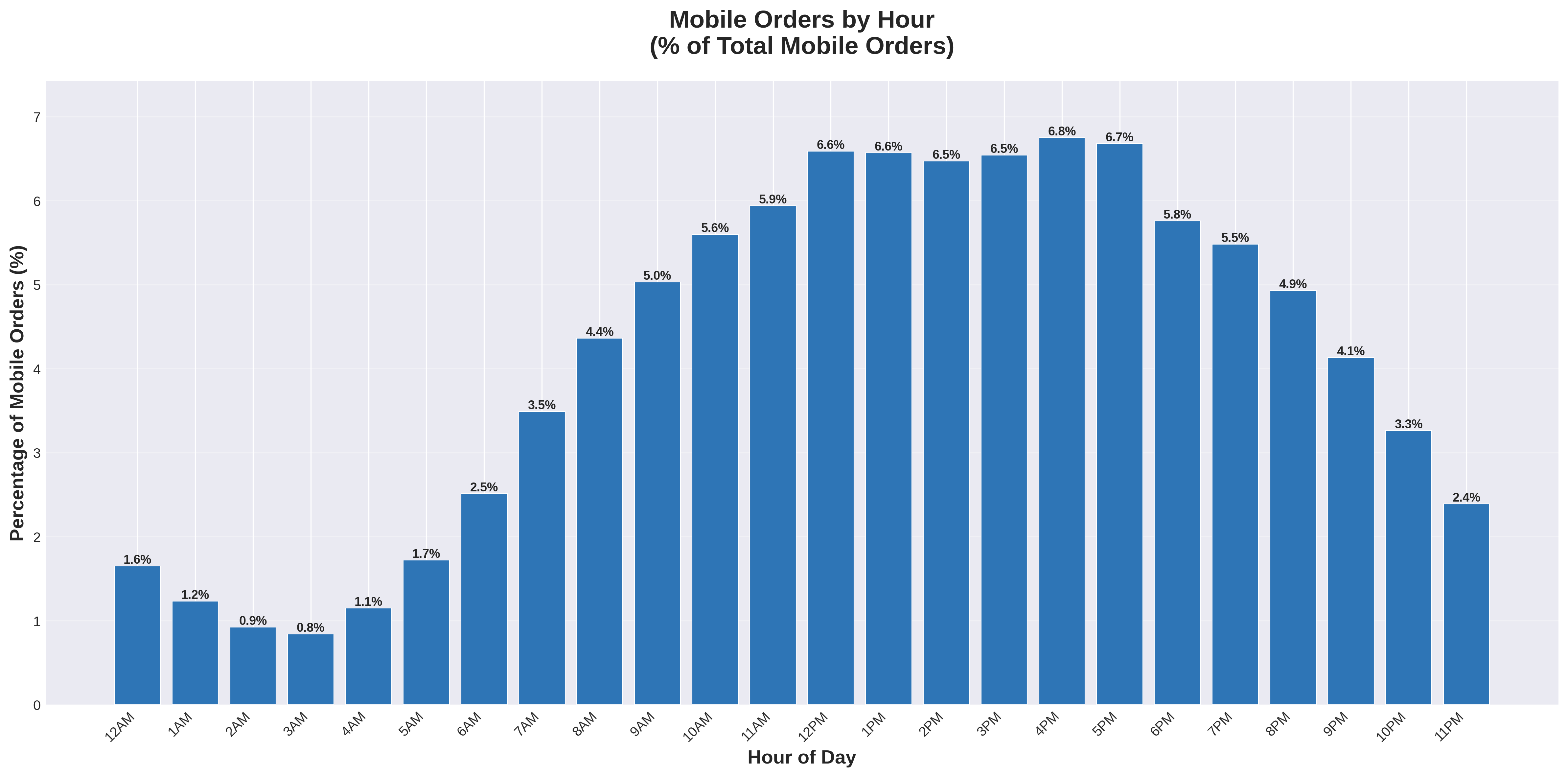
Mobile orders show their highest concentration at 4:00 PM, capturing 6.8% of all mobile orders in that single hour. This is notably later than the overall peak at noon. Mobile participation in the midday peak is strong, but mobile's maximum occurs in the late afternoon as users transition away from desk-based environments.
The mobile pattern suggests that mobile shopping extends throughout the workday and intensifies as the day progresses. By 4:00 PM, many consumers have left their desks, are commuting, or are in transition between work and personal time - contexts where mobile is the only available device. Mobile volume remains elevated through 5:00 PM and doesn't decline sharply until after 6:00 PM.
Desktop orders peak sharply at noon, with 8.3% of desktop orders occurring in that single hour - a higher peak concentration than mobile's 6.8% at 4 PM. Desktop ordering is tightly clustered in the 11:00 AM to 2:00 PM window, aligning precisely with traditional lunch hours and midday work breaks.
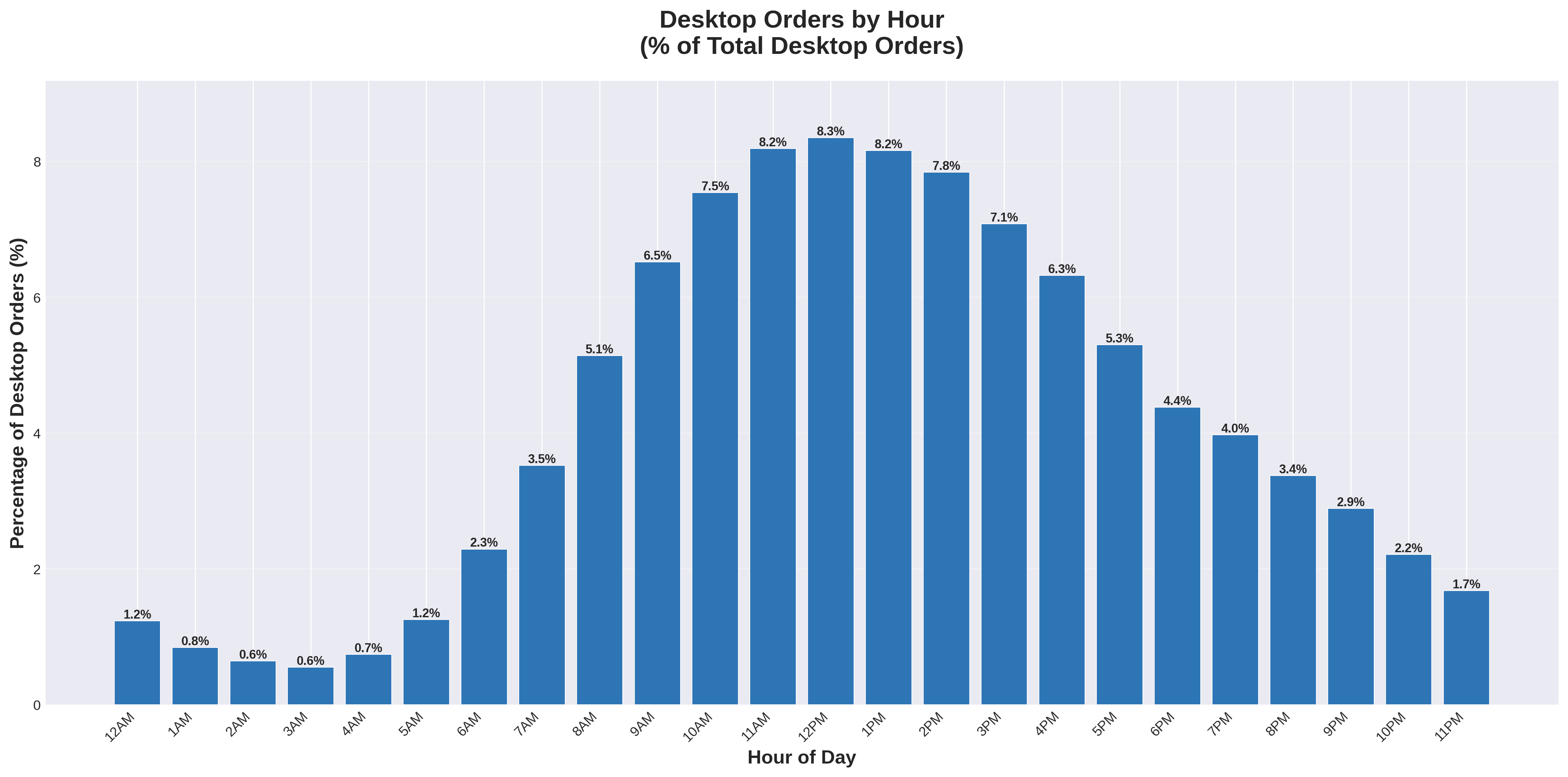
Desktop volume declines more rapidly after 3:00 PM than mobile does, suggesting that desktop shopping is constrained to times when users are at desks with computer access. Once consumers leave work or shift to mobile devices, desktop activity drops off sharply.
The different peak hours between mobile and desktop mean that unified campaign schedules are inefficient. A campaign optimized for the noon desktop peak will underperform on mobile, where peak intent arrives four hours later. Conversely, a campaign optimized for 4:00 PM mobile will miss the concentrated desktop window at midday.
Recommended approach: Run separate campaigns or apply device-specific bid adjustments. For desktop traffic, concentrate maximum budget and highest bids in the 11:00 AM to 2:00 PM window. For mobile traffic, extend elevated bids through 5:00 PM to capture the full afternoon peak. Most paid media platforms support device-level bid adjustments or separate campaign structures - use them.
For email marketing, the different device patterns suggest timing based on expected device usage. Promotional emails sent at 11:00 AM are more likely to be opened on desktop during lunch breaks. Emails sent at 4:00 PM are more likely to be opened on mobile during commutes or post-work browsing.
Segmenting orders by purchase value reveals that the timing of transactions varies meaningfully across price tiers. High-value purchases occur earlier in the day than low-value ones, suggesting that the deliberation, research, and comparison associated with expensive buying decisions happen during morning and late-morning hours, while lower-value convenience purchases are more evenly distributed across the midday plateau.
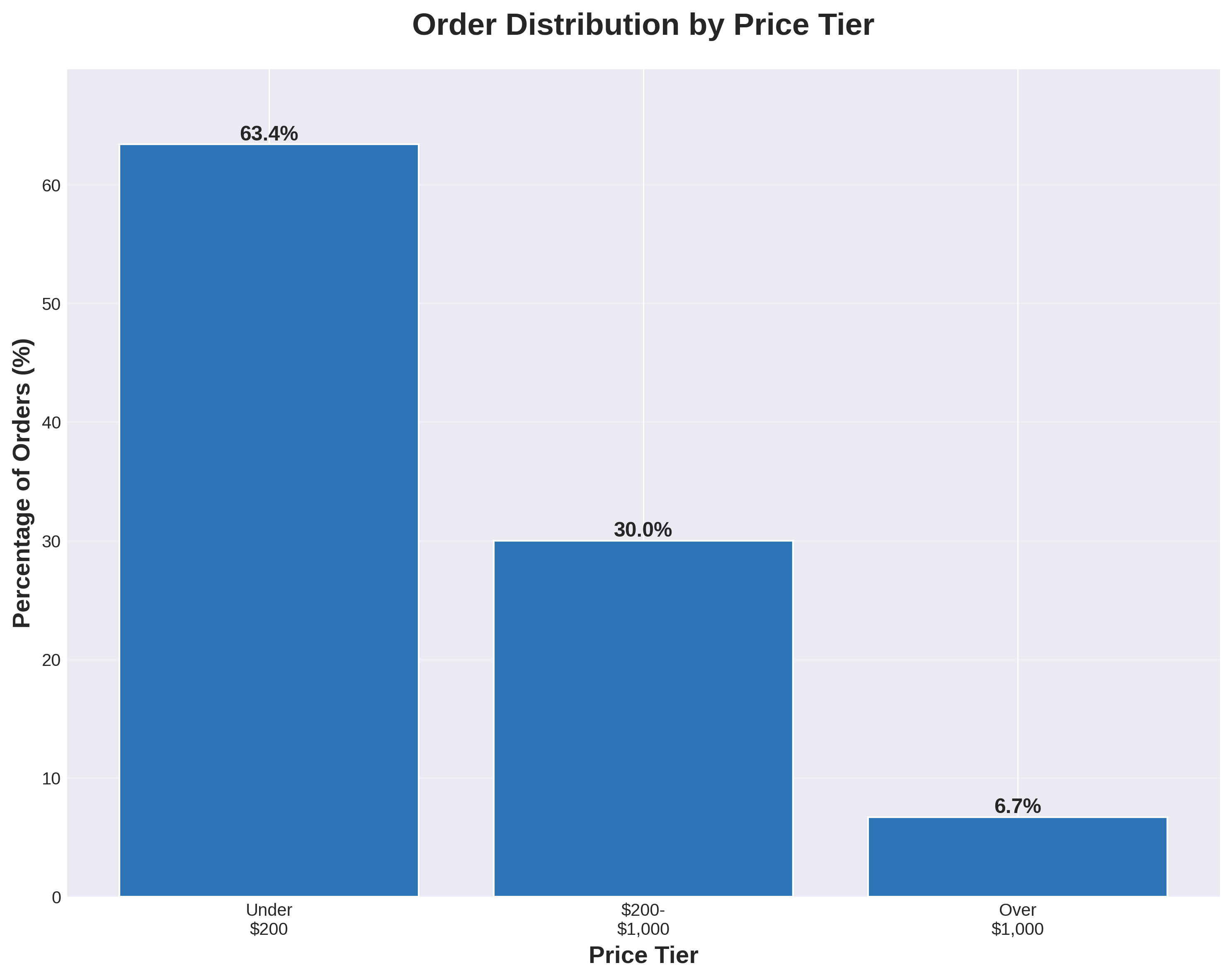
Budget purchases under $200 represent nearly two-thirds of all orders (63.4%) and follow the general midday pattern, peaking at 1:00 PM. Mid-range purchases in the $200-$1,000 tier account for 30.0% of orders and peak at noon - one hour earlier than budget purchases. Premium purchases over $1,000 represent 6.7% of orders and peak at 11:00 AM - two full hours before the budget-tier peak.
The following charts show how each price tier distributes its orders across the key shopping hours from 6 AM through 5 PM, revealing the distinct timing patterns for each segment:
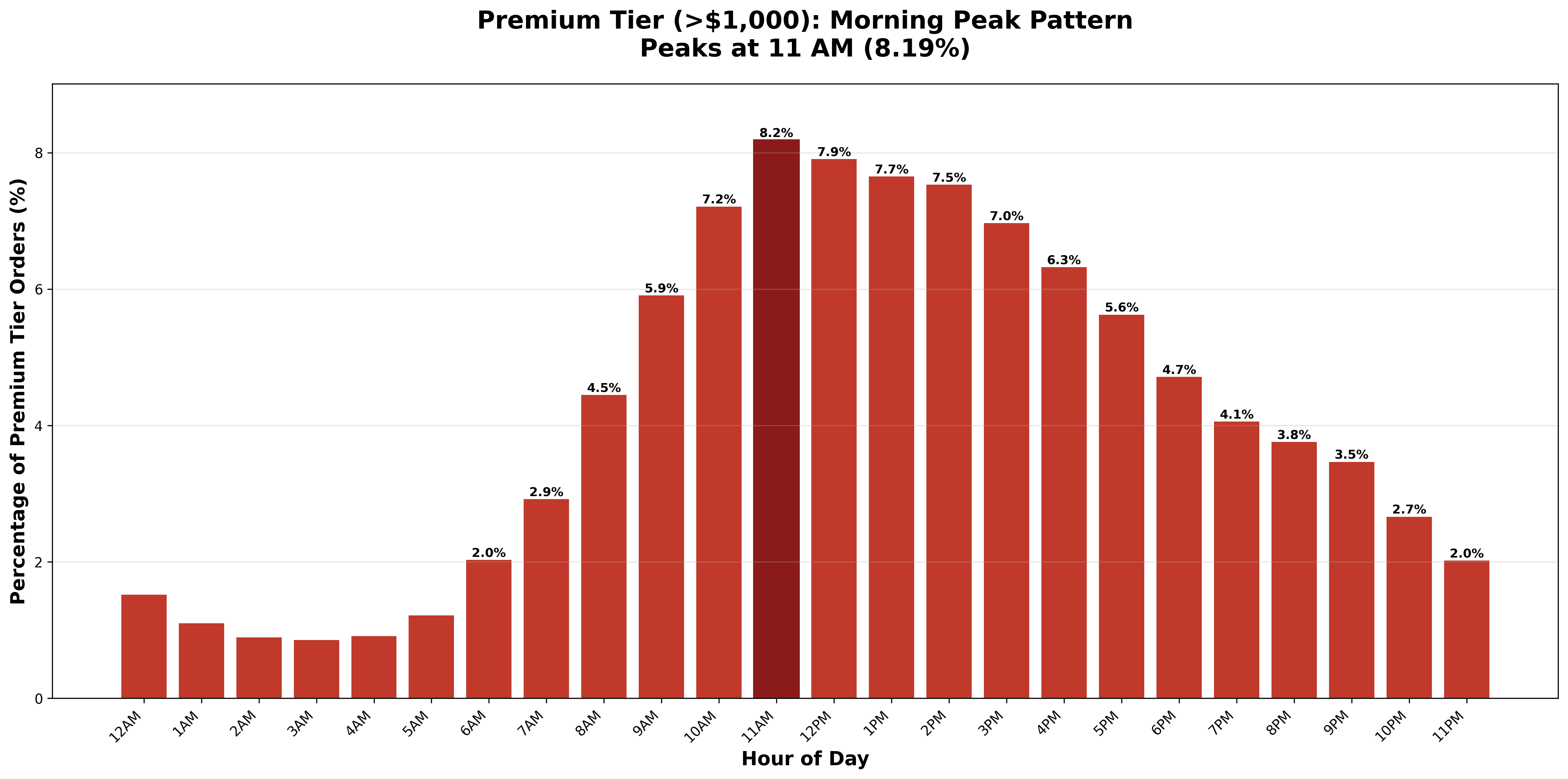
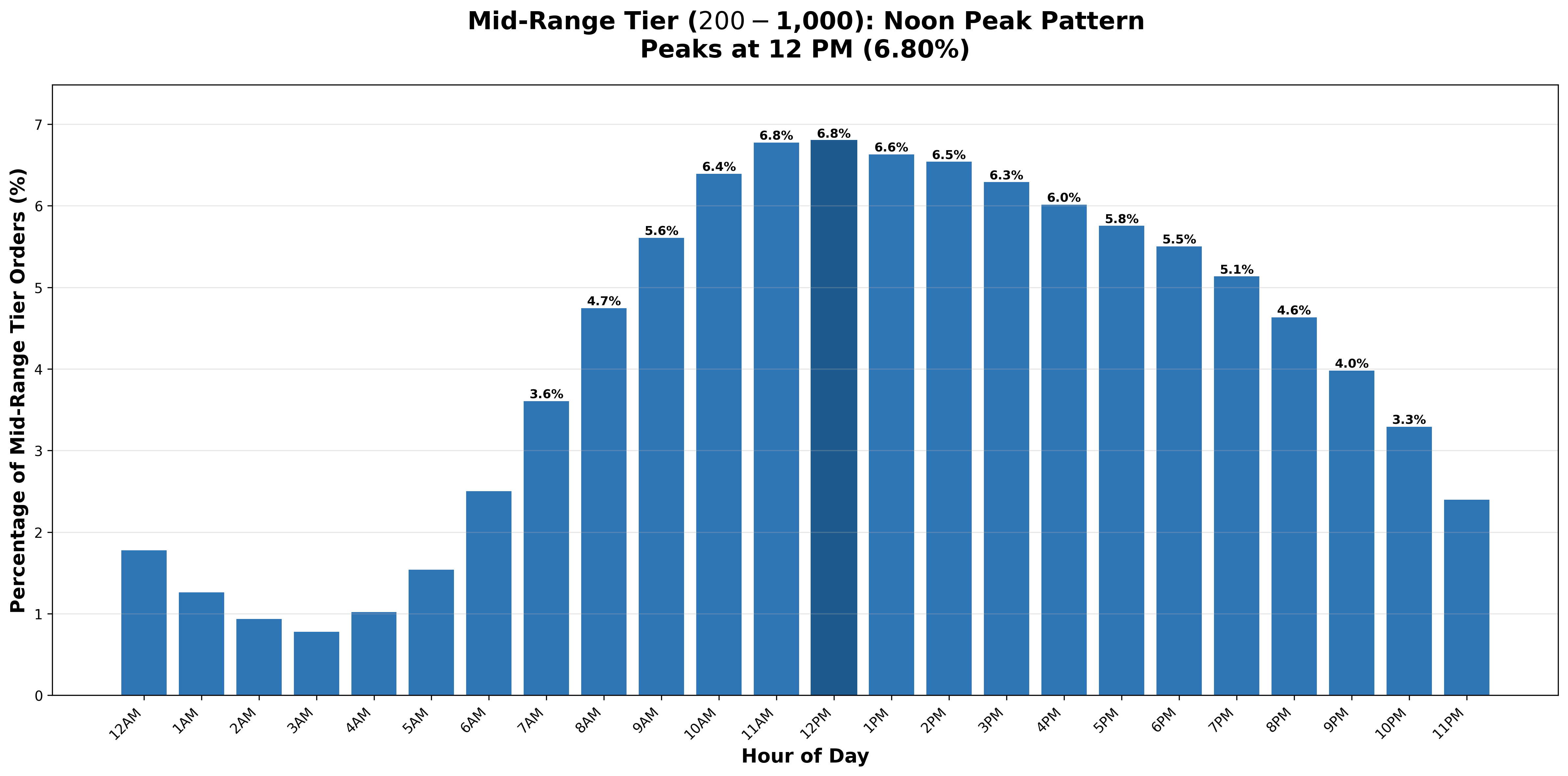
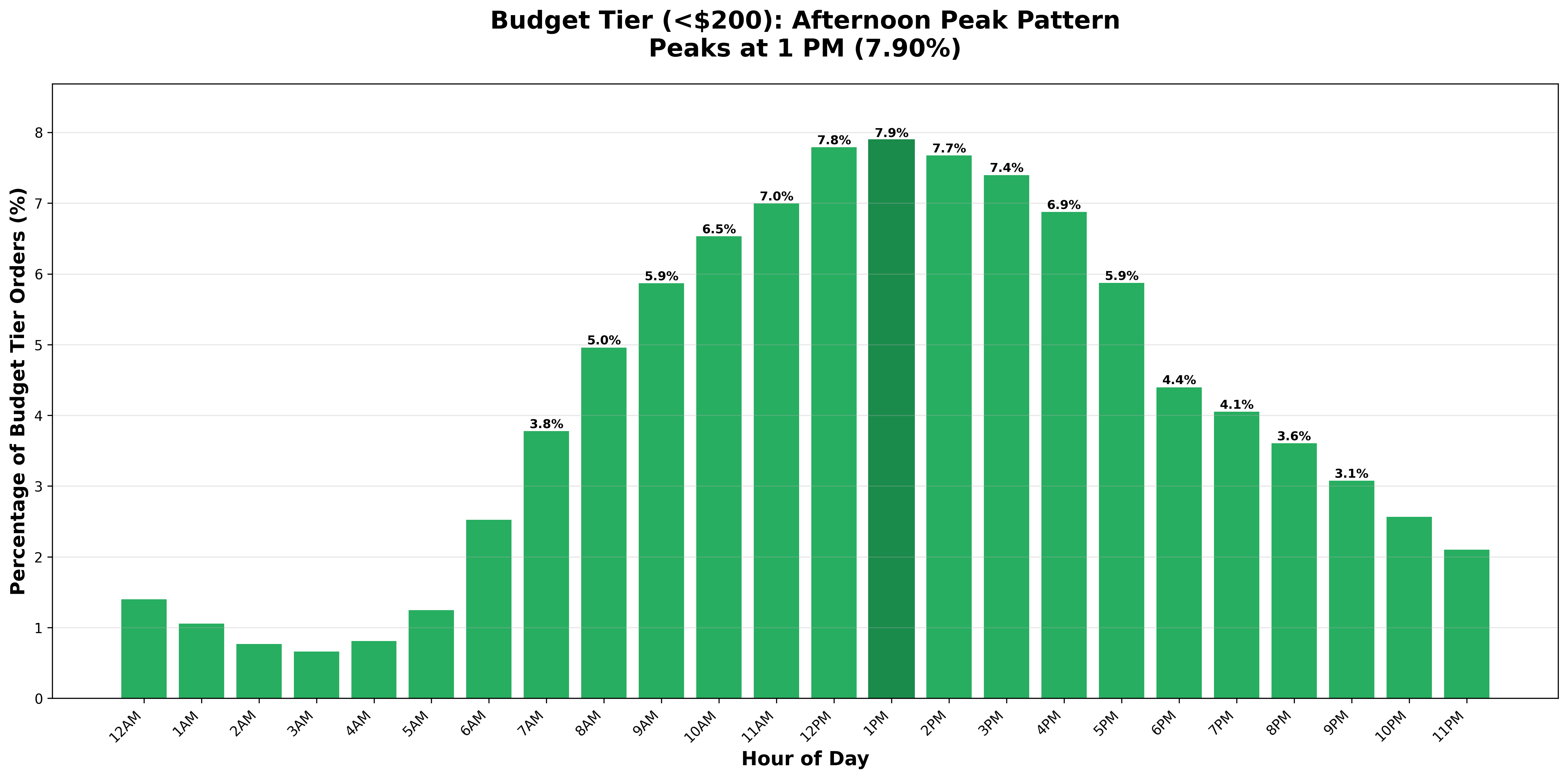
The progression of peak hours across price tiers suggests a relationship between purchase complexity and time of day. Premium purchases, which typically require more research, comparison shopping, and deliberation, are peaking during late morning when buyers have had time to conduct research but are still in an active decision-making state.
By contrast, budget purchases peak in the early afternoon, suggesting these are more impulse-driven or routine transactions that don't require the same level of morning research. The one-hour delay between mid-range and budget peaks further supports this interpretation: as purchase value decreases, so does the need for extended deliberation, and the peak shifts later into the day.
For merchants selling products over $1,000, this finding creates a specific and actionable timing opportunity. The 10:00 AM to noon window - which represents the late-morning period leading into the overall peak - is when high-value shoppers are most active. While total order volume during these hours is lower than the 1:00 PM peak, the proportion of those orders that are high-value is at its daily maximum.
This means that a merchant selling premium products can justify allocating specific budget to the 10-11 AM window even though it has lower overall traffic than 1 PM. The buyers present during late morning are disproportionately making expensive purchase decisions. For a premium furniture retailer, jewelry merchant, or high-end electronics seller, a campaign targeted at 10:30 AM may yield higher revenue per impression than one targeted at 1:30 PM, even if the latter generates more total impressions.
1. Premium Products: If your average order value exceeds $1,000, create time-specific campaigns or bid adjustments for the 10:00 AM to noon window. Use messaging that speaks to research and deliberation ('Compare our complete specs', 'Expert buying guides available') rather than urgency or impulse.
2. Mid-Range Products: Target the noon hour specifically. This is when buyers in the $200-$1,000 range are making decisions. Noon is also the desktop peak, suggesting these purchases may be occurring during work breaks with access to larger screens for comparison.
3. Budget Products: The 1:00 PM peak suggests early-afternoon is when convenience and routine purchases concentrate. This is a good window for restocking reminders, subscription prompts, and low-friction checkout flows.
The following recommendations synthesize the hourly, device, and price-tier findings into specific operational and marketing guidance for US merchants.
Default Recommendation: All time-sensitive campaigns - product launches, flash sales, promotional activations, limited-quantity drops - should launch between 11:00 AM and 3:00 PM unless specific data justifies an exception. This four-hour window captures 36.4% of daily orders and represents the highest-intent purchasing environment in the 24-hour cycle.
For campaigns that can't launch precisely at noon due to operational constraints, 11:00 AM is preferable to 1:00 PM (both are 7.0-7.5% hours), and both are preferable to any evening hour. A 7:00 PM launch captures only 4.4% of daily orders - less than 60% of what a noon launch would achieve.
Desktop Campaigns: Concentrate budget and creative testing in the 11:00 AM to 2:00 PM window. Desktop peaks sharply at noon (8.3% of desktop orders) and declines rapidly after 3:00 PM. There is no justification for heavy desktop spend after 5:00 PM.
Mobile Campaigns: Extend elevated spend through 5:00 PM to capture mobile's 4:00 PM peak (6.8% of mobile orders). Mobile requires a broader afternoon coverage window than desktop. Late-afternoon mobile spend is justified; late-afternoon desktop spend is not.
If your paid media platform does not support device-specific scheduling, prioritize mobile's later window since mobile represents 50.4% of orders versus desktop's 28.8%. It is better to capture mobile's 4 PM peak and miss desktop's post-3 PM decline than vice versa.
For merchants whose products exceed $1,000 in average order value, allocate 15-20% of daily ad budget specifically to the 10:00 AM to noon window. While this represents lower overall traffic than midday, it captures the highest concentration of high-value purchase intent.
Use this window for campaigns emphasizing product details, comparison features, expert reviews, and research-driven messaging. High-value buyers active at 10:30 AM are in research mode and will respond to depth of information more than urgency or scarcity messaging.
Customer Service: Staff live chat, phone support, and ticket response systems for peak load during 11:00 AM to 3:00 PM. Many support teams staff for evening peaks that don't exist in the data. Midday is when customers need help, not 8:00 PM.
Site Performance: Schedule server scaling, CDN optimization, and performance testing to ensure your site can handle maximum concurrent traffic during the 11 AM-3 PM window. Site slowdowns during this period impact 36% of daily revenue opportunity.
Fulfillment: If you offer same-day or next-day shipping with cut-off times, recognize that most orders requiring fast fulfillment will arrive during midday, not evening. Warehouse staffing and carrier pickup times should accommodate midday order surges.
The data establishes that US e-commerce is a midday activity, not an evening one. The four-hour window from 11:00 AM to 3:00 PM captures 36.4% of all daily orders - more than the morning (23.4%), more than the afternoon (24.2%), and substantially more than the evening (19.2%).
This pattern is consistent across device types (though peak hours differ), persistent across price tiers (with premium purchases peaking earliest), and represents a structural characteristic of US consumer behavior rather than a category-specific anomaly.
Merchants who continue to operate on evening-centric assumptions - scheduling launches for 6-8 PM, concentrating ad spend in evening hours, staffing customer service for after-work volume - are systematically misaligned with when their customers are actually shopping. The opportunity cost of this misalignment is substantial.
Realigning strategy to the midday peak is not a marginal optimization. It is a fundamental reorientation toward when purchase intent is highest, when customers are most active, and when competitive advantage can be most efficiently captured.

