

Walk down Canal Street in New York, and there is a high chance that a guy in a trench coat will open a briefcase to reveal twenty glittering “Rolexes.” To an untrained eye, the gold gleams like something straight out of a Geneva showroom. To anyone who knows watches, it’s cheap brass.
Hiring a Shopify agency can feel remarkably similar.
Open the Partner Directory and you’ll find polished logos, glowing testimonials, slick portfolios, and agencies promising seven-figure growth. Some genuinely are world-class. Others are vibe-coding their way through Liquid on their fifth client. The tricky part? Both know how to market themselves. Gotta hand it to AI, it gives everyone the polished voice of an agency.
And while Shopify’s Partner badge might tell you an agency belongs to Shopify’s ecosystem; it wouldn’t tell you where it falls on the spectrum between seasoned engineering team and ambitious newcomer.
My friend Michelle almost swore off agencies for good. She paid the first one well, and they wrecked her site and vanished. The next hire felt different from day one. They asked smart questions about her business, tested every change on a copy of her store instead of the live one, and checked in every week. “First time in months I wasn't scared to open my email,” she told me.
Michelle’s story is one that resonates with most merchants.
So, how do you look past the marketing polish and put the right guardrails in place before anyone touches your storefront?
Let’s just say you’re in the right place at the right time.
This guide breaks down what the Shopify Partner badge actually tells you, what it doesn't, and how to hire with confidence while keeping control of your store.
Claiming a Shopify Partner badge takes considerably less effort than returning a pair of shoes online.
You enter an email, fill in a few fields, and the account is yours. There is no portfolio to submit, or so much as a test to pass. The moment you sign up, you can put the badge in your email footer and start pitching clients that same afternoon.
So, the next time you spot “Shopify Partner” badge on a developer's site, treat it as proof of registration at most, because it offers zero insight into whether they have built one store or a hundred.

This is also why the pool is so enormous.
When one merchant recently went to the community forums and asked people to vouch for a specific partner, a veteran pitched in with the obvious problem:
“really reread your question back to yourself and ask how likely is it for anyone to know who/what your talking about. Your pointing to specs of dust on the beach just throwing out random names on a platform with MILLIONS of participants. Put in the effort and do your own research in vetting services.”
That beach metaphor isn’t an exaggeration. The official partner count sits past 100,000 worldwide. In a sea that enormous, building credibility requires years of hard-won client reviews - a painstaking step thousands of agencies simply skip.
The directory helps guide unsuspecting merchants through the noise.
To get listed, an agency has to climb to the “Select” tier and show a public track record of client reviews. Hit the absolute summit, and you reach true rarified air. Out of those 700,000 partners, only about 14 hold Platinum status.
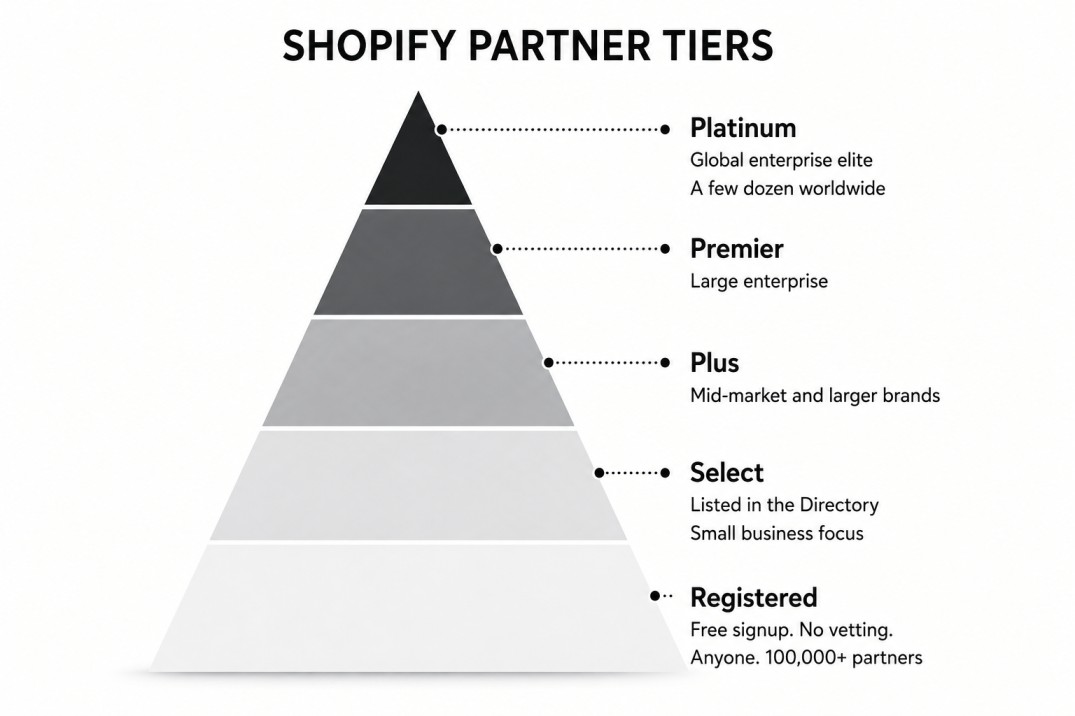
But even a verified Directory listing hits a ceiling on what it can tell you, though.
High review counts prove an agency gets hired, but they won’t reveal how carefully someone will treat your live store once your credit card is on file. Recently, a merchant wired $7,000 to an unvetted “consultant," only searching for proof of legitimacy after the wire had cleared the account.
This gullibility right here is what makes having vetting processes in place all the more important. And trust means more than just avoiding scams; that’s baseline.
The bigger challenge is knowing when you should be hiring an expert in the first place.
A post from the Shopify forums says everything you need to know about the stakes:
“I hired you to my shopify store but you COMPLETELY ruined it! You didnt even add a f***** backup”
Careless work executed on a live site carries the exact same consequence whether you touch the theme files yourself or pay someone else to do it. Before handing over administrative access, evaluate what is actually on the line rather than just looking at a developer’s pitch deck.
Some jobs on a Shopify store are forgiving. Swap a banner, recolor a button, rewrite a description, change a couple of images, and the worst-case is a thirty-second undo. These are tasks you can handle yourself, or outsource to a freelancer.
Other jobs sit under the floorboards.
A migration, your payment gateway, custom Liquid, the redirects holding your SEO together. Break one of those, and the damage reaches your revenue before it reaches your eyes.

By the time you finally notice, you’re usually typing out a panic post under a title like “Urgent Help Needed - Website Sales Plummeted Due to Checkout Issues.”
The content underneath reads nothing less than unpaid group therapy sessions.
A merchant installed a theme that silently broke Shopify's checkout logic. Online sales dropped to zero overnight. To the naked eye, the storefront looked perfectly normal, but buying anything was impossible. By the time the owner realized what happened, the theme developer had gone ghost, leaving them to watch their business bleed cash.
Once you watch a pro handle a risky change, their value becomes obvious.
Shopify hands every partner free, unlimited development stores, so a serious one duplicates your theme or spins up a sandbox and breaks things over there, far from any real shopper. The change reaches your live store only once it runs clean.
Some partners you go find. Others come find you, usually within hours of launch.
One store owner shared the kind of message that lands in many new merchants’ inboxes:
“as i went through your store during my research i discover... your store lack that can hindered your traffics and conversion ratio. Will you kindly accept to have discussion about it?”

The grammar is almost endearing until you remember the goal is your money and your admin access. The same trick wears scarier costumes too, like the fake “Shopify” emails from Gmail addresses that threaten to suspend your store in 24 hours unless you pay a “recommended expert.” One merchant lost $350 to that very script. A real partner might not slide into your inbox uninvited, so treat every unsolicited pitch as a stranger until it proves otherwise.
And apart from this, run through the following protocol that keeps the strangers out and the good ones honest:
The strongest tell is who does the vetting. A serious agency vets you right back. They ask about your margins, your catalog, and your goals, and they want you to meet the actual people who would work on your store before anyone signs anything.
One director at a Platinum-tier agency shared:
“We thoroughly vet our clients and we don't take on brands that aren't ready for serious agency services (i.e. no creative assets, untested products, shady business practices, etc.), and we do all the legal paperwork, NDAs, non-competes, and we don't take on multiple clients in the same vertical.”
Anyone racing to sign you before they understand your brand is likely only chasing the commission.

Make sure every theme edit and code change happens on a duplicate theme or a dedicated development store first. Nothing reaches your live, publishing storefront until it has been tested where no customer can watch it break.
Avoid staff accounts and admin logins entirely.
Have them send a Collaborator Request through your 4-digit request code, grant only the permissions the task needs, and revoke it the day the project ends. Shopify itself forbids a partner from ever asking for your password.
Tie money to proof. Something like 30% to start, 40% once the sandbox build passes, and 30% after it ships clean and survives a seven-day bug watch. Full payment before delivery is how the ghosting stories begin.
Guaranteed revenue is the ultimate red flag. A developer can optimize load speed or checkout UX, but they can’t control the market, just like a personal trainer can't guarantee you'll drop thirty pounds. Honest partners commit to the inputs they actually own and let the revenue follow.
Stack that beside the other fast warning signs: vague scopes, demands for full upfront payment, manufactured urgency, pushing communication off-platform, or dodging a simple video call. If you spot the two together, keep walking.
Only as much as you trust their process.
The badge proves they registered. Reviews prove they got hired. But true trust is built in a sandbox, guarded by collaborator permissions, and paid out strictly on milestones.
The marketplace is overflowing with cheap brass, but there are genuine engineering pros in the crowd. You just need to see beyond shiny badges and start enforcing the ground rules. Set your guardrails, keep the keys to your store, and make every single hire prove themselves before production.
.jpg)